National Commission for Backward Classes (NCBC)
Article 338B
The National Commission for Backward Classes (NCBC) is the body that protects the interests of backward classes in India. In the Constitution, these groups are called "socially and educationally backward classes" (SEBCs), which in everyday use means OBCs. The NCBC studies their problems, looks into complaints and advises the government on policies for them. Since 2018, it has been a constitutional body under Article 338B.
Why does the NCBC exist?
Deciding which communities are backward is a big decision. If a group that is not backward gets added to the OBC list, real backward groups lose a share of seats and jobs. If a backward group is left out, it is denied help it needs. So India needs an expert, neutral body to study such claims, instead of leaving it only to political decisions. The NCBC also acts like a watchman: it checks whether the protections given to OBCs actually work on the ground.
Where did it come from?
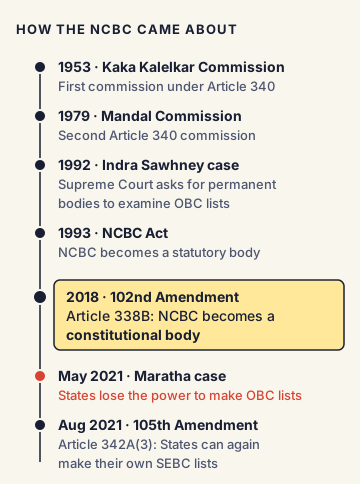
- Article 340 of the Constitution lets the President set up a commission to study backward classes. Two such commissions were formed: the Kaka Kalelkar Commission (1953) and the Mandal Commission (1979).
- In Indra Sawhney v. Union of India (1992), the Supreme Court directed the Centre and the States to set up permanent bodies to examine requests for adding or removing communities from OBC lists.
- Following this, Parliament passed the National Commission for Backward Classes Act, 1993. The NCBC became a statutory body (a body created by an ordinary law) under the Ministry of Social Justice and Empowerment. Its main job was to advise on adding communities to the Central List of OBCs, or removing them.
- The 102nd Constitutional Amendment Act, 2018 inserted Article 338B and gave the NCBC constitutional status. It also inserted Article 342A (on lists of SEBCs) and Article 366(26C) (a definition of SEBCs). The NCBC (Repeal) Act, 2018 ended the old 1993 Act.
- In Jaishri Laxmanrao Patil v. Chief Minister, Maharashtra (May 2021), the Maratha reservation case, the Supreme Court read the 102nd Amendment to mean that only the President could identify SEBCs, even for state lists. This took away the power of States to make their own OBC lists.
- The 105th Constitutional Amendment Act, 2021 (passed as the 127th Amendment Bill and given assent in August 2021) restored this power. It added Article 342A(3), so each State can again prepare its own list of SEBCs.
How is the NCBC organised?
The NCBC has:
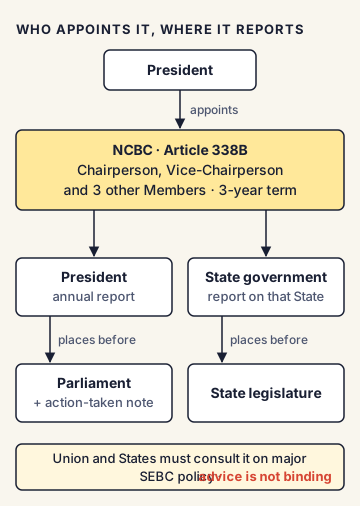
- a Chairperson,
- a Vice-Chairperson, and
- three other Members.
All of them are appointed by the President by "warrant under his hand and seal" (a formal signed order). Their conditions of service and term are fixed by rules made by the President. Under the 2018 rules, the term is three years.
What does the NCBC do? (Article 338B(5))
- Investigates and monitors all safeguards given to SEBCs under the Constitution and other laws, and checks how well they work.
- Inquires into specific complaints where SEBCs are denied their rights and safeguards.
- Advises on the planning of social and economic development of SEBCs and checks progress at the Union and State levels.
- Reports to the President every year, and at other times if needed. The President places these reports before Parliament, along with a note on the action taken. If a report concerns a State, it is sent to the State government, which places it before the State legislature.
- Must be consulted by the Union and every State government on all major policy matters affecting SEBCs (Article 338B(9)). After the 105th Amendment, this does not apply to a State preparing its own State list.
What powers does it have?
While investigating or inquiring into a complaint, the NCBC has the powers of a civil court (Article 338B(8)). It can summon any person and examine them on oath, ask for documents, receive evidence on affidavits and ask for public records. Think of it like a school inquiry committee that can call any student or teacher and ask to see any register.
How is a community added to the Central List?
Under Article 342A(1), the President (in practice, the Union government) notifies the SEBCs in the Central List, after consulting the Governor of the State concerned. Once a list is notified, only Parliament, by law, can add or remove a community (Article 342A(2)). Communities are tested on backwardness indicators, following the approach of the Mandal Commission, which used 11 indicators (social, educational and economic).
The Central List is used for central government jobs and central educational institutions. Each State uses its own State List for State jobs and colleges.
India's position and examples
The Central List covers communities from many religions, because OBC status is given to a community, not to a religion. States also have their own State Backward Classes Commissions, which study claims for State lists. Before 2018, the NCBC could only advise on list inclusion. After 2018, it gained wider powers, similar to the National Commission for Scheduled Castes, including handling complaints from OBC individuals.
Commonly confused concepts
- NCBC (Article 338B) vs NCSC (Article 338) vs NCST (Article 338A): The NCSC is for Scheduled Castes. The NCST, for Scheduled Tribes, was separated from it by the 89th Amendment Act, 2003. The NCBC, for backward classes, got constitutional status only through the 102nd Amendment Act, 2018.
- NCBC vs Article 340 commissions: An Article 340 commission (like Mandal) is a one-time body set up to study backward classes and recommend steps. The NCBC is a permanent body.
- Central List vs State List: The Central List is for central jobs and institutions and is notified by the President. The State List is for State jobs and institutions and, since the 105th Amendment, is prepared by each State.
- Statutory vs constitutional body: A statutory body is created by an ordinary law of Parliament and can be ended by another law (like the NCBC from 1993 to 2018). A constitutional body is created by the Constitution itself and can only be changed by a constitutional amendment.
Issues, criticism and the way forward
- Advice is not binding: The NCBC's recommendations are advisory. Governments can choose not to follow them.
- Lack of fresh data: The last full caste count in a Census was in 1931, so decisions on backwardness often rely on old or partial data. The government decided in 2025 that the next Census will count caste.
- Pressure for inclusion: Many powerful communities demand OBC status, such as in the Maratha, Jat and Patidar agitations. This puts pressure on the Commission to stay neutral.
- Sub-categorisation: A few communities within the OBC list take most benefits. The Justice G. Rohini Commission (set up in 2017 under Article 340) studied how to divide OBCs into sub-groups and submitted its report in 2023.
- Way forward: Experts suggest regular reviews of lists using fresh data, a clear and public method for testing backwardness, and better coordination between the NCBC and State commissions.
Concepts to Know
- Socially and Educationally Backward Classes (SEBCs): The Constitution's term for groups that are behind in social standing and education. In practice, this means OBCs.
- Constitutional body: An institution created directly by the Constitution, such as the Election Commission or the NCBC after 2018.
- Warrant under his hand and seal: A formal order signed and sealed by the President, used for important appointments.
- Powers of a civil court: The legal power to summon people, take statements on oath and demand documents, like an ordinary court hearing a property case.
- Creamy layer: The better-off section of OBCs (based on income and the status of parents), which is left out of reservation benefits.
- Sub-categorisation: Dividing a reserved group into smaller sub-groups, so that the most backward among them get a fair share.
- Article 340: President can set up a Backward Classes Commission (Kalelkar 1953; Mandal 1979)
- NCBC first set up under the NCBC Act, 1993, following Indra Sawhney (1992)
- 102nd Amendment Act, 2018: inserted Articles 338B, 342A and 366(26C); NCBC (Repeal) Act, 2018 ended the 1993 Act
- Composition: Chairperson, Vice-Chairperson and three other Members, appointed by the President
- Article 338B(5): duties; 338B(8): civil court powers; 338B(9): Union and States must consult it on major policy matters
- Annual report goes to the President, who places it before Parliament
- Jaishri Laxmanrao Patil (May 2021): only the President could identify SEBCs; reversed by the 105th Amendment Act, 2021 (Article 342A(3) restored State lists)
- Article 342A(1): President notifies Central List after consulting the Governor; 342A(2): only Parliament can change it by law
- NCST separated from NCSC by the 89th Amendment Act, 2003 (Article 338A)
● Tracked since June 26, 2026 · last seen October 21, 2026 · updates as the daily brief publishes