Montreal Protocol on Substances that Deplete the Ozone Layer
The Montreal Protocol is a global treaty that protects the ozone layer, a thin shield of ozone gas high up in the sky. It does this by making countries stop producing and using man-made chemicals that destroy ozone, such as CFCs (chlorofluorocarbons) and halons. It was signed on 16 September 1987 and came into force on 1 January 1989. It is widely called the most successful environmental treaty in history, because every country in the world has joined it and it has actually worked.
Why does it exist?
The ozone layer sits in the stratosphere, roughly 15 to 35 km above the Earth. It absorbs most of the Sun's harmful ultraviolet-B (UV-B) rays. Without it, many more people would get skin cancer and cataracts (clouding of the eye), crops would grow less, and sea life would suffer. In the 1970s, scientists found that chlorine and bromine from man-made chemicals could rise to the stratosphere and break apart ozone.
One chlorine atom can destroy thousands of ozone molecules. These chemicals were everywhere: in refrigerators, ACs, spray cans, foam and fire extinguishers. So the world needed a common rulebook to stop them.
Where did it come from?
- 1974: Scientists Mario Molina and F. Sherwood Rowland warned that CFCs could destroy stratospheric ozone. Along with Paul Crutzen, they later won the 1995 Nobel Prize in Chemistry for this work.
- 22 March 1985: Countries adopted the Vienna Convention for the Protection of the Ozone Layer. This was only a "framework": countries agreed to cooperate on research and share information, but it set no limits on any chemical.
- May 1985: Scientists of the British Antarctic Survey (Joe Farman, Brian Gardiner and Jonathan Shanklin) published proof of a huge seasonal loss of ozone over Antarctica. This became known as the ozone hole and shocked the world into action.
- 16 September 1987: The Montreal Protocol was signed. Unlike the Vienna Convention, it set fixed, binding timetables to cut specific chemicals.
- 1 January 1989: It came into force.
- 2009: It became the first UN treaty to be ratified by every country. Today it has 198 parties (all UN member states plus a few others, and the European Union).
How does it work?
Think of it like a school timetable for giving up harmful chemicals. The treaty lists each harmful chemical in an annex (an attached list) and gives each one a phase-out schedule: a freeze first, then step-by-step cuts, then zero.
- Two speeds for two groups: Developing countries, called Article 5 countries, got extra years (a grace period) to meet each deadline. A country qualified for this if its yearly use of the main controlled chemicals was below 0.3 kg per person. Developed countries had to act first.
- Money and technology help: The Multilateral Fund (MLF) pays developing countries the extra costs of switching to safer technology, for example converting factories and training AC repair technicians. It was set up by the meeting of parties in London in June 1990 and started working in 1991. Rich countries contribute to it.
- Science guides decisions: Expert panels, including a scientific assessment co-sponsored by the WMO (World Meteorological Organization) and UNEP every four years, tell countries how the ozone layer is doing.
- Trade rules: Parties cannot freely trade controlled chemicals with countries that have not joined, which pushed every country to sign up.
- Annual meeting: The parties meet every year at the Meeting of the Parties (MOP) to tighten rules. The treaty's secretariat, called the Ozone Secretariat, is hosted by UNEP.
How has it changed over time?
The Protocol is a living treaty. Countries have made it stronger through amendments (which add new chemicals or new duties):
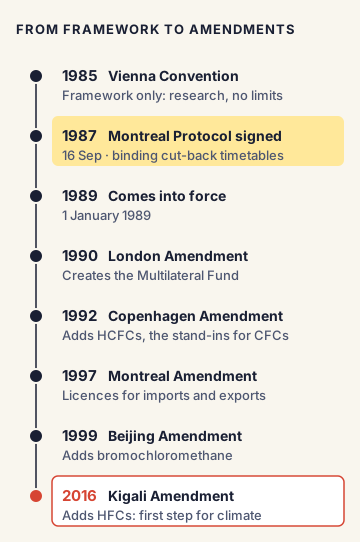
- London Amendment (1990): created the Multilateral Fund and added more chemicals.
- Copenhagen Amendment (1992): brought in HCFCs (hydrochlorofluorocarbons), the "interim" replacements for CFCs.
- Montreal Amendment (1997): added a licensing system for imports and exports.
- Beijing Amendment (1999): added more controls, including on bromochloromethane.
- Kigali Amendment (2016): added HFCs. These do not harm ozone but heat the planet. This was the first time the treaty was used directly for climate.
What has it achieved?
The Protocol has phased out nearly all (about 99%) of the ozone-destroying chemicals it controls. According to the 2022 WMO-UNEP scientific assessment, if current policies stay in place, the ozone layer should return to its 1980 condition (before the hole appeared) by around 2040 for most of the world, 2045 over the Arctic and 2066 over the Antarctic. Because CFCs were also powerful greenhouse gases, the treaty has done a great deal for the climate too.
India's position and Indian examples
- India became a party to the Vienna Convention on 18 March 1991 and to the Montreal Protocol on 19 June 1992. India is an Article 5 (developing) country.
- The Ozone Cell in the Ministry of Environment, Forest and Climate Change (MoEFCC) is India's national body that runs the programme. India prepared a detailed Country Programme to phase out ozone-depleting substances in 1993.
- The Ozone Depleting Substances (Regulation and Control) Rules, 2000, made under the Environment (Protection) Act, 1986, are India's legal tool to control these chemicals, through licences and bans.
- India stopped producing and using CFCs from 1 August 2008, about 17 months ahead of the Protocol's 2010 deadline (pharmaceutical-grade CFCs for inhalers were allowed a little longer).
- India completely phased out HCFC-141b (used to make foam) from 1 January 2020.
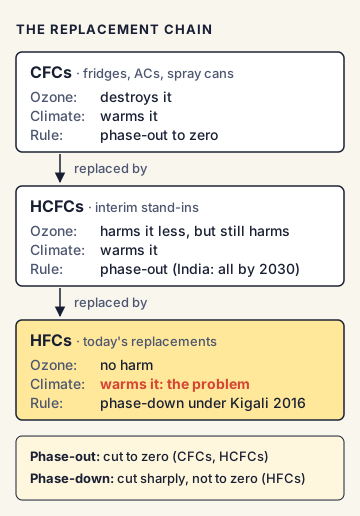
- India is now running Stage III of its HCFC Phase-out Management Plan (HPMP), aiming to phase out all HCFCs by 2030.
- World Ozone Day (International Day for the Preservation of the Ozone Layer) is observed on 16 September, the day the Protocol was signed. The UN General Assembly declared it in 1994.
Commonly confused concepts
- Stratospheric ozone vs ground-level ozone: Ozone high up in the stratosphere is "good ozone" because it blocks UV rays. Ozone near the ground (in the troposphere) is "bad ozone": it is an air pollutant formed from vehicle and factory emissions that harms lungs and crops.
- Vienna Convention vs Montreal Protocol: Vienna (1985) is the framework that only promised cooperation and research. Montreal (1987) is the protocol with real, binding cut-back schedules.
- Ozone depletion vs global warming: Ozone depletion lets more UV rays reach the ground. Global warming is the trapping of heat by greenhouse gases. Some chemicals (like CFCs) cause both; HFCs cause only warming.
- Montreal Protocol vs Kyoto Protocol / Paris Agreement: Montreal controls ozone-depleting chemicals (and, after Kigali, HFCs) using production and consumption limits. Kyoto (1997) and Paris (2015) are under the UN climate convention (UNFCCC) and deal with greenhouse gas emissions broadly.
- Phase-out vs phase-down: Phase-out means bringing use to zero (as with CFCs). Phase-down means cutting use sharply but not to zero (as with HFCs under Kigali).
Issues, criticism and the way forward
- Illegal emissions: In 2018, scientists found an unexpected rise in emissions of CFC-11, a banned gas, later traced mostly to eastern China. Emissions fell again after action was taken. This showed that monitoring and enforcement must stay strong.
- The replacement problem: CFCs were first replaced by HCFCs and then by HFCs. HFCs saved the ozone layer but added to global warming. This is why the Kigali Amendment became necessary.
- Old equipment and "banks": Millions of old fridges and ACs still hold ozone-depleting gases and HFCs. If these leak or are scrapped carelessly, the gases escape. Proper recovery and destruction are needed.
- Gaps in coverage: Some ozone-depleting gases, like nitrous oxide (N₂O), are not controlled by the Protocol.
- Way forward: Experts suggest stronger monitoring networks, better tracking of trade, safe disposal of old equipment and steady funding through the Multilateral Fund.
Concepts to Know
- Ozone (O₃): A gas made of three oxygen atoms. In the upper sky it protects us; near the ground it is a pollutant.
- Ultraviolet-B (UV-B) rays: A type of invisible sunlight that damages skin, eyes and living cells in large amounts.
- CFCs (chlorofluorocarbons): Man-made gases once used in fridges, ACs and spray cans. They are very stable, so they float up to the stratosphere, where sunlight breaks them and releases ozone-destroying chlorine.
- HCFCs (hydrochlorofluorocarbons): Gases that replaced CFCs for some years. They harm ozone less, but still harm it, so they are also being phased out.
- Ratify / accede: To formally accept a treaty so that it becomes legally binding on your country. "Accede" means joining a treaty after it has already been signed by others.
- Protocol: A detailed agreement attached to a broader convention that sets concrete rules and targets.
- Vienna Convention: adopted 22 March 1985 (framework, no fixed limits)
- Montreal Protocol: signed 16 September 1987; in force 1 January 1989; 198 parties (universal)
- Article 5 (developing) country test: use of controlled substances below 0.3 kg per person
- Multilateral Fund: set up at London meeting, June 1990; operational from 1991
- Amendments: London 1990, Copenhagen 1992, Montreal 1997, Beijing 1999, Kigali 2016
- Ozone recovery to 1980 levels: about 2040 (most of the world), 2045 (Arctic), 2066 (Antarctic)
- India: Vienna Convention 18 March 1991; Montreal Protocol 19 June 1992; CFCs phased out from 1 August 2008; HCFC-141b out from 1 January 2020; all HCFCs targeted by 2030
- India's law: Ozone Depleting Substances (Regulation and Control) Rules, 2000, under the Environment (Protection) Act, 1986
- World Ozone Day: 16 September (declared by UNGA in 1994)
- 1995 Nobel Prize in Chemistry: Crutzen, Molina and Rowland
● Tracked since October 19, 2026 · last seen October 19, 2026 · updates as the daily brief publishes