India Cooling Action Plan (ICAP)
The India Cooling Action Plan (ICAP) is a long-term government plan to give everyone in India access to cooling while using less energy and fewer harmful refrigerant gases. It was launched by the Ministry of Environment, Forest and Climate Change (MoEFCC) in March 2019. It looks 20 years ahead, from 2017-18 to 2037-38. India was one of the first countries in the world to make such a complete cooling plan.
Why does it exist?
India is a hot country, and heat waves are getting worse. Cooling is not a luxury: people need fans and ACs to stay healthy, farmers need cold storage so fruits and vegetables do not rot, and hospitals need cold chains for vaccines. ICAP projects that India's total cooling demand could grow about 8 times by 2037-38 compared to 2017-18.
If this happens with today's inefficient machines and high-GWP gases, electricity demand and emissions would shoot up. ICAP tries to meet this need in a smarter way.
Where did it come from?
India committed to protecting the ozone layer under the Montreal Protocol, and to fighting climate change under the Paris Agreement. During the Kigali Amendment talks in 2016, it became clear that cooling would decide India's future HFC use. ICAP was prepared by the Ozone Cell of MoEFCC with input from many ministries, industry and experts, and was released in March 2019.
What are its targets?
All by 2037-38:
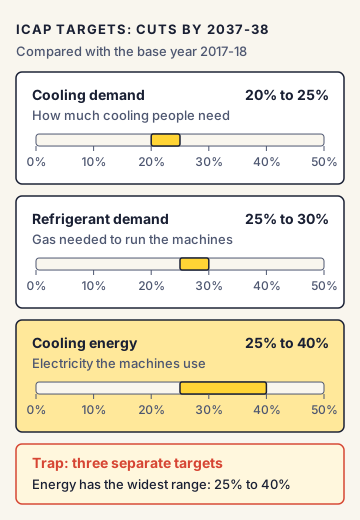
- Reduce cooling demand across sectors by 20% to 25%
- Reduce refrigerant demand by 25% to 30%
- Reduce cooling energy requirements by 25% to 40%
- Recognise "cooling and related areas" as a thrust area of research under the national science and technology programme
- It also aimed to train and certify 1,00,000 servicing technicians by 2022-23, in line with the Skill India Mission.
What areas does it cover?
ICAP looks at cooling across the whole economy:
- Space cooling in buildings (homes, offices), including better building design so that buildings need less cooling in the first place
- Air-conditioning technology and its efficiency
- Cold chain and refrigeration (cold storage for food, medicines)
- Transport air-conditioning (cars, buses, trains)
- Servicing sector (AC and fridge repair technicians)
- Refrigerant demand and production in India
- Research and development of alternative refrigerants and new cooling technologies
How does it work in practice?
ICAP is a guiding plan, not a law. It works by pointing ministries and industry in the same direction. Some examples of how it connects to other policies:
- Energy efficiency labels: The Bureau of Energy Efficiency (BEE) star-rating system for ACs and fridges pushes buyers to choose efficient machines.
- Default AC temperature: Since 1 January 2020, all star-labelled room ACs must come with a default setting of 24°C, because each degree higher saves electricity. Users can still change it.
- Building codes: The Energy Conservation Building Code encourages building designs that keep heat out.
- Affordable housing: ICAP suggests "thermal comfort" design in housing for poorer families (EWS and LIG housing).
- HFC strategy: ICAP's refrigerant targets support India's Kigali commitments.
India's position and Indian examples
ICAP is the cooling arm of India's climate and ozone policy. It supports India's Kigali Amendment schedule (freeze in 2028), its Nationally Determined Contributions (NDCs) under the Paris Agreement, and its HFC phase-down strategy finalised in 2023. Cooling already accounts for a little over one-tenth of India's yearly electricity demand, according to the IEA, so efficient cooling directly reduces the need for new power plants.
Commonly confused concepts
- ICAP vs Heat Action Plans (HAPs): ICAP is a national, long-term plan about cooling technology, energy and refrigerants. Heat Action Plans are city or state plans for handling heat waves (warnings, cooling shelters, changes in work hours), guided by the National Disaster Management Authority (NDMA).
- ICAP vs NAPCC: The National Action Plan on Climate Change (2008) has eight national missions (solar, energy efficiency, etc.). ICAP is a separate 2019 plan focused only on cooling.
- Cooling demand vs refrigerant demand vs energy demand: Cooling demand is how much cooling people need. Refrigerant demand is how much gas is needed to run the machines. Energy demand is how much electricity the machines use. ICAP has separate targets for each.
Issues, criticism and the way forward
- Not legally binding: ICAP sets goals but does not have the force of law, so progress depends on other schemes and rules.
- Access gap: Many poor households have no cooling at all. Making cooling affordable while keeping it efficient is a big challenge.
- Cold-chain gaps: Farmers still lose a large share of fruits and vegetables because of poor cold storage.
- Technician skills: Unskilled servicing causes gas leaks and is unsafe with new flammable refrigerants. Training must reach the informal sector.
- Way forward: Experts suggest stricter appliance standards before Kigali deadlines, more research into low-GWP refrigerants, passive cooling in building design (shade, ventilation, cool roofs) and regular progress reports.
Concepts to Know
- Cold chain: A chain of cold storage and refrigerated transport that keeps food or medicines cool from the farm or factory to the consumer.
- Passive cooling: Keeping buildings cool without machines, by using shade, ventilation, light-coloured roofs and good design.
- Bureau of Energy Efficiency (BEE): A government body under the Ministry of Power that runs the star-label system for appliances.
- Nationally Determined Contributions (NDCs): Each country's own climate action promises under the Paris Agreement.
- Launched: March 2019 by MoEFCC; 20-year horizon 2017-18 to 2037-38
- Targets by 2037-38: cooling demand down 20%–25%; refrigerant demand down 25%–30%; cooling energy down 25%–40%
- Training and certifying 1,00,000 servicing technicians by 2022-23 (with Skill India Mission)
- Cooling demand projected to grow about 8 times by 2037-38 from 2017-18
- Cooling recognised as a thrust area of research
- Supports India's Kigali Amendment and Paris Agreement goals
● Tracked since October 19, 2026 · last seen October 19, 2026 · updates as the daily brief publishes