Global Warming Potential (GWP)
Comparing the Warming Power of Gases
Global Warming Potential, or GWP, is a number that tells us how much heat a gas traps in the atmosphere compared with carbon dioxide (CO₂). CO₂ is the measuring stick, so its GWP is always 1. If a gas has a GWP of 1,000, then releasing 1 kg of it warms the Earth as much as releasing 1,000 kg of CO₂ over the same period. The period most often used is 100 years.
Why do we need GWP?
Many different gases warm the planet: CO₂, methane, nitrous oxide and many factory-made gases like HFCs. They trap heat with very different strength, and they stay in the air for very different lengths of time. Without one common scale, we could not add them up or compare them. Think of it like converting rupees, dollars and euros into one currency before you add up your savings. GWP converts every gas into "CO₂ money" so that countries can set one total target and track it.
Where did it come from?
The Intergovernmental Panel on Climate Change (IPCC), the UN body that assesses climate science, introduced GWP in its First Assessment Report in 1990. The IPCC publishes updated GWP values in each of its big Assessment Reports, because scientists keep measuring the gases more precisely. The main reports are:
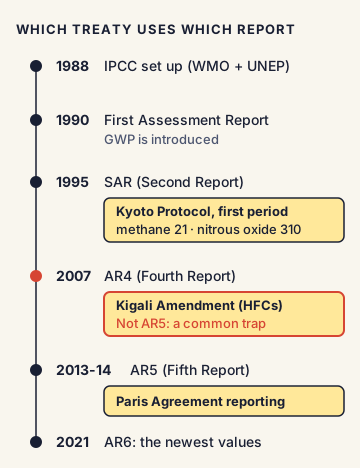
- Second Assessment Report (SAR), 1995: its values were used for the first period of the Kyoto Protocol.
- Fourth Assessment Report (AR4), 2007: its values are used in the Kigali Amendment to the Montreal Protocol.
- Fifth Assessment Report (AR5), 2013-14: its values are used for national reporting under the Paris Agreement.
- Sixth Assessment Report (AR6), 2021: the newest values.
How is GWP worked out?
Two things decide a gas's GWP:
- How strongly it traps heat. Some molecules absorb heat rays (infrared radiation) far better than CO₂ does. This is called its radiative efficiency.
- How long it stays in the air. This is called its atmospheric lifetime. Methane breaks down in about 12 years. CO₂ stays for centuries.
Scientists add up the total heat a gas traps over a chosen period (the time horizon) and divide it by the heat trapped by the same weight of CO₂ over the same period. That ratio is the GWP.
Why does the time horizon matter so much?
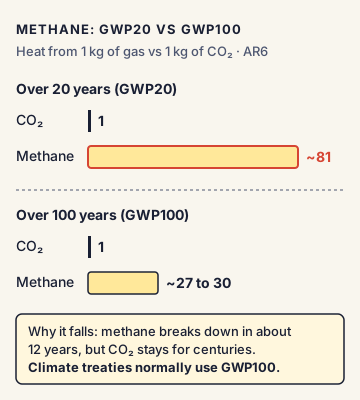
A short-lived gas looks much stronger over a short period. Methane is the best example. Over 20 years (GWP20), methane traps about 81 times more heat than CO₂ (AR6). Over 100 years (GWP100), the figure falls to about 27 to 30, because most of the methane has broken down while the CO₂ is still there. So always check which time horizon a number uses. Climate treaties normally use GWP100.
GWP values UPSC likes to ask about (100-year)
Each line gives the value in AR4 (used by Kigali) · AR5 (used for Paris reporting) · AR6 (latest):
- Carbon dioxide (CO₂): 1 · 1 · 1
- Methane (CH₄): 25 · 28 (30 for fossil methane) · 27.0 (29.8 for fossil methane)
- Nitrous oxide (N₂O): 298 · 265 · 273
- HFC-32: 675 · 677 · 771
- HFC-134a: 1,430 · 1,300 · 1,530
- HFC-23: 14,800 · 12,400 · 14,600
- Sulphur hexafluoride (SF₆): 22,800 · 23,500 · 24,300
- Nitrogen trifluoride (NF₃): 17,200 · 16,100 · 17,400
Under the older SAR values used for the Kyoto Protocol's first period, methane was 21 and nitrous oxide was 310. SF₆ is the strongest greenhouse gas that treaties track. Natural refrigerants have very low GWPs: propane (R-290) is about 3, and ammonia is 0.
How is GWP used? CO₂-equivalent
To put every gas in one unit, you multiply the amount released by its GWP. The result is called CO₂-equivalent (CO₂e). For example, if a leaking AC releases 2 kg of HFC-134a, that equals 2 × 1,430 = 2,860 kg CO₂e (using AR4 values). Countries report their total emissions in tonnes of CO₂e. The Kigali Amendment also measures each country's HFC baseline and cuts in CO₂e, not in plain tonnes. This means a country gets more credit for cutting a high-GWP HFC than a low-GWP one.
India's position and Indian examples
India reports its greenhouse gas emissions to the UN Framework Convention on Climate Change (UNFCCC) in CO₂e, using GWP values. In cooling, GWP decides the choice of refrigerant. Older Indian room ACs used R-22 (an HCFC, which also harms ozone) and then R-410A, a blend with a GWP of about 2,088. Indian companies have moved to lower-GWP options such as R-32 (GWP 675) and R-290 propane (GWP about 3). India's HFC phase-down under Kigali and the India Cooling Action Plan both push towards such low-GWP gases.
Commonly confused concepts
- GWP vs ODP: GWP measures warming power, compared with CO₂ (= 1). ODP (Ozone Depletion Potential) measures ozone damage, compared with CFC-11 (= 1). HFCs have zero ODP but high GWP. CFCs have both high ODP and high GWP.
- GWP vs GTP: GWP adds up the heat trapped over the whole period. GTP (Global Temperature change Potential) looks only at how much the temperature has changed at the end of the period. For short-lived gases, GTP gives a smaller number.
- GWP20 vs GWP100: Same gas, different time horizon. For methane, GWP20 is about 81, GWP100 about 27 to 30.
- Emissions vs concentration: GWP compares the effect of releasing 1 kg of a gas. It does not tell you how much of that gas is already in the air.
Issues, criticism and the way forward
- Changing values: Each IPCC report changes the numbers a little. A country's emissions total in CO₂e can change just because the GWP table changed, even if real emissions did not. That is why treaties fix which report to use.
- Short-lived gases look smaller: Critics say GWP100 hides how fast methane warms the planet in the next 20 to 30 years. Some scientists suggest newer measures (such as GWP*) for gases that do not stay long in the air.
- Equity debate: Developing countries point out that converting everything into one number can treat methane from rice fields and cattle (often for survival) the same as emissions from luxury uses.
- Way forward: Experts suggest reporting both GWP20 and GWP100 for methane, and using the latest IPCC values once all countries agree on them.
Concepts to Know
- Greenhouse gas: A gas that lets sunlight in but traps the heat that the Earth sends back, like the glass of a greenhouse.
- IPCC (Intergovernmental Panel on Climate Change): A UN body set up in 1988 by the World Meteorological Organization and UNEP. It does not do new research; it reviews all the science and publishes Assessment Reports.
- Refrigerant: The working gas inside an AC or fridge. It absorbs heat from inside and releases it outside. When an AC leaks or is scrapped carelessly, the refrigerant escapes into the air.
- Hydrofluorocarbons (HFCs): Factory-made gases containing hydrogen, fluorine and carbon. They were brought in to replace ozone-harming CFCs and HCFCs, but many have a very high GWP.
- CO₂ is the reference gas: GWP of CO₂ = 1 by definition
- Standard time horizon in treaties: 100 years (GWP100)
- Methane GWP100: 25 (AR4), 28 (AR5), 27.0 non-fossil / 29.8 fossil (AR6); GWP20 about 81 (AR6); lifetime about 12 years
- HFC-134a GWP100: 1,430 (AR4, used by Kigali); HFC-23: 14,800 (AR4)
- SF₆ is the most potent treaty-listed gas: 22,800 (AR4) to 24,300 (AR6)
- Kyoto first period used SAR (1995) values; Kigali uses AR4 (2007); Paris reporting uses AR5
- CO₂e = mass of gas × its GWP
● Tracked since October 19, 2026 · last seen October 19, 2026 · updates as the daily brief publishes