Kigali Amendment to the Montreal Protocol
HFC Phase-Down
The Kigali Amendment is a 2016 addition to the Montreal Protocol. It makes countries gradually cut the production and use of hydrofluorocarbons (HFCs), the gases now used in most ACs and refrigerators. HFCs do not harm the ozone layer, but they are very strong greenhouse gases. The amendment was adopted on 15 October 2016 in Kigali, Rwanda, and came into force on 1 January 2019. It is legally binding on countries that ratify it.
Why does it exist?
When the world banned CFCs and started reducing HCFCs, industry switched to HFCs because they do not damage ozone. But HFCs trap a lot of heat. For example, HFC-134a, common in car ACs and fridges, traps about 1,430 times more heat than CO₂ over 100 years. HFC-23 traps about 14,800 times more. As countries like India get richer and hotter, the number of ACs is rising fast, so HFC use was set to grow sharply.
Without action, these gases alone could have added a noticeable amount of warming by 2100. Kigali stops this problem before it gets big.
Where did it come from?
From 2009 onwards, several countries proposed bringing HFCs under the Montreal Protocol. Many developing countries, including India, first worried about the cost and about whether safe alternatives existed for hot climates. After years of talks, countries agreed on a plan at the 28th Meeting of the Parties (MOP28) in Kigali in October 2016. It entered into force on 1 January 2019.
As of August 2026, 174 of the 198 parties had ratified it. The parties had hoped to reach universal ratification by its 10th anniversary in October 2026.
How does it work?
The amendment uses the same proven method as the Montreal Protocol, with a few new features:
- Phase-down, not phase-out: HFC use must fall by 80% to 85% from a starting level, not to zero. Some uses will continue.
- Measured in CO₂ terms: Limits are counted in "CO₂-equivalent" tonnes. So a country gets more credit for cutting a very strong HFC than a mild one.
- Baseline: Each country's starting point (baseline) is its average HFC use in certain years, plus a part of its old HCFC use.
- Freeze, then cut: First, use is frozen (not allowed to grow), then reduced in steps.
- Licensing: Every party must set up a licensing system for HFC imports and exports.
- Trade with non-parties: From 2033, parties must stop HFC trade with countries that have not ratified the amendment.
- HFC-23: Factories that make HCFCs or HFCs produce HFC-23 as a waste by-product. Countries must destroy it as far as practicable, using approved technology.
- Funding: The Multilateral Fund pays developing countries the agreed extra costs of switching.
The three groups and their timetables
Countries are split into three groups, so that each moves at a fair speed:
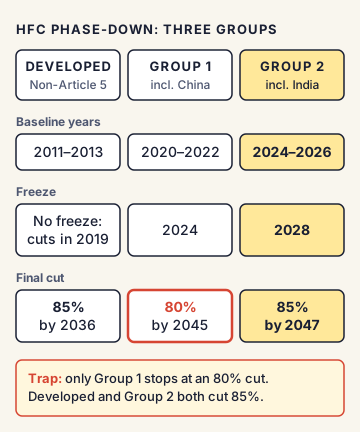
| Group | Who | Baseline years | Freeze | Final cut |
|---|---|---|---|---|
| Non-Article 5 | Most developed countries | 2011–2013 | Cuts start 2019 | 85% by 2036 |
| Article 5, Group 1 | Most developing countries, including China | 2020–2022 | 2024 | 80% by 2045 |
| Article 5, Group 2 | India, Pakistan, Iran, Iraq and Gulf countries (very hot countries) | 2024–2026 | 2028 | 85% by 2047 |
Group 2 got more time because these countries are very hot, need a lot of cooling, and their AC markets are still growing.
India's position and Indian examples
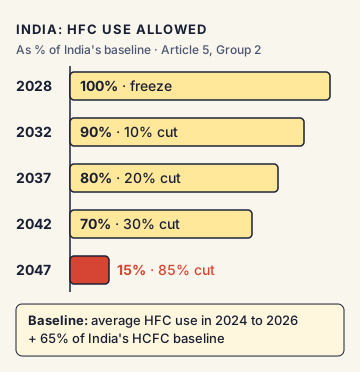
- India is in Group 2. Its baseline is its average HFC use in 2024, 2025 and 2026, plus 65% of its HCFC baseline.
- India must freeze HFC use in 2028, then cut it by 10% by 2032, 20% by 2037, 30% by 2042 and 85% by 2047.
- The Union Cabinet approved ratification in August 2021, and India ratified in September 2021.
- India finalised its National Strategy for HFC phase-down in 2023. It picks sectors in order of priority, based on how much HFC each uses and whether low-warming alternatives are available.
- India linked this to the India Cooling Action Plan (2019), which aims to reduce the demand for cooling and refrigerants.
- India argued during the talks that the late baseline years were fair because its use of cooling was still low per person and growing fast.
Commonly confused concepts
- ODP vs GWP: ODP (ozone depletion potential) measures how much a gas harms the ozone layer. GWP (global warming potential) measures how much heat it traps compared to CO₂. HFCs have zero ODP but high GWP.
- CFC vs HCFC vs HFC vs HFO: CFCs harm ozone a lot and warm the planet. HCFCs harm ozone less. HFCs do not harm ozone but warm the planet strongly. HFOs (hydrofluoroolefins) and natural refrigerants like propane (R-290, GWP about 3) are newer, low-GWP options.
- Kigali Amendment vs Kyoto Protocol: HFCs are one of the gases covered by the Kyoto Protocol's basket of greenhouse gases, which deals with emissions in general. Kigali controls HFC production and consumption directly, under the Montreal Protocol.
- Phase-down (HFCs) vs phase-out (CFCs, HCFCs): HFCs are being reduced by 80% to 85%, not banned completely.
Issues, criticism and the way forward
- Safety of alternatives: Many low-GWP options, like propane or R-32, are flammable to some degree. Technicians need training and equipment standards must be updated.
- New chemical worries: Some HFOs break down into a chemical called TFA (trifluoroacetic acid), which stays in water for a long time. Scientists are still studying its effects.
- Funding and technology: Manufacturers in developing countries need money and access to new technology while demand keeps rising.
- Old equipment: ACs bought before the cuts may run well into the 2030s. Leaks during servicing and scrapping are a big source of emissions.
- Energy efficiency is the other half: Cooling causes warming in two ways: gas leaks and the electricity it uses. UNEP and the IEA say combining the HFC phase-down with more efficient machines could roughly double the climate benefit.
- Illegal trade: As HFCs become restricted, smuggling could rise. Licensing systems must be strong.
Concepts to Know
- Hydrofluorocarbons (HFCs): Man-made gases containing hydrogen, fluorine and carbon. They are used as refrigerants in ACs and fridges, and in foams and sprays.
- Global warming potential (GWP): A number that tells how much heat a gas traps over a period (usually 100 years) compared with the same weight of CO₂, which has a GWP of 1.
- CO₂-equivalent: A way of expressing different greenhouse gases in one unit, by multiplying the amount of each gas by its GWP.
- Refrigerant: The working gas inside an AC or fridge that absorbs heat from inside and releases it outside.
- Baseline: The starting level against which future cuts are measured.
- Adopted: 15 October 2016 at MOP28, Kigali, Rwanda; in force: 1 January 2019
- Ratifications: 174 of 198 parties as of August 2026
- Expected benefit: avoid about 0.3°C to 0.5°C of warming by 2100
- India: Article 5 Group 2; baseline 2024–2026 plus 65% of HCFC baseline; freeze 2028; cuts of 10% (2032), 20% (2037), 30% (2042), 85% (2047)
- Group 1 (incl. China): baseline 2020–2022, freeze 2024, 80% cut by 2045
- Developed countries: baseline 2011–2013, cuts from 2019, 85% by 2036
- Trade ban with non-parties from 2033; licensing system mandatory
- India ratified: September 2021 (Cabinet approval August 2021); National HFC phase-down strategy finalised 2023
- GWPs (100-year, IPCC AR4): HFC-134a about 1,430; HFC-23 about 14,800; HFC-32 about 675; propane about 3
● Tracked since March 01, 2026 · last seen October 19, 2026 · updates as the daily brief publishes