Maritime Labour Convention (MLC) 2006
The Maritime Labour Convention, 2006 (MLC, 2006) is a global treaty of the International Labour Organization (ILO) that sets minimum working and living standards for seafarers, the people who work on ships. It covers their age, contracts, wages, working hours, food, cabins, medical care and their right to be sent home. Because it collects all seafarer rights into one document, it is often called the "Seafarers' Bill of Rights".
Why does it exist?
A ship may be owned by a company in one country, carry the flag of a second country and hire sailors from a third. When something goes wrong, sailors often do not know which country's law protects them. Some shipowners register their ships in countries with weak rules (this is called a "flag of convenience") to save money.
Sailors also spend months far from home, often in the middle of the ocean, where no labour inspector can reach them. Without one common rulebook, they could be underpaid, overworked or simply abandoned in a foreign port.
Where did it come from?
From 1920 onwards, the ILO made dozens of separate conventions and recommendations for seafarers. They were scattered, and many countries had ratified only a few. So the ILO combined them into one modern treaty. The MLC, 2006 brought together 68 earlier maritime labour instruments (conventions and recommendations). It was adopted at the 94th (Maritime) Session of the International Labour Conference in Geneva in February 2006. Its ILO number is Convention No. 186.
When did it start working?
The treaty had a double condition for coming into force: it needed ratification by at least 30 countries that together owned at least 33% of the world's ship gross tonnage (the total carrying size of ships). This condition was met in August 2012. The convention then came into force 12 months later, on 20 August 2013. As of 2025, more than 110 countries have ratified it, covering about 96% of the world's gross tonnage. That means almost every big ship in the world is covered.
How is it organised?
The MLC has three layers, like a school rulebook with chapters, rules and detailed instructions:
- Articles and Regulations: the basic rights and principles.
- The Code, Part A (Standards): detailed rules that are compulsory.
- The Code, Part B (Guidelines): advice on how to carry out the rules; not compulsory, but countries must give it due consideration.
The Regulations and Code are grouped under five Titles:
- Title 1, minimum requirements to work on a ship: minimum age of 16 years; a medical fitness certificate; proper training; fair recruitment agencies.
- Title 2, conditions of employment: a written Seafarers' Employment Agreement; wages paid at least monthly; limits on working hours; paid leave; the right to repatriation (being sent home at the shipowner's cost).
- Title 3, accommodation and food: decent cabins, recreation, clean drinking water and food.
- Title 4, health and welfare: medical care on board and ashore, shipowners' liability for sickness, injury and death, safety at work and access to shore welfare.
- Title 5, compliance and enforcement: how countries check that the rules are followed.
Working hours: the 14/72 and 10/77 rule
Each country must choose one of two ways to protect sailors from exhaustion:
- Maximum hours of work: not more than 14 hours in any 24 hours and 72 hours in any 7 days; or
- Minimum hours of rest: at least 10 hours in any 24 hours and 77 hours in any 7 days.
A tired sailor on a night watch can cause a collision or an oil spill, so these numbers protect both the worker and the sea.
How is it enforced?
The MLC uses three checkpoints:
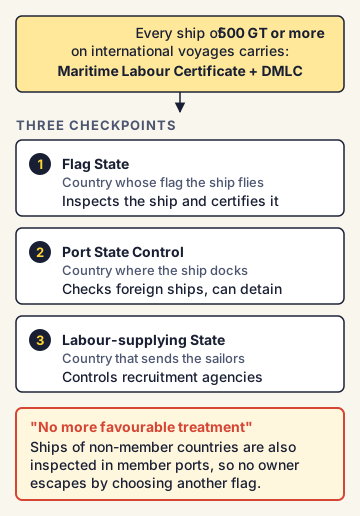
- Flag State: the country whose flag the ship flies must inspect the ship. Every ship of 500 gross tonnage or more on international voyages must carry a Maritime Labour Certificate and a Declaration of Maritime Labour Compliance (DMLC).
- Port State Control: when a foreign ship enters a port, inspectors of that port country can check it and even detain it if conditions are very poor.
- Labour-supplying State: countries that send sailors abroad must regulate their recruitment agencies and social security.
A special clause called "no more favourable treatment" means ships from countries that have not ratified the MLC are also inspected in ports of countries that have. So no shipowner can escape the rules by choosing a non-member flag.
How has it changed over time?
The MLC can be updated faster than most treaties. A Special Tripartite Committee (governments, shipowners and seafarers' unions) proposes changes to the Code. Important amendments:
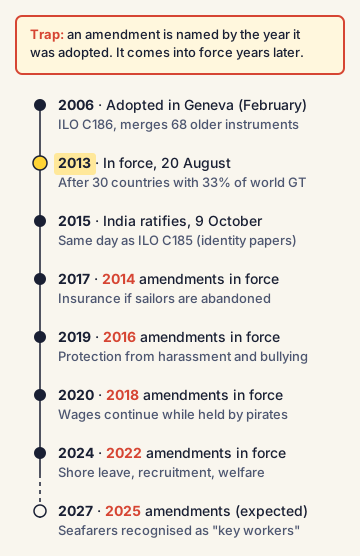
- 2014 amendments (in force 18 January 2017): shipowners must have financial security (insurance) for abandonment and for death or long-term disability. If a sailor is abandoned, this cover pays up to four months of unpaid wages, plus the cost of going home, food and medical care. A sailor counts as abandoned if, for example, the owner stops paying wages for two months or leaves the sailor without the cost of getting home.
- 2016 amendments (in force 8 January 2019): protection against harassment and bullying on board.
- 2018 amendments (in force 26 December 2020): if pirates or armed robbers hold a sailor captive, the employment contract does not end, and wages continue during the whole captivity.
- 2022 amendments (in force 23 December 2024): improvements on matters such as shore leave, recruitment and welfare.
- 2025 amendments (adopted June 2025, expected in force 23 December 2027): recognise seafarers as "key workers", a lesson from COVID-19 when many sailors were stuck on ships for months because ports would not let them change crews.
India's position
India deposited its ratification of the MLC, 2006 with the ILO on 9 October 2015, the same day it ratified the Seafarers' Identity Documents Convention (Revised), 2003 (ILO Convention No. 185). India brought the convention into its own law through the Merchant Shipping (Maritime Labour) Rules, 2016, notified on 29 February 2016. The Directorate General of Shipping (DG Shipping), Mumbai, under the Ministry of Ports, Shipping and Waterways, carries out inspections and certification.
India is one of the world's biggest suppliers of sailors. As of 2026, an industry report (BIMCO-ICS Seafarer Workforce Report) placed India second in the world, after the Philippines, with about 12% of the global seafaring workforce (roughly 3.1 lakh seafarers). So rules that protect seafarers directly protect lakhs of Indian families.
Commonly confused concepts
- MLC, 2006 vs STCW: The MLC (made by the ILO) is about labour rights: pay, hours, contracts, living conditions. The STCW Convention, 1978 (made by the IMO, the International Maritime Organization) is about training, certification and watchkeeping: what skills a sailor must have.
- The "four pillars" of shipping law: The MLC is called the fourth pillar. The other three are IMO conventions: SOLAS (safety of life at sea, 1974), MARPOL (pollution from ships, 1973/78) and STCW (training, 1978).
- ILO vs IMO: Both are UN agencies. The ILO (Geneva, 1919) deals with work and workers; the IMO (London) deals with ships, safety and pollution.
- Flag State vs Port State: The flag State is the country the ship is registered in. The port State is the country where the ship happens to be docked.
Issues, criticism and the way forward
- Abandonment still happens: Even with insurance rules, hundreds of crews are abandoned each year, often on old ships under flags of convenience. Getting the insurer to pay can take months.
- Attacks at sea: In recent conflicts, missiles and drones have hit merchant ships, and sailors from countries like India have been killed or injured. The MLC protects wages and repatriation, but it cannot stop such attacks. That needs naval cooperation and diplomacy.
- Weak inspection in some countries: Some flag States lack enough inspectors, so certificates exist on paper but conditions on board are poor.
- Shore leave and crew change: The COVID-19 crisis showed that ports can lock sailors on board. The 2025 "key worker" amendments try to fix this.
- Way forward: Experts suggest stronger port State checks, quick payout from abandonment insurance, joint training for emergencies at sea, and regional cooperation so that sailors in danger get help fast.
Concepts to Know
- International Labour Organization (ILO): A UN agency set up in 1919, based in Geneva, that makes global rules for workers. It is "tripartite": governments, employers and workers all vote.
- Ratify: When a country formally agrees to be legally bound by a treaty.
- Gross tonnage: A measure of the total inside size (volume) of a ship, not its weight. It shows how big a ship is.
- Flag of convenience: When a shipowner registers a ship in a country with low fees and light rules, even though the owner has no real link to that country.
- Repatriation: Sending a seafarer back to their home country, at the shipowner's cost.
- Merchant ship: A ship that carries goods or passengers for business, not a navy warship.
- MLC, 2006 = ILO Convention No. 186; adopted February 2006, 94th (Maritime) Session of the International Labour Conference, Geneva
- Consolidated 68 earlier maritime labour instruments; called the "Seafarers' Bill of Rights" and the "fourth pillar" with SOLAS, MARPOL and STCW
- Entry-into-force condition: 30 countries with 33% of world gross tonnage; in force from 20 August 2013
- More than 110 ratifications, about 96% of world gross tonnage (as of 2025)
- Minimum age 16; hours: max 14 in 24 and 72 in 7 days, or min rest 10 in 24 and 77 in 7 days
- Maritime Labour Certificate + DMLC required for ships of 500 GT or more on international voyages
- Amendments: 2014 (abandonment insurance, in force 2017), 2016 (harassment, in force 2019), 2018 (wages during piracy captivity, in force 2020), 2022 (in force 2024), 2025 (key worker status, expected 2027)
- India ratified on 9 October 2015 (with ILO C185); Merchant Shipping (Maritime Labour) Rules, 2016; regulator: DG Shipping
- India: second-largest supplier of seafarers, about 12% of the global workforce (as of 2026)
● Tracked since June 25, 2026 · last seen November 17, 2026 · updates as the daily brief publishes