Exercise Malabar
Exercise Malabar is a regular naval war exercise between the navies of India, the United States, Japan and Australia. Their warships, submarines and aircraft train together at sea, so that they can work as one team if a crisis comes. It began in 1992 as a small India-US exercise and has grown into one of the most important naval exercises in the Indo-Pacific. It takes its name from the Malabar Coast of Kerala, where the first edition was held.
What does a naval exercise actually do?
Think of two cricket teams that have never played together being asked to play as one team in a final. They would not know each other's signals, and they would make mistakes. Navies face the same problem. Each navy has its own radios, codes, ways of giving orders and ways of hunting a submarine. A joint exercise lets them practise together in peacetime. This ability of different forces to work smoothly together is called interoperability.
Why does Malabar matter?
- Sea lanes: Most of the world's trade, including most of India's oil imports, moves by sea through the Indian Ocean and the Pacific Ocean. Keeping these routes safe and open matters to all four countries.
- A free and open Indo-Pacific: The four countries share an aim of keeping the Indo-Pacific region open to all, with freedom of navigation (the right of ships to move through international waters) and respect for international law of the sea.
- Disaster response: Navies that train together can also respond faster together to tsunamis, cyclones and other disasters.
- Signal of trust: The exercise shows that four major democracies trust each other enough to share tactics and train side by side.
Where did it come from?
The story has several stages:
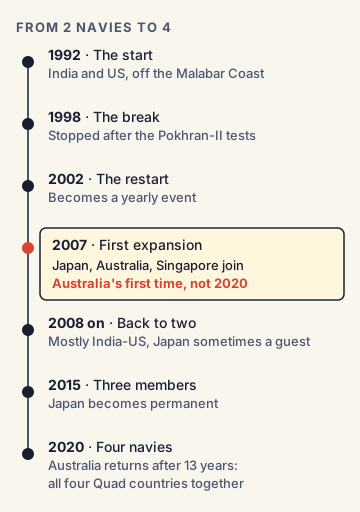
- 1992, the start: India and the US held the first Malabar as a simple "passing exercise" (a basic drill where ships meet at sea and practise signals and manoeuvres). It took place off India's west coast, on the Malabar Coast.
- 1998, the break: After India's nuclear tests at Pokhran in May 1998 (Pokhran-II), the US put sanctions on India and stopped the exercise.
- 2002, the restart: India-US defence ties improved after 2001, and Malabar resumed in 2002. After this it became a yearly event.
- 2007, the first expansion: Malabar was held twice in 2007. The second edition, held in the Bay of Bengal in September 2007, also included Japan, Australia and Singapore. This was the first time countries beyond India and the US joined. China objected to this large five-country exercise.
- 2008 onwards, back to two: After China's objections and political changes in some partner countries, the exercise went back to mostly India-US for some years. Japan took part in some editions as a guest.
- 2015, Japan becomes permanent: In 2015, Japan became a permanent member of Malabar. The exercise became trilateral (three countries): India, the US and Japan.
- 2020, Australia returns: In November 2020, Australia rejoined after 13 years. The 2020 edition was held in two phases, in the Bay of Bengal (off Visakhapatnam) and in the Arabian Sea. For the first time since 2007, all four Quad countries trained together at sea.
How is the exercise run?
The host country changes from year to year, and so does the location. A typical edition has two phases:
- Harbour phase: Ships meet in a port. Officers hold planning meetings, share information, play sports and make professional visits to each other's ships.
- Sea phase: Ships sail out together and carry out drills. These usually include anti-submarine warfare (finding and tracking enemy submarines), anti-air warfare (defending against aircraft and missiles), anti-surface warfare (fighting enemy ships), replenishment at sea (refuelling one ship from another while both are moving), flying operations from ships, and a "photo exercise" where all ships sail in formation.
Recent editions at a glance
- 2021: Two phases, in the Philippine Sea (off Guam) and in the Bay of Bengal.
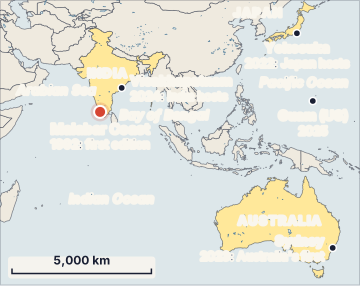
- 2022: Hosted by Japan, off Yokosuka. It marked 30 years since the first Malabar in 1992.
- 2023: Hosted by Australia for the first time, off Sydney (August 2023).
- 2024: Hosted by India, starting at Visakhapatnam (October 2024), with the sea phase in the Bay of Bengal.
- 2025: Held in and around Guam, a US island territory in the western Pacific (November 2025). INS Sahyadri represented India.
What kinds of ships and aircraft take part?
Each navy usually sends a few warships, such as destroyers, frigates or corvettes, often with helicopters on board. Some editions include aircraft carriers and submarines. Long-range maritime patrol aircraft are now a regular part. India and the US both fly the P-8 aircraft (India's version is called the P-8I), and Australia also flies the P-8A. Japan flies its own P-1. These aircraft can search large areas of sea for submarines.
India's position
India sees Malabar as part of its wider sea-security policy, not as a military alliance. India's guiding ideas are:
- SAGAR (Security and Growth for All in the Region), announced in 2015, and its wider form MAHASAGAR (Mutual and Holistic Advancement for Security and Growth Across Regions), announced in 2025. Both say India wants to be a helpful and trusted security partner in the Indian Ocean.
- Strategic autonomy: India keeps the freedom to make its own choices. It trains with the Quad navies at Malabar, but it also holds exercises with Russia (INDRA), France (Varuna), the UK (Konkan) and others.
- India says Malabar is not aimed at any third country.
Commonly confused concepts
- Malabar vs the Quad: The Quad is a diplomatic grouping of the same four countries. It works on health, technology, climate and maritime awareness, and it has no military command. Malabar is a separate naval exercise. Malabar started in 1992, long before the Quad (first met 2007). The Quad does not run Malabar.
- Malabar vs RIMPAC: RIMPAC (Rim of the Pacific) is a much larger exercise hosted by the US Navy near Hawaii every two years, with more than 25 countries. Malabar is a smaller, four-country exercise.
- Malabar vs MILAN: MILAN is a multilateral exercise hosted by India at Visakhapatnam (earlier at Port Blair), open to many friendly navies. Malabar is limited to four countries and its host changes.
- Malabar vs bilateral exercises: Bilateral exercises involve only two countries: for example, JIMEX (India-Japan), AUSINDEX (India-Australia), Varuna (India-France) and INDRA (India-Russia). Malabar is multilateral.
- Malabar Coast vs Coromandel Coast: The Malabar Coast is India's south-western coast (mainly Kerala and coastal Karnataka). The Coromandel Coast is the south-eastern coast (Tamil Nadu and Andhra Pradesh). The exercise is named after the Malabar Coast because the first edition was held there.
Issues, criticism and the way forward
- China's view: China sees Malabar as a sign of a group forming against it, and has objected since 2007. Supporters say the exercise is defensive and open, and that freedom of navigation benefits every country.
- No alliance, no promise: Malabar does not oblige any country to defend another. Some experts say this limits its real military value. Others say this flexible model suits India's policy of strategic autonomy.
- Scale and regularity: Some editions have been small, with one ship from India. Experts suggest larger and more complex drills, including more submarine and air components.
- Way forward: Experts suggest linking Malabar more closely with sharing of maritime information (such as the Quad's Indo-Pacific Partnership for Maritime Domain Awareness), more joint disaster-relief drills, and keeping the exercise open-ended rather than aimed at any one country.
Concepts to Know
- Interoperability: The ability of different armed forces to work together smoothly, using shared signals, procedures and equipment.
- Indo-Pacific: The large sea region from the east coast of Africa, across the Indian Ocean, to the western and central Pacific Ocean.
- Anti-submarine warfare (ASW): Finding, tracking and, in war, destroying enemy submarines, using sonar on ships, helicopters and patrol aircraft.
- Anti-surface warfare: Fighting enemy ships on the surface of the sea, mainly with missiles and guns.
- Freedom of navigation: The right of ships of all countries to sail through international waters, as recognised under the UN Convention on the Law of the Sea (UNCLOS), 1982.
- Maritime patrol aircraft: Long-range planes that fly over the sea for many hours to watch ships and hunt submarines. The P-8I and P-1 are examples.
- Started: 1992, as a bilateral India-US exercise off the Malabar Coast
- Suspended after India's 1998 nuclear tests; resumed in 2002
- 2007 (Bay of Bengal edition): Japan, Australia and Singapore joined for the first time
- Japan: permanent member since 2015
- Australia: rejoined in 2020 after 13 years; all four Quad nations together again
- 2023: first edition hosted by Australia (off Sydney); 2024: hosted by India at Visakhapatnam; 2025: held around Guam
- Exercise has a harbour phase and a sea phase
● Tracked since July 22, 2026 · last seen November 05, 2026 · updates as the daily brief publishes