East Asia Summit (EAS)
Updated 13 Nov 2026: Added India's Indo-Pacific Oceans Initiative, launched at the 14th East Asia Summit in Bangkok in November 2019.
The East Asia Summit (EAS) is a yearly meeting of the top leaders (Presidents and Prime Ministers) of 19 countries in the Indo-Pacific region. It brings together the 11 ASEAN countries and eight big partners: Australia, China, India, Japan, New Zealand, South Korea, Russia and the United States. Leaders use it to talk openly about big political, security and economic issues of the region. It is the only regular forum where the leaders of all these major powers sit at one table in Asia.
Why does it exist?
After the Cold War, Asia had no single meeting where all the important powers of the region could talk at the highest level. Many disputes, over seas, trade and security, involved several countries at once. Small countries of Southeast Asia also did not want the region to be run only by big powers. So ASEAN created a forum that it would lead, where big powers would come and talk, but under ASEAN's chairmanship and rules. You can think of ASEAN as the host who invites powerful guests to its table and sets the agenda.
Where did it come from?
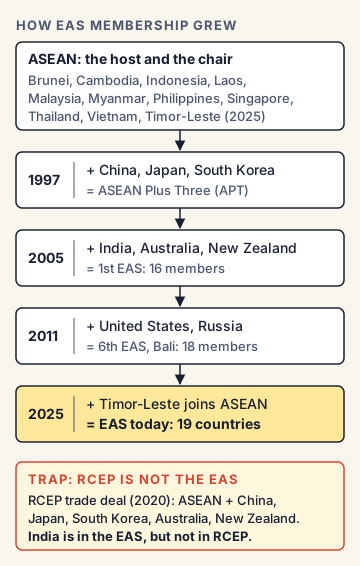
The idea of an "East Asian" grouping goes back to 1991, when Malaysia's then Prime Minister Mahathir Mohamad proposed it. In 1997, ASEAN started meeting China, Japan and South Korea together, a format called ASEAN Plus Three (APT). In 2002, a study group set up by ASEAN Plus Three suggested building a wider East Asia Summit. The 2004 ASEAN Plus Three summit decided to hold it.
The first East Asia Summit was held on 14 December 2005 in Kuala Lumpur, Malaysia. It had 16 members: the then 10 ASEAN countries plus Australia, China, India, Japan, New Zealand and South Korea. This group was often called "ASEAN Plus Six". The founding document is the Kuala Lumpur Declaration on the East Asia Summit (2005).
How did it grow?
- 2011: The United States and Russia formally joined at the 6th EAS in Bali, Indonesia (November 2011), taking membership to 18. Russia had attended the first summit only as an observer.
- 2025: Timor-Leste became the 11th member of ASEAN on 26 October 2025, and so became an EAS participant. This took membership to 19.
Who can join? The three entry rules
ASEAN fixed these conditions in July 2005. A country must:
- have signed (acceded to) ASEAN's Treaty of Amity and Cooperation (TAC), a treaty in which countries promise to settle disputes peacefully and respect each other's sovereignty;
- be a full Dialogue Partner of ASEAN; and
- have substantive relations with ASEAN, meaning real and deep cooperation in trade, investment and other areas.
How does it work?
The EAS is "leaders-led": it is a meeting of heads of state or government, not of ministers. It is held every year, right after the ASEAN Summit, in the country that chairs ASEAN that year. So it always has an ASEAN chair, and its venue rotates among ASEAN countries. Below the leaders, there are meetings of EAS foreign ministers, economic ministers, energy ministers and senior officials, and an EAS Ambassadors' Meeting in Jakarta (where the ASEAN Secretariat sits).
Decisions are made by consensus, meaning everyone must agree. The EAS does not have its own secretariat or binding treaties; its outcomes are declarations and statements, which are political promises, not legal obligations.
What does it work on?
The EAS has six long-standing priority areas of cooperation:
- environment and energy
- education
- finance
- global health issues and pandemic diseases
- natural disaster management
- ASEAN connectivity
Over time, leaders have also discussed maritime security, terrorism, the South China Sea, the Korean Peninsula and trade. Its work is guided by multi-year plans, such as the EAS Plan of Action 2024-2028.
Important EAS outcomes to remember
- Cebu Declaration on East Asian Energy Security (2nd EAS, January 2007, Philippines).
- Economic Research Institute for ASEAN and East Asia (ERIA): a think tank agreed in 2007 and confirmed at the 3rd EAS (Singapore, November 2007).
- Nalanda University revival: EAS countries supported the revival of ancient Nalanda at the 2nd EAS (Cebu, 2007) and the 4th EAS (Hua Hin, Thailand, 2009). India passed the Nalanda University Act, 2010, and the university at Rajgir, Bihar, was set up on 25 November 2010.
- Bali Principles (2011): the Declaration on the Principles for Mutually Beneficial Relations, adopted when the US and Russia joined.
India's position and role
India is a founding member of the EAS (2005). For India, the EAS matters for three reasons. First, it is a place to talk directly with the US, China, Japan, Russia and ASEAN leaders together. Second, it supports India's Act East Policy, which was itself announced at the 12th ASEAN-India Summit and 9th EAS in Nay Pyi Taw, Myanmar, in November 2014.
Third, it lets India push for a free, open, rules-based Indo-Pacific and freedom of navigation at sea. India has hosted several EAS Conferences on Maritime Security Cooperation; the 6th was held in Mumbai on 4 and 5 July 2024, co-organised with Australia and Indonesia. At the 14th EAS in Bangkok, Thailand, on 4 November 2019, India launched the Indo-Pacific Oceans Initiative (IPOI).
It is an open, non-binding plan for countries to work together on the seas. It has seven areas of work, called pillars, such as maritime security, maritime ecology and disaster risk reduction. Partner countries can choose to lead a pillar. Nalanda University is India's best-known EAS project.
Commonly confused concepts
- EAS vs ASEAN Plus Three (APT): APT (started 1997) is ASEAN plus only China, Japan and South Korea. EAS (2005) is wider and includes India, Australia, New Zealand, the US and Russia.
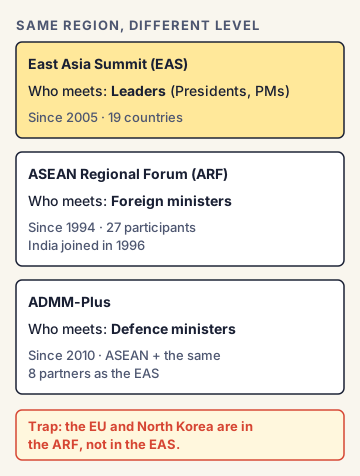
- EAS vs ASEAN Regional Forum (ARF): ARF (1994) is a security dialogue at the foreign minister level with a wider membership (27 participants in the official ASEAN list), including the European Union and North Korea. EAS is at the leaders' level with 19 countries. India joined ARF in 1996.
- EAS vs ADMM-Plus: The ASEAN Defence Ministers' Meeting-Plus (started 2010) is for defence ministers. Its eight "Plus" countries are the same eight non-ASEAN members of the EAS.
- EAS vs RCEP: The Regional Comprehensive Economic Partnership (RCEP) is a trade agreement signed on 15 November 2020 by ASEAN with China, Japan, South Korea, Australia and New Zealand. India took part in the talks but left in November 2019. India is in the EAS but not in RCEP.
- EAS vs ASEAN-India Summit: The ASEAN-India Summit is a meeting only between ASEAN and India. The EAS is a meeting of all 19 members. Both are held in the same week.
Issues, criticism and the way forward
- A talk shop? Critics say the EAS produces statements but few concrete results, because it has no binding rules and works only by consensus.
- Great-power rivalry: Tensions between the US and China, and disputes in the South China Sea, often make it hard to agree on strong joint statements.
- Uneven attendance: When top leaders skip the summit and send ministers, the "leaders-led" value of the forum weakens.
- ASEAN centrality: ASEAN wants to stay in the driver's seat. Some feel this slows decisions; others say it keeps the forum neutral and acceptable to all big powers.
- Way forward: Experts suggest a stronger EAS unit within the ASEAN Secretariat, more practical projects (in maritime safety, disaster relief and health), and better follow-up of decisions through the Plan of Action.
Concepts to Know
- ASEAN centrality: The idea that ASEAN, not any big power, should sit at the centre of the region's meetings and set their agenda.
- Dialogue Partner: A country that has a formal, structured relationship with ASEAN, with regular meetings at different levels. India is one.
- Consensus: A way of deciding where a decision is taken only when no member objects. It avoids voting.
- Indo-Pacific: The connected region of the Indian Ocean and the western and central Pacific Ocean, seen as one strategic space.
- Pillar: One main area of work inside a larger plan. The IPOI has seven, and each partner country can lead one.
- Freedom of navigation: The principle that ships of all countries can sail through international waters without interference, as recognised under the UN Convention on the Law of the Sea (UNCLOS).
- Declaration: A joint statement of political commitment. Unlike a treaty, it is not legally binding.
- Founded: 14 December 2005, Kuala Lumpur (1st EAS); Kuala Lumpur Declaration
- Founding members: 16 (10 ASEAN + Australia, China, India, Japan, New Zealand, South Korea)
- US and Russia joined: 6th EAS, Bali, November 2011 (18 members)
- Timor-Leste joined ASEAN on 26 October 2025, taking EAS to 19 participating countries
- Entry criteria: accede to TAC, be a full ASEAN Dialogue Partner, have substantive relations with ASEAN
- Leaders-led; annual; held after the ASEAN Summit in the ASEAN chair country; consensus-based
- Six priority areas: environment and energy, education, finance, global health and pandemic diseases, natural disaster management, ASEAN connectivity
- Nalanda University revival backed at 2nd (2007) and 4th (2009) EAS; Nalanda University Act, 2010
- Act East Policy announced at the 9th EAS / 12th ASEAN-India Summit, Nay Pyi Taw, November 2014
- Indo-Pacific Oceans Initiative (IPOI) launched by India at the 14th EAS, Bangkok, 4 November 2019
- 20th EAS: Kuala Lumpur, October 2025; 21st EAS: Manila, November 2026
- 13 Nov 2026Added India's Indo-Pacific Oceans Initiative, launched at the 14th East Asia Summit in Bangkok in November 2019.
● Tracked since July 23, 2026 · last seen November 12, 2026 · updates as the daily brief publishes