Maritime Domain Awareness (MDA)
Updated 18 Nov 2026: Added the Quad's 2026 Indo-Pacific Maritime Surveillance Collaboration (IPMSC), which builds on IPMDA, and India's IPMDA role through IFC-IOR.
Maritime Domain Awareness, or MDA, means knowing what is happening at sea: which ships are where, where they are going, what they are carrying and whether they pose any danger. The International Maritime Organization (IMO) describes it as an effective understanding of anything linked to the sea that could affect a country's security, safety, economy or environment. In simple words, MDA is like a CCTV system for the ocean. You cannot protect what you cannot see.
Why does it matter?
The sea is huge, and most of it is empty and unwatched. This allows many threats to move freely:
- Terrorists and smugglers can arrive by boat. The 2008 Mumbai attacks (26/11) were carried out by terrorists who came by sea from Pakistan.
- Illegal, unreported and unregulated (IUU) fishing steals fish from a country's waters and hurts poor fishing communities.
- Piracy, arms trafficking, drug smuggling and human trafficking all use sea routes.
- Accidents and disasters such as oil spills, shipwrecks and cyclones need fast rescue.
- Military activity, including foreign submarines and survey ships, needs to be watched.
India alone has a coastline of over 11,000 km (as remeasured in 2024) and an Exclusive Economic Zone (EEZ) of about 2 million sq km. About 95% of India's trade by volume moves by sea. Without MDA, a navy is like a guard on duty in the dark.
Where did it come from?
The idea grew after the 9/11 attacks in the US in 2001, when countries realised that ships could also be used for terrorism. For India, the turning point was 26/11 in 2008. The attack showed that India's coastal watch had big gaps. After it, India built a layered system:
- Coastal Surveillance Network (CSN): In Phase I, 46 coastal radar stations were set up, including 10 on the islands. Phase II adds 38 more radar stations and 8 mobile surveillance systems.
- National Command, Control, Communication and Intelligence (NC3I) network: It links 51 Navy and Coast Guard stations (20 Navy, 31 Coast Guard) along the coast and islands, so that all of them see the same picture.
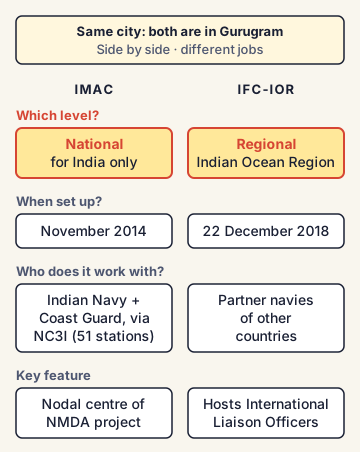
- Information Management and Analysis Centre (IMAC): Set up in Gurugram and inaugurated in November 2014, run jointly by the Navy and Coast Guard. It is the nodal centre of the NC3I network and of India's National Maritime Domain Awareness (NMDA) project.
- Information Fusion Centre - Indian Ocean Region (IFC-IOR): Launched on 22 December 2018 at Gurugram, alongside IMAC. It shares information with partner countries and hosts International Liaison Officers from partner navies.
How does MDA work?
Think of it in three steps: collect, combine, share.
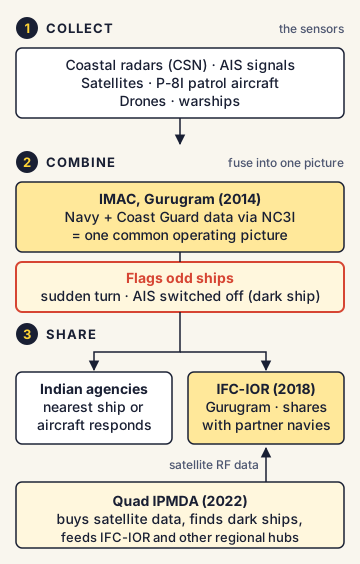
- Collect: Data comes from many "sensors": coastal radars, satellites, patrol aircraft, drones, warships and the Automatic Identification System (AIS). AIS is a radio transponder that ships use to broadcast their name, position, speed and course. Under the IMO's SOLAS convention, it is mandatory for passenger ships and for most large cargo ships (300 gross tonnage and above on international voyages).
- Combine (fuse): Fusion centres put all these pieces together into one map, called a common operating picture. Computers then look for unusual behaviour, such as a ship that suddenly changes course or switches off its AIS.
- Share: The picture is shared with other agencies and partner countries, so that the nearest ship or aircraft can respond.
A key problem is dark ships: vessels that switch off their AIS to hide. They are often linked to illegal fishing or smuggling. They can still be found using satellites that pick up their other radio signals (radio frequency, or RF, detection), radar images, or patrol aircraft.
The role of maritime patrol aircraft
Patrol aircraft can cover vast areas quickly. India's main one is the P-8I, made by Boeing in the US. India ordered 8 in January 2009, the first arrived in 2013, and 4 more were ordered in July 2016, making a fleet of 12. They fly from INS Rajali (Arakkonam, Tamil Nadu) and Goa. The P-8I can track ships and submarines, and carry torpedoes and anti-ship missiles.
The P-3C Orion, made by Lockheed in the US, is an older patrol aircraft still flown by Japan and some other navies. The US operates the P-8A, and Australia also flies the P-8A.
MDA as a group effort: white shipping and IPMDA
No country can watch the whole ocean alone. So countries share data:
- White shipping agreements: deals to share information about commercial (merchant) ships. "White" shipping means ordinary commercial ships, as opposed to warships ("grey" shipping). India has signed such agreements with many countries.
- Indo-Pacific Partnership for Maritime Domain Awareness (IPMDA): launched by the Quad leaders at their Tokyo summit on 24 May 2022. It buys commercial satellite RF data and gives partner countries a near-real-time picture of activity in their waters, including dark ships, at no cost to them. It works through existing regional centres: IFC-IOR in India, the Information Fusion Centre in Singapore, the Pacific Islands Forum Fisheries Agency in Honiara (Solomon Islands) and the Pacific Fusion Centre in Vanuatu. As of May 2026, India runs the Indian Ocean Region part of IPMDA through IFC-IOR in Gurugram.
- Indo-Pacific Maritime Surveillance Collaboration (IPMSC): announced by the Quad foreign ministers in New Delhi on 26 May 2026, and listed among the new steps at the Quad leaders' summit in Manila on 17 November 2026. IPMDA mainly shares satellite data. IPMSC adds coordinated surveillance: the four countries plan their own patrols together, first in the Indian Ocean Region, and share real-time information on ships. It also uses expert exchanges and tabletop exercises. The aim is one common operating picture for the whole Indo-Pacific. As of November 2026, the four countries plan to fly their patrol aircraft (P-8 and P-3C) together in a maritime exercise in 2027, the first time under the Quad.
Commonly confused concepts
- MDA vs maritime security: MDA is about seeing and knowing. Maritime security is about acting: stopping pirates, catching smugglers, defending sea lanes. MDA is the first step that makes action possible.
- IMAC vs IFC-IOR: Both are in Gurugram. IMAC is India's national centre, joining Indian Navy and Coast Guard data. IFC-IOR is the regional centre, sharing information with foreign partners.
- IPMDA vs IFC-IOR: IPMDA is a Quad initiative (2022) that supplies satellite data. IFC-IOR is an Indian Navy centre (2018) that is one of the hubs receiving and sharing that data.
- IPMDA vs IPMSC: Both are Quad initiatives. IPMDA (2022) shares satellite data on ships. IPMSC (2026) coordinates the four countries' own surveillance, such as patrol flights, and builds on IPMDA.
- AIS vs LRIT: AIS broadcasts openly by radio and anyone nearby can receive it. Long Range Identification and Tracking (LRIT) sends a ship's position by satellite only to authorised governments, at set intervals.
- White shipping vs grey shipping: white means commercial ships; grey means warships.
Issues, criticism and the way forward
- Trust in sharing data: countries are careful about sharing raw military data. Many share only filtered commercial information.
- Coverage gaps: analysts point to weak coverage in parts of the western Indian Ocean and among small island states with few ships or aircraft.
- Dependence on commercial data: IPMDA relies on data bought from private satellite companies, which raises questions of cost and long-term continuity.
- Small states' capacity: a picture is useless if a country has no boats to respond. Training and equipment are needed alongside data.
- Perception concerns: some countries see Quad surveillance as aimed at one power, which can make neutral states hesitant to join.
- Way forward: more fusion centres and liaison officers, wider use of AI to flag suspicious ships, more patrol aircraft and drones (India signed a deal for 31 MQ-9B drones with the US in October 2024), and stronger links between national centres and regional hubs.
Concepts to Know
- Exclusive Economic Zone (EEZ): The sea area up to 200 nautical miles from a country's coast, where it alone can fish and use resources under UNCLOS, the UN law of the sea.
- Fusion centre: An office where data from many sources is joined into one clear picture and studied by experts.
- SOLAS: The International Convention for the Safety of Life at Sea, the IMO's main treaty on ship safety.
- Gross tonnage: A measure of a ship's overall internal size (not its weight).
- Liaison officer: An officer from one country posted in another country's office, to pass information quickly between the two.
- Radio frequency (RF) detection: Finding a ship by picking up the radio signals it gives out (from radars or radios), even when its AIS is off.
- Tabletop exercise: A practice drill where officials talk through how they would handle an imagined event, without moving real ships or aircraft.
- IMO definition: understanding anything linked to the maritime domain that could affect security, safety, economy or environment
- IMAC, Gurugram: inaugurated November 2014; Navy plus Coast Guard; nodal centre of NC3I and NMDA project
- IFC-IOR, Gurugram: launched 22 December 2018; hosts International Liaison Officers
- NC3I links 51 stations (20 Navy, 31 Coast Guard); CSN Phase I: 46 radars (10 on islands); Phase II: 38 radars plus 8 mobile systems
- IPMDA: launched at Quad Tokyo summit, 24 May 2022; uses commercial satellite RF data
- IPMSC: announced by Quad foreign ministers, New Delhi, 26 May 2026; coordinates Quad maritime surveillance, first in the Indian Ocean Region; builds on IPMDA
- P-8I: 8 ordered January 2009 plus 4 in July 2016 = 12; first inducted 2013; bases Arakkonam (INAS 312) and Goa (INAS 315)
- AIS mandatory under SOLAS for passenger ships and ships of 300 GT and above on international voyages
- 18 Nov 2026Added the Quad's 2026 Indo-Pacific Maritime Surveillance Collaboration (IPMSC), which builds on IPMDA, and India's IPMDA role through IFC-IOR.
● Tracked since November 17, 2026 · last seen November 17, 2026 · updates as the daily brief publishes