Submarine Communication Cables
The Hidden Backbone of the Internet
Submarine communication cables are thick-skinned fibre-optic cables laid on the sea floor to carry internet, phone and data traffic between countries and continents. When you watch a video hosted abroad, send money overseas or make a video call to another country, the data almost certainly travels through these cables. More than 99% of international data traffic moves through undersea cables, not satellites.
Why are they so important?
Modern life runs on data. Banking, stock markets, government services, e-commerce, cloud storage and AI all depend on fast links between countries. Satellites carry only a very small share, because cables can carry far more data, far faster and far more cheaply. So these cables are called critical infrastructure: if they are cut, a country's economy and communication can slow down or stop. They also carry military and government data, which makes them a security concern.
Where did they come from?
The history has three big stages:
- Telegraph era: The first undersea telegraph cable crossed the English Channel in 1850-51. The first transatlantic telegraph cable was laid in 1858, but worked for only about three weeks. It still cut the time to send a message between London and New York from about ten days to minutes. Lasting transatlantic links came from 1866.
- Telephone era: TAT-1, the first transatlantic telephone cable, opened in 1956.
- Fibre-optic era: TAT-8, the first transatlantic fibre-optic cable, began working in December 1988. Fibre optics carry data as pulses of light, which made huge capacity possible and built today's internet.
How does a cable work?
Inside the cable are hair-thin glass fibres. Data travels through them as pulses of laser light. Light weakens over long distances, so repeaters (small boosters) are placed along the cable at regular intervals to strengthen the signal. In the deep sea, a cable can be as thin as a garden hose, because there is little danger there.
Near the shore, where fishing and ship anchors are common, it is thicker, armoured with steel wire and usually buried under the seabed. A cable comes ashore at a cable landing station (CLS), a building that connects it to the country's land network. Special cable ships lay new cables and repair broken ones.
Who owns them?
Earlier, most cables were owned by telecom companies, often in groups called consortiums. Today, big technology companies (such as Google, Meta, Microsoft and Amazon) own or fund many new cables and use most of the international bandwidth. This raises questions about who controls this critical infrastructure.
What does international law say?
Cables are governed mainly by two treaties:
- The 1884 Convention for the Protection of Submarine Telegraph Cables: the first international treaty on cables. It made damaging cables a punishable offence.
- UNCLOS (UN Convention on the Law of the Sea), 1982:
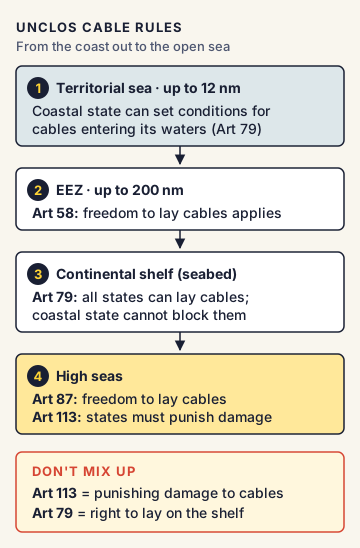
- Article 87: freedom to lay submarine cables is one of the freedoms of the high seas.
- Article 58: this freedom also applies in another country's Exclusive Economic Zone (EEZ).
- Article 79: all states can lay cables on the continental shelf. The coastal state cannot block them, but it can take reasonable measures to explore and use its own seabed resources. (Its consent for the exact route is required for pipelines; for cables, the coastal state can set conditions only for cables entering its territory or territorial sea.)
- Article 113: each country must make it a punishable offence for its ships or people to break or damage a cable under the high seas, whether on purpose or through culpable negligence (serious carelessness).
What are the threats?
- Accidents: about two-thirds of cable faults are caused by accidental human activity, mainly fishing gear and ship anchors dragging on the seabed.
- Natural hazards: undersea earthquakes and landslides.
- Deliberate damage (sabotage): several cables were damaged in the Baltic Sea in 2024 and 2025, and around Taiwan. Proving who did it is very hard.
- Chokepoints: many cables pass through narrow sea routes. In February 2024, several cables were cut in the Red Sea near the Bab el-Mandeb strait, disrupting a large share of Europe-Asia traffic.
- Slow repairs: there are few repair ships in the world, and many are old. Repairs can take weeks or months.
- Spying: cables and landing stations can be targets for tapping data.
India's position and Indian examples
As per TRAI's count at the end of 2022, about 17 international submarine cables land at 14 cable landing stations in just 5 cities: Mumbai, Chennai, Kochi, Tuticorin and Thiruvananthapuram. Most land in Mumbai and Chennai. This concentration is a risk: damage in one city could cut a big part of India's international bandwidth. Important domestic cables include:
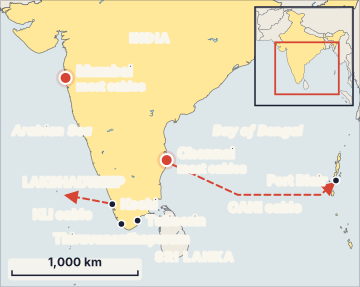
- Chennai-Andaman and Nicobar Islands (CANI) cable: about 2,312 km long, completed in 2020, giving the islands high-speed internet.
- Kochi-Lakshadweep Islands (KLI) cable: links Kochi to 11 islands of Lakshadweep.
In June 2023, TRAI (Telecom Regulatory Authority of India) recommended easier rules for setting up landing stations, including a new category called CLS Points of Presence. Cable landing stations need a licence from the Department of Telecommunications (DoT).
The Quad angle
The Quad leaders announced the Quad Partnership for Cable Connectivity and Resilience at their Hiroshima meeting on 20 May 2023. It brings governments and private companies together to fill gaps in cable networks and coordinate future cable routes, construction and maintenance. Under it, Australia set up an Indo-Pacific Cable Connectivity and Resilience Program to give technical help to regional governments.
Commonly confused concepts
- Submarine cable vs satellite internet: satellites cover remote places and ships, but carry only a tiny share of international data. Cables carry more than 99%.
- Communication cable vs power cable: communication cables carry data as light. Power cables (often high-voltage direct current, HVDC) carry electricity between countries or from offshore wind farms. They face similar risks but serve different purposes.
- Submarine cable vs submarine: the word "submarine" here only means "under the sea". These cables have nothing to do with submarine boats.
- Article 113 vs Article 79 of UNCLOS: Article 113 is about punishing damage to cables. Article 79 is about the right to lay cables on the continental shelf.
Issues, criticism and the way forward
- Weak international law: Article 113 only asks countries to make cable damage a crime. It does not let warships board or arrest a foreign ship suspected of cutting a cable on the high seas. Few countries have strong laws to apply it.
- Concentration risk: too many cables pass through a few chokepoints and land at a few cities.
- Repair capacity: the shortage of cable repair ships delays fixes.
- Private control: a few big companies own much of the new capacity.
- Way forward: more landing stations at new locations (India's east coast and other west coast sites are often suggested), diverse cable routes that avoid chokepoints, more repair ships stationed in the region, stronger national laws to protect cables, and cooperation among trusted partners on secure cable building, as the Quad partnership aims to do.
Concepts to Know
- Fibre-optic cable: A cable with thin glass threads that carry data as flashes of light. Very fast and able to carry huge amounts of data.
- Bandwidth: The amount of data a link can carry each second. More bandwidth means faster internet for more people.
- Repeater: A small device on a cable that boosts the light signal so it does not fade over long distances.
- Chokepoint: A narrow sea passage that many ships or cables must pass through, so a problem there affects a lot of traffic.
- Continental shelf: The gently sloping seabed next to a country's coast, before the deep ocean begins. Under UNCLOS, the coastal country has rights over its resources.
- Culpable negligence: Carelessness so serious that the law treats it as blameworthy, like a ship dropping anchor where it clearly should not.
- More than 99% of international data travels by submarine cables
- 1850-51: first undersea telegraph cable (English Channel); 1858: first transatlantic telegraph cable; 1956: TAT-1 (first transatlantic telephone cable); 1988: TAT-8 (first transatlantic fibre-optic cable)
- 1884 Convention for the Protection of Submarine Telegraph Cables: first cable treaty
- UNCLOS: Art 87 (high seas freedom), Art 58 (EEZ), Art 79 (continental shelf), Art 113 (punishing damage)
- India (TRAI, end 2022): about 17 international cables at 14 landing stations in 5 cities
- CANI cable: about 2,312 km, completed 2020
- Quad Partnership for Cable Connectivity and Resilience: announced at Hiroshima, 20 May 2023
● Tracked since November 17, 2026 · last seen November 17, 2026 · updates as the daily brief publishes