Comprehensive Convention on International Terrorism (CCIT)
The Comprehensive Convention on International Terrorism, or CCIT, is a proposed United Nations treaty that would make all forms of international terrorism a crime under one single global law. India first proposed it in 1996. It would require every country that joins to punish terrorists, deny them money, weapons and safe havens, and either put them on trial or hand them over to another country.
Even after almost 30 years of talks, the treaty has not been adopted, mainly because countries cannot agree on how to define "terrorism".
Why does the world need it?
Today there is no single, agreed legal definition of terrorism in international law. Instead, the world has many separate treaties, each covering one type of attack: hijacking a plane, taking hostages, bombing a public place, funding terror, and so on. This is like a school having separate rules for "no hitting with a bat" and "no hitting with a stick", but no rule that simply says "no hitting".
A new kind of attack can fall through the gaps. A country that shelters terrorists can also argue that its "fighters" are not terrorists at all. A comprehensive treaty would close these gaps with one common definition and one common set of duties for every member.
Where did it come from?
- 17 December 1996: The UN General Assembly passed Resolution 51/210. It set up an Ad Hoc Committee (a special, temporary committee) to work on treaties against terrorism. India placed a draft of a comprehensive convention before the UN that year.
- 2000 onwards: Talks on a comprehensive convention, based on India's draft text, began in the Ad Hoc Committee. Later, the work moved to a Working Group of the Sixth Committee (the General Assembly's legal committee), which meets every year under the agenda item "Measures to eliminate international terrorism".
- 2002: A draft definition of the offence was agreed in the Ad Hoc Committee's text. Since then, the fight has been over the exceptions, not the core definition.
- After 2014: India kept raising the CCIT at the UN General Assembly, at BRICS summits and at other forums, asking for it to be adopted quickly. BRICS leaders' declarations have repeatedly called for its early finalisation within the UN framework.
- 2024: At the 79th session, the Sixth Committee again accepted that there was no consensus and kept the item on the next year's agenda. So, as of October 2026, the CCIT remains a draft.
What does the draft say?
Under the draft definition, a person commits an offence if he or she, by any means, unlawfully and intentionally causes:
- death or serious bodily injury to any person; or
- serious damage to public or private property, including places of public use, government facilities, public transport, infrastructure or the environment; or
- damage to such property or systems that causes, or is likely to cause, major economic loss.
The act counts as terrorism when its purpose, by its nature or context, is to frighten a population, or to force a government or an international organisation to do or not do something. Trying, threatening, helping, organising or directing such acts would also be crimes.
India's main goals for the treaty
India wants the CCIT to:
- adopt one universal definition of terrorism that all UN members accept;
- ban all terror groups and close their training camps;
- make cross-border terrorism an extraditable offence (one for which a person can be handed over to another country for trial) everywhere;
- make every country prosecute terrorists, including under its own laws, so no terrorist finds a safe place to hide;
- stop the flow of money and weapons to terrorists.
Why is it stuck? The definition fight
The deadlock is about who should be left out of the definition:
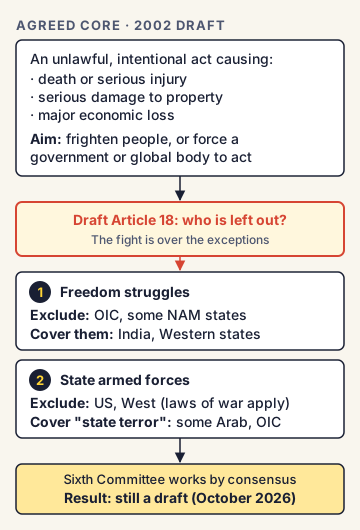
- Freedom struggles: Members of the Organisation of Islamic Cooperation (OIC), backed by some Non-Aligned Movement countries, want the treaty to exclude armed struggles for self-determination and against foreign occupation. They point to cases such as Palestine. India and many Western countries fear this would let any group call its terror a "liberation struggle".
- State armed forces: Western countries, including the United States, want the activities of national armed forces during armed conflict to be left out, since those are already governed by international humanitarian law (the laws of war). Some Arab and OIC states want "state terrorism" (violence by governments) to be covered.
This disagreement sits in the draft's exceptions clause (draft Article 18). Because the Sixth Committee works by consensus, a few objections are enough to keep the treaty stuck.
What already exists instead?
The world fights terrorism today through a patchwork:
- 19 international legal instruments (treaties and protocols) made since 1963 under the UN and the International Atomic Energy Agency. Each covers one kind of act. Examples: the Tokyo Convention, 1963 (crimes on board aircraft); the Terrorist Bombings Convention, 1997; the Terrorist Financing Convention, 1999; and the Nuclear Terrorism Convention, 2005.
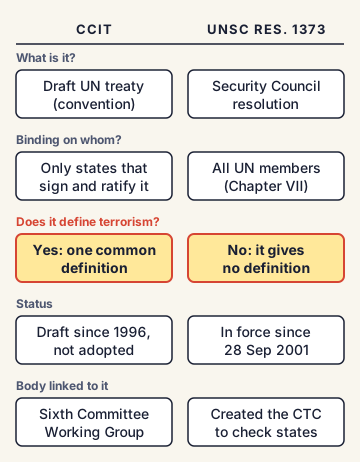
- UN Security Council Resolution 1373 (28 September 2001), passed after the 9/11 attacks, made it binding on all countries to criminalise terror financing and deny safe havens. It created the Counter-Terrorism Committee (CTC).
- UN Security Council Resolution 1566 (2004) described terrorist acts and said they can never be justified by any political, religious, ethnic or other reason. India has suggested that this description could be a starting point for the CCIT definition.
- UN Global Counter-Terrorism Strategy, adopted by the General Assembly by consensus on 8 September 2006 (A/RES/60/288). It has four pillars: tackling the conditions that help terrorism spread; preventing and fighting terrorism; building countries' capacity; and protecting human rights and the rule of law. It is reviewed about every two years.
- UN Office of Counter-Terrorism (UNOCT), created by General Assembly Resolution 71/291 on 15 June 2017, coordinates the UN's work.
India's position and Indian examples
India has suffered cross-border terrorism for decades, so it has been the strongest supporter of the CCIT. India chaired the UN Security Council's Counter-Terrorism Committee in 2022. That year, the CTC held a special meeting in India for the first time (Mumbai on 28 October and New Delhi on 29 October 2022), which adopted the non-binding Delhi Declaration on stopping terrorists from misusing new technologies such as drones, social media and online payments.
At home, India's main anti-terror law is the Unlawful Activities (Prevention) Act (UAPA), 1967, which got anti-terror provisions in 2004. A 2019 amendment allowed the government to declare individuals as terrorists (Fourth Schedule), not only organisations. The National Investigation Agency (NIA) was set up under the NIA Act, 2008, after the 26/11 Mumbai attacks.
Commonly confused concepts
- CCIT vs the 19 sectoral treaties: The sectoral treaties are already in force but each covers only one type of act. The CCIT would be one umbrella treaty with a general definition. It is still only a draft.
- CCIT vs UNSC Resolution 1373: Resolution 1373 is binding on all UN members because the Security Council passed it under Chapter VII of the UN Charter. But it does not define terrorism. The CCIT would be a treaty, binding only on countries that sign and ratify it, with a definition.
- UNSC 1267 Committee vs Counter-Terrorism Committee: The 1267 Committee keeps the sanctions list of individuals and groups linked to ISIL (Da'esh) and Al-Qaida. The CTC, set up by Resolution 1373, checks whether countries are following their counter-terror duties.
- CCIT vs FATF: The Financial Action Task Force is an inter-governmental body that sets standards against money laundering and terror financing and can "grey-list" countries. It is not a UN treaty.
Issues, criticism and the way forward
- Definition deadlock: The core difficulty is political, not legal. "One person's terrorist is another's freedom fighter" is the argument that has blocked the treaty for decades.
- Double standards: India argues that some countries condemn terrorism in general but protect groups that serve their interests, for example by blocking UN listings of known terrorists. A binding global definition would make such selective approaches harder.
- Human rights concern: Some experts warn that a very wide definition could let governments label peaceful protesters or critics as terrorists. A good treaty must balance security with rights.
- Way forward: Experts suggest building on language that all countries have already accepted, such as Resolution 1566, keeping a clear exception for the laws of war, and saying plainly that no cause can justify deliberate attacks on civilians. India continues to press for the CCIT at the UN, BRICS, SCO and G20.
Concepts to Know
- Convention (treaty): A written agreement between countries that becomes legally binding on those countries that sign and ratify (formally approve) it.
- Sixth Committee: The UN General Assembly has six main committees. The Sixth deals with legal questions, such as drafting new treaties.
- Consensus: A way of deciding where there is no vote; a decision passes only if no member objects.
- Extradition: Handing over a person accused of a crime from one country to another so that he or she can face trial there.
- Safe haven: A place, usually inside a country, where terrorists can live, train and plan without being arrested.
- International humanitarian law: The rules of war, such as the Geneva Conventions, that protect civilians and prisoners during armed conflict.
- Organisation of Islamic Cooperation (OIC): A group of 57 countries with large Muslim populations that often take a common position at the UN.
- CCIT proposed by India in 1996; Ad Hoc Committee set up by UNGA Resolution 51/210 of 17 December 1996
- Negotiated in the Ad Hoc Committee and later a Sixth Committee Working Group; still not adopted as of October 2026
- Main dispute: exclusions for self-determination movements and for state armed forces (draft Article 18)
- 19 international legal instruments against terrorism since 1963, including the 1997 Bombings, 1999 Financing and 2005 Nuclear Terrorism conventions
- UNSC Resolution 1373 (28 September 2001) created the Counter-Terrorism Committee; Resolution 1566 (2004) described terrorist acts as never justifiable
- UN Global Counter-Terrorism Strategy: 8 September 2006, four pillars, reviewed about every two years; UNOCT created 15 June 2017
- India chaired the CTC in 2022; Delhi Declaration adopted on 29 October 2022
● Tracked since October 20, 2026 · last seen October 20, 2026 · updates as the daily brief publishes