Land Use, Land-Use Change and Forestry (LULUCF)
Land Use, Land-Use Change and Forestry, or LULUCF, is the part of climate accounting that covers how land releases or absorbs greenhouse gases. When forests grow, they pull CO2 out of the air and store carbon in wood and soil. When forests are cut, burned or drained, that stored carbon goes back into the air. LULUCF counts both these flows. It can be a source of emissions (when land loses carbon) or a sink (when land gains carbon).
Why does it matter?
Land holds huge amounts of carbon. Cutting down a tropical forest or burning a peatland can release carbon that took hundreds or thousands of years to build up. On the other hand, planting trees and protecting forests can remove CO2 from the air. So land can either help or hurt the fight against climate change. Without counting land, a country's climate report would miss a big part of the picture.
Where did it come from?
LULUCF accounting grew out of the global climate treaties:
- UNFCCC (1992): asked all countries to report emissions and removals by sinks, and to protect and enhance sinks such as forests.
- Kyoto Protocol (1997): let developed countries count some land activities towards their targets. Article 3.3 made it compulsory to count afforestation, reforestation and deforestation since 1990. Article 3.4 covered other activities like forest management, which became compulsory in the second commitment period (2013 to 2020).
- Warsaw Framework for REDD+ (COP19, 2013): a set of seven decisions giving the rules for paying developing countries to cut emissions from deforestation and forest degradation.
- Paris Agreement (2015): Article 5 asks all Parties to conserve and enhance sinks, including forests, and encourages REDD+.
How is LULUCF measured?
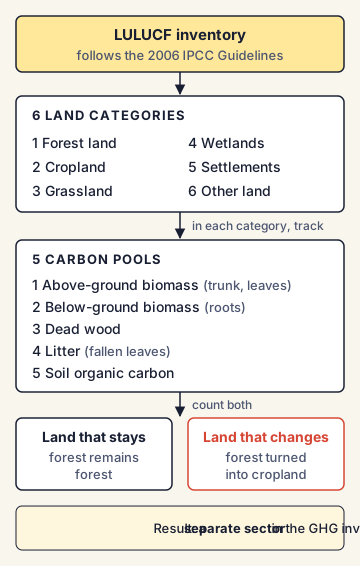
Countries follow guidelines made by the IPCC (2006 IPCC Guidelines). Land is divided into six categories:
- Forest land
- Cropland
- Grassland
- Wetlands
- Settlements (towns and cities)
- Other land (such as bare rock and ice)
For each category, countries track carbon in five carbon pools: above-ground biomass (trunks, branches, leaves), below-ground biomass (roots), dead wood, litter (fallen leaves) and soil organic carbon. They count both land that stays in a category (forest that remains forest) and land that changes category (forest turned into cropland). The result is reported as a separate sector in a country's greenhouse gas inventory, next to energy, industry, agriculture and waste.
Why are there two different global numbers?
Global science groups like the Global Carbon Project and national governments count land carbon differently. National inventories treat all carbon flows on "managed" land as human-caused. This includes extra growth of forests caused by more CO2 in the air, which is an indirect effect. Global models count only the direct effects of human actions like cutting or planting.
A study in Nature found a gap of about 4 to 7 billion tonnes of CO2 a year between the two methods. This matters because, if not adjusted, countries' reports can look better than what global science shows.
India's position and Indian examples
In India, the LULUCF sector is a net sink: Indian forests and trees absorb more CO2 than land use releases.
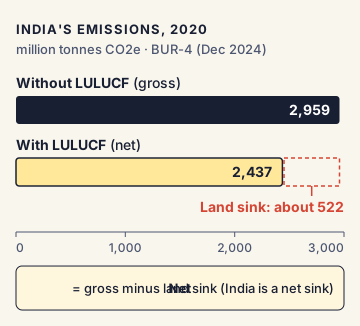
- India's Fourth Biennial Update Report (BUR-4), submitted to the UNFCCC on 30 December 2024, reported 2020 emissions of 2,959 million tonnes CO2e without LULUCF and 2,437 million tonnes with LULUCF. So land removed a net about 522 million tonnes, which offset about 22% of India's CO2 emissions.
- India's NDC target includes creating an additional carbon sink of 2.5 to 3 billion tonnes of CO2e through more forest and tree cover by 2030.
- The India State of Forest Report (ISFR) 2023 says India has already created an additional sink of about 2.29 billion tonnes compared with 2005.
- Programmes such as the Green India Mission (one of eight missions under the National Action Plan on Climate Change) and compensatory afforestation under the CAMPA framework support this sink.
Commonly confused concepts
- LULUCF vs AFOLU: AFOLU (Agriculture, Forestry and Other Land Use) is the wider IPCC category that includes farming emissions (like methane from rice fields and cattle) as well as LULUCF. LULUCF covers only land use and forests, not farm animals or fertiliser.
- Afforestation vs reforestation: afforestation means planting forest on land that has not been forest for a long time (under Kyoto rules, at least 50 years). Reforestation means replanting land that was forest before but lost it.
- Deforestation vs forest degradation: deforestation turns forest into non-forest land. Degradation means the forest remains, but it loses trees and carbon (for example, through over-logging or fire).
- Gross emissions vs net emissions: gross emissions do not subtract land sinks. Net emissions subtract them. India's 2,959 vs 2,437 figure shows this difference.
- Natural sink vs LULUCF sink: the natural land sink in global science counts all absorption by land. The LULUCF sink in national reports counts only absorption on land the country calls "managed".
Issues, criticism and the way forward
- Not permanent: carbon in trees can return to the air through fires, pests or later cutting. A sink built today can become a source tomorrow, especially as heat and drought rise.
- Measurement gaps: forest carbon, soil carbon and peat are hard to measure accurately. Different methods give very different answers.
- Quality of forest cover: critics point out that India's "forest and tree cover" includes plantations and orchards, which store less carbon and support less biodiversity than natural forests.
- Risk of offsetting instead of cutting: relying on land sinks can be used to delay real cuts in fossil fuel use. That is why the EU, for example, caps how much removals can count towards its 2030 target.
- Way forward: experts recommend better satellite monitoring, protecting natural forests and peatlands first, restoring degraded land, and adjusting national and global numbers so they can be fairly compared.
Concepts to Know
- Greenhouse gas inventory: a country's official yearly list of how much of each greenhouse gas it releases and removes, sector by sector.
- Biennial Update Report (BUR): a report that developing countries submitted to the UNFCCC every two years with updated emissions data. It is being replaced by the Biennial Transparency Report under the Paris Agreement.
- REDD+: Reducing Emissions from Deforestation and forest Degradation, plus conservation, sustainable forest management and increasing forest carbon stocks. It rewards developing countries for keeping forests standing.
- Peatland: wet land where dead plants have piled up for thousands of years without fully rotting. It stores a great deal of carbon, which is released when peat is drained or burned.
- Managed land: land that a country treats as being under human use or care, such as farms, plantations and most forests. Countries choose this boundary themselves.
- IPCC land categories: 6 (forest land, cropland, grassland, wetlands, settlements, other land); carbon pools: 5.
- Kyoto Protocol: Article 3.3 (afforestation, reforestation, deforestation since 1990); Article 3.4 (forest management and others).
- Warsaw Framework for REDD+: COP19, 2013; Paris Agreement Article 5: sinks and REDD+.
- India BUR-4 (submitted 30 Dec 2024), year 2020: 2,959 Mt CO2e without LULUCF, 2,437 Mt with LULUCF; net LULUCF sink about 522 Mt.
- India NDC: additional sink of 2.5 to 3 billion tonnes CO2e by 2030; ISFR 2023: 2.29 billion tonnes achieved vs 2005.
- Global land-use change emissions: about 4.1 billion tonnes CO2 in 2025 (Global Carbon Budget 2025).
- Gap between model and inventory estimates: about 4 to 7 billion tonnes CO2 a year.
● Tracked since November 10, 2026 · last seen November 10, 2026 · updates as the daily brief publishes