Khelo India Scheme
India's Flagship Programme for Sports
Updated 30 Oct 2026: Added the Khelo India Sports Goods Manufacturing Scheme approved on 28 October 2026: ₹1,856.67 crore up to 2033-34, with manufacturing zones.
The Khelo India Scheme is the main central government programme to develop sports in India, from the playground in a village to the Olympic podium. It is run by the Ministry of Youth Affairs and Sports. It pays for sports infrastructure, finds and trains talented young athletes, organises national games for schoolchildren and university students, and promotes fitness among ordinary people. "Khelo India" simply means "Play, India".
Why was it needed?
For a country of its size, India has won very few Olympic medals. There were many reasons. Most children had no proper playground, coach or equipment. Talented children in small towns were rarely spotted. Sports was seen as a hobby, not a career. Separate small schemes existed, but they did not work together. Khelo India was designed as one big umbrella programme to fix these gaps step by step: build facilities, spot talent early, train it well and give it competitions.
Who is responsible for sports?
Under the Constitution, "sports" is a State subject (Entry 33 of the State List). So state governments are mainly responsible for sports in their territory. The Centre supports them through schemes and through national bodies such as the Sports Authority of India (SAI), set up in 1984. This is why Khelo India works closely with states, often through a State Action Plan where the Centre and the state share costs.
Where did it come from?
The Khelo India programme was introduced in 2016-17 as a central sector scheme (fully paid by the Centre). Over time it grew:
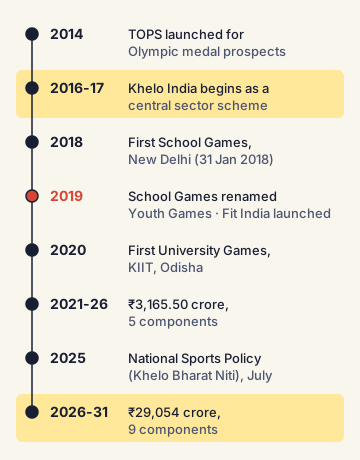
- 2018: The first Khelo India School Games were held in New Delhi, opening on 31 January 2018. From 2019 they were renamed the Khelo India Youth Games.
- 2020: The first Khelo India University Games were held at KIIT in Odisha.
- 2021-22 to 2025-26: The scheme continued for the 15th Finance Commission period with an outlay of ₹3,165.50 crore and five components: sports infrastructure, competitions and talent development, Khelo India Centres and sports academies, the Fit India Movement, and promotion of inclusiveness through sports.
- 2026-27 to 2030-31: The Cabinet approved an expanded Khelo India Scheme along with more money for National Sports Federations, with a combined outlay of ₹36,441 crore. The Khelo India part is reported at ₹29,054 crore, split into nine components.
How does it work? The athlete's pathway
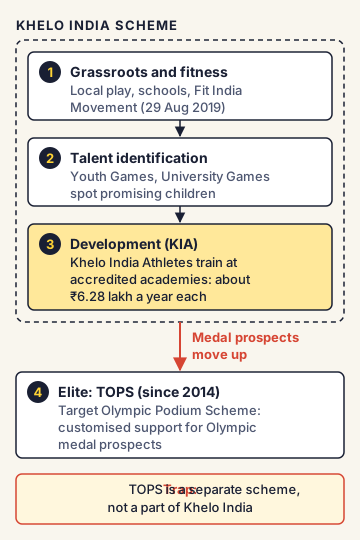
Think of it like a ladder:
- Foundation and grassroots: Children play in local facilities and schools. Fitness is encouraged through the Fit India Movement (launched on 29 August 2019, National Sports Day).
- Talent identification: Scouts and competitions (Youth Games, University Games and others) spot promising children.
- Development: Selected athletes, known as Khelo India Athletes (KIA), train at accredited academies and centres. They have received annual support of about ₹6.28 lakh, of which ₹1.20 lakh is an out-of-pocket allowance paid straight into their bank account, and the rest covers coaching, diet, equipment and sports science.
- Elite level: The best athletes move to the Target Olympic Podium Scheme (TOPS), launched in 2014, which gives customised support to medal prospects.
The nine components for 2026-31
As reported, these are:
- Sports Infrastructure for Medal Strategy (₹4,866 crore)
- Strengthening Strategic Sports Assets
- State Action Plan for Sports Infrastructure Development (₹1,965 crore, of which ₹565 crore is the states' share)
- Sports Competitions and Leagues
- Talent Identification and Development (₹2,407 crore)
- Coach and Support Staff Development (₹748 crore)
- Khelo India Training Facilities (₹10,586 crore), which link government, state and private facilities
- Fit India Movement
- Sports Technology (₹302 crore), including digital systems to track athletes and competitions
India's policy framework around it
In July 2025 the Union Cabinet approved the National Sports Policy 2025, also called Khelo Bharat Niti. It replaces the 2001 policy and rests on five pillars: excellence on the global stage, sports for economic development, sports for social development, sports as a people's movement, and integration with education (NEP 2020). Its long-term goal is to make India one of the top five sporting nations by 2047.
The "sports for economic development" pillar is where the sports goods industry comes in. India will host the 2030 Commonwealth Games in Ahmedabad (awarded in November 2025) and has submitted a letter of intent to host the 2036 Olympics.
Commonly confused concepts
- Khelo India vs TOPS: Khelo India is broad and covers grassroots to development. TOPS is a narrow scheme for elite athletes who could win medals at the Olympics and similar events.
- Khelo India vs Fit India: Fit India is about everyday fitness for all citizens. It is now one component within the wider Khelo India Scheme.
- Khelo India Youth Games vs University Games: Youth Games are for school-age athletes (under 18 categories); University Games are for college and university students.
- Central sector scheme vs Centrally Sponsored Scheme: A central sector scheme is fully paid and run by the Centre. A Centrally Sponsored Scheme is run by states with costs shared. Khelo India is a central sector scheme, though some parts (like the State Action Plan) involve state contributions.
- Khelo India Scheme vs Khelo India Sports Goods Manufacturing Scheme: The first builds athletes and facilities. The second supports the industry that makes balls, bats, shoes and equipment. It was announced in the Union Budget 2026-27 and approved by the Union Cabinet on 28 October 2026. Its outlay is ₹1,856.67 crore for the period up to 2033-34. It will set up special Sports Goods Manufacturing Zones, which are industrial areas where many makers work side by side. About ₹1,130 crore goes to support for big anchor investors and to rewards linked to sales, and ₹105 crore helps makers get certificates from international sports federations.
Issues, criticism and the way forward
- Uneven spread: Facilities and funds have often gone more to some states than others. Critics want more balanced coverage, especially in rural and tribal areas.
- Infrastructure without use: Some stadiums are built but poorly maintained or underused because of a lack of coaches and staff.
- Coaching shortage: India has too few certified coaches and sports science experts. The new coach development component tries to address this.
- Governance of federations: Disputes and poor governance in some National Sports Federations have hurt athletes.
- Way forward: link sports with school education, keep facilities open to the community, train more coaches, use data to track athletes, and build a domestic sports goods industry so that good equipment is affordable.
Concepts to Know
- National Sports Federation (NSF): The body that manages one sport in India (for example, the federation for athletics or wrestling). It selects national teams and organises national championships.
- Sports science: The use of physiology, nutrition, psychology and biomechanics to help athletes train better and avoid injury.
- Talent identification: A system of tests and competitions to find children with natural ability in a sport at an early age.
- Outlay: The total money a government sets aside for a scheme over a period.
- Anchor investor: A large company that sets up first in a new industrial area. Its presence pulls smaller suppliers and makers to come and work around it.
- Ministry: Youth Affairs and Sports; introduced in 2016-17 as a central sector scheme
- 2021-22 to 2025-26 outlay: ₹3,165.50 crore (five components)
- 2026-27 to 2030-31: combined outlay ₹36,441 crore with assistance to NSFs; Khelo India part ₹29,054 crore, nine components
- First Khelo India School Games: New Delhi, January 2018; renamed Khelo India Youth Games from 2019
- Fit India Movement: 29 August 2019; TOPS: 2014; SAI: 1984
- Sports: Entry 33, State List
- National Sports Policy 2025 (Khelo Bharat Niti): approved July 2025; five pillars; top-five sporting nation by 2047
- Khelo India Sports Goods Manufacturing Scheme: approved 28 October 2026; ₹1,856.67 crore up to 2033-34; Sports Goods Manufacturing Zones
- 30 Oct 2026Added the Khelo India Sports Goods Manufacturing Scheme approved on 28 October 2026: ₹1,856.67 crore up to 2033-34, with manufacturing zones.
● Tracked since October 28, 2026 · last seen October 28, 2026 · updates as the daily brief publishes