Container Manufacturing Promotion Scheme (CMPS)
The Container Manufacturing Promotion Scheme is a central government scheme to help companies make shipping containers in India. Shipping containers are the large steel boxes in which most of the world's goods travel by sea. Today almost all of them are made in China, so India depends on imports for a basic tool of its own trade. The scheme gives money support to Indian factories so they can make these boxes at a competitive cost.
Why does India need it?
A container is like a suitcase for trade. Every exporter in Tiruppur or importer in Mumbai needs one to move goods. When the world runs short of containers, freight costs jump and goods get stuck. This happened during the COVID-19 period, when Indian exporters struggled to find empty containers. China's container industry, according to its industry association, makes about 96% of the world's containers.
If supply from one country is disrupted, India's trade suffers. Making containers at home gives India supply security, saves foreign exchange, and creates jobs in steel, paint, wood and component industries.
Why are Indian makers weak today?
Chinese factories are very large and have their steel, parts and testing facilities close by. This lets them make each container cheaply. Indian makers have small factories, pay more for loans and land, and often need to send containers abroad for some safety tests. So an Indian-made container usually costs more than an imported one. The scheme tries to close this cost gap.
Where did it come from?
The idea grew out of India's long-term maritime plans:
- Maritime Amrit Kaal Vision 2047 (launched in 2023) sets goals for ports, shipping and shipbuilding up to 2047. It projects India's container handling to rise from about 24 million TEUs in 2024 to about 175 million TEUs by 2047.
- In the Union Budget 2026-27 (1 February 2026), the Finance Minister announced ₹10,000 crore for a container manufacturing scheme. It was first described as the Container Manufacturing Assistance Scheme, over five years.
- After appraisal by the ministry, the Union Cabinet approved it on 28 October 2026 as the Container Manufacturing Promotion Scheme, with a longer support period up to FY 2039-40.
How does it work, step by step?
- A company proposes a new factory (greenfield, built from scratch) of at least 1,00,000 TEUs a year, or an expansion of an existing factory (brownfield) of at least 25,000 TEUs a year.
- An Inter-Ministerial Steering Committee, chaired by the Secretary of the Ministry of Ports, Shipping and Waterways, approves guidelines and sanctions support.
- During the first three years, the company builds its plant. It gets interest subvention of 3% a year on eligible term loans, which lowers its borrowing cost.
- For the next ten years, the company gets operational expenditure support for each eligible container it makes to global shipping standards and sells.
- Containers must meet a rising domestic content rule, going from 70% to 90%. This pushes companies to buy steel and parts in India, not just assemble imported kits.
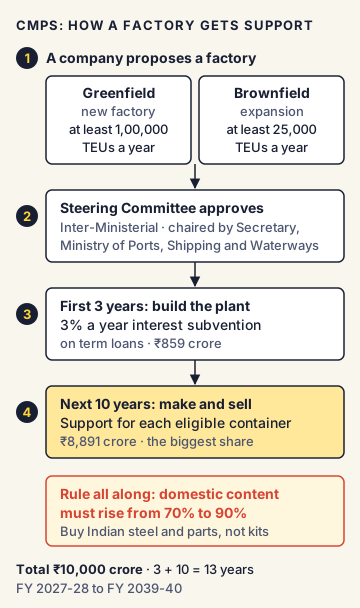
The key parts and facts
The ₹10,000 crore outlay is split into four parts:
| Component | Amount | What it does |
|---|---|---|
| Operational expenditure assistance | ₹8,891 crore | Support for each eligible container produced and sold |
| Interest subvention | ₹859 crore | 3% a year interest support on eligible term loans |
| Common testing and certification facilities | ₹150 crore | Testing labs in India, so containers need not be tested abroad |
| Administration, monitoring and capacity building | ₹100 crore | Running and checking the scheme |
Other features:
- Land support: land at major ports leased at 25% of the notified rate.
- Jobs: about 3,000 direct jobs and more than 50,000 indirect jobs, mostly in steel, components, transport and logistics.
- Output: the government estimates about ₹75,000 crore of economic output by FY 2039-40.
- Supplier industries: corner castings (the strong metal blocks at each corner used for lifting and locking), special steel, wooden floors, and industrial paints.
India's position and Indian examples
The scheme fits into a wider push to build India's maritime economy:
- Sagarmala Programme for port-led development.
- Shipbuilding Financial Assistance Policy and the 2025 shipbuilding package for Indian shipyards.
- New deep-water ports such as Vadhavan Port in Palghar, Maharashtra, and the planned transshipment port at Galathea Bay in Great Nicobar, which will handle many more containers.
- A proposed Indian container shipping line is expected to be one buyer of Indian-made containers.
Commonly confused concepts
- CMPS vs PLI (Production Linked Incentive) Scheme: Both reward production. PLI pays a percentage of extra sales above a base year in 14 sectors. CMPS is a separate, sector-specific scheme for containers that combines per-container support, interest subvention and testing facilities.
- CMPS vs shipbuilding schemes: Shipbuilding schemes support building ships. CMPS supports making the boxes that ships carry.
- Greenfield vs brownfield: Greenfield means a completely new factory on new land. Brownfield means expanding or upgrading an existing factory.
- Container capacity vs container traffic: Capacity (in this scheme) is how many containers India can make in a year. Traffic is how many containers India's ports handle in a year. Both are measured in TEUs, but they are different numbers.
- Interest subvention vs capital subsidy: Interest subvention reduces the interest on a loan. A capital subsidy directly pays part of the cost of a machine or building.
Issues, criticism and the way forward
- Cost gap: Chinese makers have huge scale. Experts note that support for 13 years may still not fully close the price gap unless Indian steel and parts become cheaper.
- Demand risk: Shipping lines buy containers when trade is booming and stop when it slows. Indian factories could face idle periods in a downturn.
- Steel quality and supply: Containers need special corrosion-resistant steel. Domestic supply of this steel at the right price is essential for the 90% domestic content target.
- Projections, not results: The capacity and job numbers are targets. Their success depends on how quickly guidelines are issued and factories are set up.
- Way forward: Suggestions include long-term purchase deals with Indian shipping lines and ports, quick setting up of testing labs, cheaper steel supply, and clustering factories near ports to cut transport costs.
Concepts to Know
- TEU (twenty-foot equivalent unit): The standard way to count containers. One 20-foot container = 1 TEU; one 40-foot container = 2 TEUs.
- Interest subvention: The government pays part of the interest on a loan, so the borrower pays a lower rate. If a loan carries 10% interest and the subvention is 3%, the company effectively pays 7%.
- Domestic content (local value addition): The share of a product's value that comes from materials and work done inside India.
- Outlay: The total money the government has set aside for a scheme over its full period.
- Term loan: A loan for a fixed period, usually to buy land, buildings or machines, repaid in instalments.
- Approved by Union Cabinet: 28 October 2026; announced in Union Budget 2026-27
- Nodal ministry: Ministry of Ports, Shipping and Waterways
- Outlay: ₹10,000 crore; period FY 2027-28 to FY 2039-40 (3 years setting up + 10 years production support)
- Components: ₹8,891 crore operational support; ₹859 crore interest subvention (3% a year); ₹150 crore testing; ₹100 crore administration
- Eligibility: greenfield at least 1,00,000 TEUs a year; brownfield at least 25,000 TEUs a year
- Capacity: about 70,000 TEUs → 7.5 lakh TEUs a year; domestic content 70% → 90%
- Jobs: about 3,000 direct, 50,000+ indirect; land at major ports at 25% of notified rate
- China makes about 96% of the world's containers (industry estimate)
● Tracked since October 28, 2026 · last seen October 28, 2026 · updates as the daily brief publishes