IndiaAI Mission
India's National AI Programme
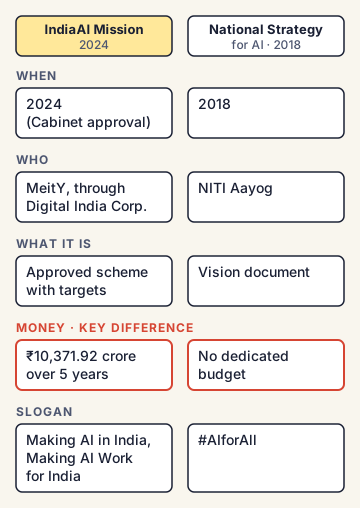
The IndiaAI Mission is the Government of India's main programme to build a complete AI system inside the country: computing power, data, home-grown AI models, skilled people, start-ups and safety tools. The Union Cabinet approved it in March 2024 with a budget of ₹10,371.92 crore for five years. Its vision is "Making AI in India and Making AI Work for India".
In simple words, the mission wants India to build its own AI and use it to solve Indian problems in farming, health, education and governance.
Why does India need it?
Building modern AI needs three costly things: powerful computer chips (GPUs), huge amounts of data, and highly trained people. In 2023, most of these were controlled by a few large foreign companies, and Indian start-ups and researchers could not afford them. Popular AI models also worked poorly in Indian languages. Without its own capacity, India would depend fully on foreign AI for sensitive uses like government services and defence.
The mission aims to fix this by making these resources cheap and widely available, a bit like how the government built Aadhaar and UPI as shared public platforms.
Where did it come from?
- 2018: NITI Aayog released the National Strategy for Artificial Intelligence, with the slogan #AIforAll. It named five focus sectors: healthcare, agriculture, education, smart cities and smart mobility.
- 2023: The government set up three Centres of Excellence (CoEs) for AI in healthcare, agriculture and sustainable cities.
- March 2024: The Cabinet approved the IndiaAI Mission.
- 2025: The mission's GPU pool, dataset platform and foundation model selections were launched; Budget 2025 announced a fourth CoE for education.
- February 2026: India hosted the AI Impact Summit at Bharat Mandapam, New Delhi (core summit 19 to 20 February). It ended with the non-binding New Delhi Declaration on AI Impact, signed by close to 90 countries and organisations. The government also spoke of an "AI Mission 2.0" focused on research, innovation and spreading AI use, and announced plans to add about 20,000 more GPUs.
Who runs it?
The mission is implemented by the IndiaAI Independent Business Division (IBD) under the Digital India Corporation (DIC), which comes under MeitY.
The seven pillars (with the approved budget)
- IndiaAI Compute Capacity (₹4,563.36 crore): A shared pool of high-end GPUs for start-ups, researchers and students, built through public-private partnership. The original goal was 10,000+ GPUs; by late 2025 more than 38,000 GPUs were onboarded, offered at a subsidised rate of about ₹65 per GPU-hour.
- IndiaAI Innovation Centre / Foundation Models (₹1,971.37 crore): Funding to build India's own large AI models trained on Indian data and languages. Twelve teams were selected in the first two phases, including Sarvam AI, Soket AI, Gnani.ai, Gan AI and the IIT Bombay-led BharatGen consortium. At the February 2026 summit, Sarvam launched 30-billion and 105-billion parameter models, and BharatGen launched Param-2, a 17-billion parameter multilingual model.
- IndiaAI Datasets Platform, AIKosh (₹199.55 crore): A single platform for high-quality, non-personal datasets from government and other sources. By December 2025 it hosted over 5,500 datasets and 251 AI models across 20 sectors.
- IndiaAI Application Development Initiative (₹689.05 crore): Support for AI solutions to Indian problems in health, agriculture, climate, governance and learning tools, often through hackathons with ministries.
- IndiaAI FutureSkills (₹882.94 crore): Fellowships for 500 PhD, 5,000 postgraduate and 8,000 undergraduate students, and Data and AI Labs in Tier 2 and Tier 3 cities, many set up with NIELIT (National Institute of Electronics and Information Technology).
- IndiaAI Startup Financing (₹1,942.5 crore): Funding for AI start-ups at different stages. For example, the IndiaAI Startups Global programme (March 2025) helps 10 Indian start-ups enter the European market with Station F and HEC Paris.
- Safe and Trusted AI (₹20.46 crore): Projects on removing bias, protecting privacy, explaining AI decisions, deepfake detection and AI auditing. The IndiaAI Safety Institute was announced under this pillar in January 2025.
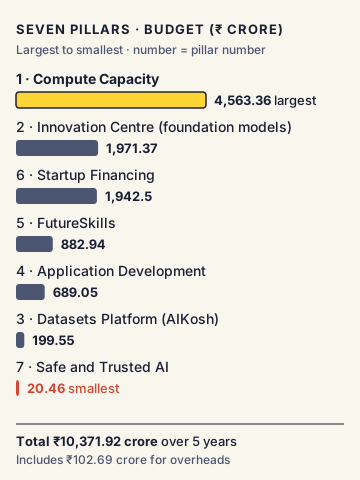
About ₹102.69 crore (1%) is kept for overheads and contingencies, bringing the total to ₹10,371.92 crore.
How does the compute pillar work, step by step?
The government does not buy and run all the chips itself. Instead:
- It invites private cloud companies to offer GPU capacity through an open tender.
- Selected companies (empanelled providers) put their GPUs into the IndiaAI pool.
- A start-up, university or researcher applies on the IndiaAI portal.
- The user pays a low subsidised price; the government pays part of the cost to the provider.
Think of it like a government-run "ration shop" for computing power: costly goods bought in bulk and sold cheaply to those who need them.
Homegrown GPUs
Today, almost all advanced AI chips are designed by a few foreign companies and made in a few places such as Taiwan. The government has said India aims to design its own GPU within a few years, building on the India Semiconductor Mission (launched in December 2021) that supports chip factories, assembly and testing plants, and chip design. The news roadmap for homegrown GPUs is part of this push for "sovereign AI": AI capacity that a country controls itself.
Commonly confused concepts
- IndiaAI Mission vs India AI Governance Guidelines: The mission is a funding and building programme (chips, data, models, skills). The guidelines are a rulebook on how AI should be used safely. The mission's Safe and Trusted AI pillar links the two.
- IndiaAI Mission vs National Strategy for AI (2018): The 2018 NITI Aayog strategy was a vision document with no dedicated budget. The 2024 mission is an approved scheme with money and targets.
- IndiaAI Mission vs India Semiconductor Mission: The Semiconductor Mission supports making chips (fabs, assembly, design). The IndiaAI Mission supports using chips for AI, by giving access to compute and funding models.
- GPU vs CPU: A CPU (Central Processing Unit) is the general "brain" of a computer that does tasks one after another very fast. A GPU does thousands of small calculations at the same time, which is exactly what training AI needs.
- Bhashini vs BharatGen: Bhashini (launched 2022) is a MeitY platform for translation and speech tools in Indian languages. BharatGen is a government-funded project building large multilingual foundation models.
Issues, criticism and the way forward
- Slow spending: Reports based on parliamentary replies show that only about ₹400 crore of the ₹10,372 crore had been released by February 2026. Critics say slow fund flow could delay results.
- Small scale compared with global players: Single US or Chinese companies spend many times India's total mission budget every year on AI chips and data centres.
- Dependence on imported chips: Even the 38,000 GPUs in the pool are imported. Global export controls on advanced chips can limit supply.
- Data quality and privacy: Good Indian-language data is scarce, and datasets must respect the Digital Personal Data Protection Act, 2023.
- Transparency: Experts have asked for clearer rules on how start-up funds and foundation model grants are chosen.
- Energy and water: Large data centres need a lot of electricity and water for cooling.
- Way forward: Experts suggest faster release of funds, long-term support for chip design, open Indian-language datasets, stronger links between universities and industry, and building safety testing capacity alongside growth.
Concepts to Know
- Artificial Intelligence (AI): The ability of computer systems to do tasks that normally need human intelligence, such as understanding language, recognising images or making decisions.
- GPU (Graphics Processing Unit): A computer chip first made for video games and graphics. It can do many calculations at once, so it is now the main chip used to train and run AI.
- Foundation model / Large Language Model (LLM): A very large AI model trained on huge amounts of text, images or speech that can then be adapted for many tasks, such as chatbots, translation and summarising. ChatGPT is built on such models.
- Parameters: The internal "settings" an AI model learns during training. More parameters usually means a bigger, more capable model; "30 billion parameters" means 30 billion such settings.
- Sovereign AI: A country's ability to build and run important AI systems using its own chips, data, models and infrastructure, without depending fully on foreign companies.
- Public-private partnership (PPP): A project in which the government and private companies share the cost, work and risk.
- Approved by the Union Cabinet in March 2024; outlay ₹10,371.92 crore over five years.
- Implemented by the IndiaAI Independent Business Division under Digital India Corporation, MeitY.
- Vision: "Making AI in India and Making AI Work for India".
- Seven pillars: Compute Capacity (largest, ₹4,563.36 crore), Innovation Centre/Foundation Models, Datasets Platform (AIKosh), Application Development, FutureSkills, Startup Financing, Safe and Trusted AI (smallest, ₹20.46 crore).
- More than 38,000 GPUs onboarded, at about ₹65 per GPU-hour (as of December 2025).
- AIKosh: 5,500+ datasets and 251 models across 20 sectors (as of December 2025).
- FutureSkills fellowships: 500 PhD, 5,000 postgraduate, 8,000 undergraduate.
- IndiaAI Safety Institute announced January 2025.
- AI Impact Summit: Bharat Mandapam, New Delhi, February 2026; New Delhi Declaration on AI Impact adopted.
● Tracked since February 07, 2026 · last seen October 11, 2026 · updates as the daily brief publishes
Plus 9 earlier mentions since February 07, 2026.