India-Canada Relations
History, Rupture and Reset
Updated 15 Oct 2026: Added the 2025 total trade figure (CAD 30.4 billion), the August 2025 envoy appointments and details of the 2015 Cameco uranium deal.
India and Canada are both democracies, members of the Commonwealth and the G20, and share deep people-to-people ties through one of the largest Indian diasporas in the world. Their relationship has seen long periods of friendship and sharp breakdowns. The two biggest strains came from the 1974 nuclear test and, much later, from disputes over Khalistani extremism in Canada. Since 2025, both countries have been rebuilding ties with a focus on trade, energy and education.
Why does this relationship matter?
For India, Canada is a source of key resources: uranium for nuclear power, potash for fertilisers, pulses, and critical minerals. Canadian pension funds are among the largest foreign investors in Indian infrastructure. Canada is home to about 1.8 million Indo-Canadians and about 1 million non-resident Indians, and Indian students are the largest group of international students there. For Canada, India is a fast-growing market and a partner as it tries to diversify its trade away from heavy dependence on the United States.
Where did it come from?
Here is the story in simple stages:
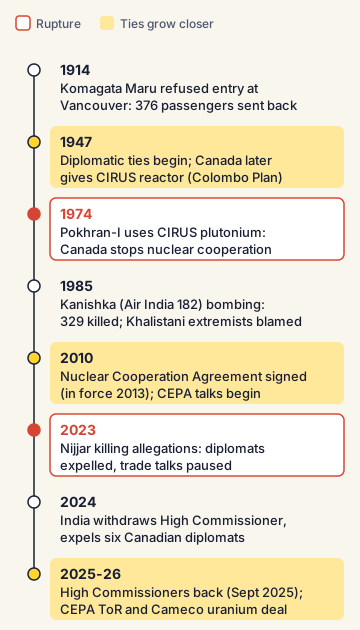
- Early migration and Komagata Maru (1914): Punjabi Sikhs were among the first Indians to settle in Canada in the early 1900s. In 1914, the ship Komagata Maru, carrying 376 passengers from British India, was refused entry at Vancouver under racist immigration rules and forced to return. Many passengers were killed or arrested when it reached Budge Budge near Calcutta. Canada's Prime Minister formally apologised in Parliament in 2016.
- Diplomatic ties (1947) and nuclear help: Diplomatic relations began in 1947. In the 1950s, under the Colombo Plan (a development aid scheme for Asian countries), Canada gave India the CIRUS research reactor, which started working in 1960.
- The 1974 rupture: India's first nuclear test at Pokhran in May 1974 used plutonium produced in the CIRUS reactor. Canada felt its peaceful aid had been misused and stopped nuclear cooperation with India. Ties stayed cool for decades.
- The Kanishka bombing (1985): On 23 June 1985, Air India Flight 182 (Kanishka), flying from Montreal to London, was destroyed by a bomb over the Atlantic Ocean off Ireland. All 329 people on board were killed, most of them Canadian citizens of Indian origin. Khalistani extremists based in Canada were blamed. It remains the deadliest terror attack in Canada's history.
- Warming (2010-2018): A Nuclear Cooperation Agreement was signed in June 2010 and came into force in September 2013. In April 2015, India's Department of Atomic Energy signed a deal with the Canadian company Cameco to buy about 7.1 million pounds of uranium for 2015-2020, worth about C$350 million. CEPA talks also began in 2010, though they moved slowly and stalled in 2017. Earlier, in June 2007, the two sides had finished talks on a FIPA (Foreign Investment Promotion and Protection Agreement), a deal to protect each other's investors. It was never signed, because India later stopped signing investment deals that let foreign companies take a government to international arbitration (a private court outside the country).
- The 2023-24 breakdown: On 18 September 2023, Canada's then Prime Minister told the Canadian Parliament that there were "credible allegations" linking Indian government agents to the killing of Hardeep Singh Nijjar, a Khalistan supporter shot dead in Surrey, British Columbia in June 2023. India rejected the claims as absurd. Both sides expelled diplomats, and India suspended visas for Canadians for some weeks. The trade talks had already stopped: Canada paused them on 1 September 2023, a few weeks before the allegations were made public. (These talks had restarted in March 2022, aiming first for a smaller interim deal, the EPTA.) In October 2024, ties hit a new low: India withdrew its High Commissioner and other diplomats, and expelled six Canadian diplomats.
- The reset (2025-26): After a new Canadian government took office in 2025, the Indian Prime Minister attended the G7 Summit at Kananaskis in June 2025. The two sides agreed to return their High Commissioners. Both countries named their new High Commissioners on 28 August 2025, and they took up their posts from September 2025. At the G20 Summit in Johannesburg on 23 November 2025, the leaders agreed to launch CEPA talks and welcomed the Australia-Canada-India Technology and Innovation (ACITI) Partnership. In March 2026, the Canadian Prime Minister visited India, the first bilateral visit by a Canadian Prime Minister since 2018. The two sides set up a Strategic Energy Partnership, signed the CEPA Terms of Reference, relaunched talks on a modern investment chapter (rules to protect each other's investors), and Cameco signed a uranium supply deal worth about C$2.6 billion. Under it, Cameco will supply nearly 22 million pounds of uranium ore concentrate (the processed powder form of uranium used to make reactor fuel) to India's Department of Atomic Energy from 2027 to 2035. The leaders also set a goal of CAD 70 billion in two-way trade by 2030, and aimed to finish the CEPA talks by the end of 2026. They signed MoUs (Memorandums of Understanding, or written promises to cooperate) on critical minerals and clean energy. Formal CEPA rounds followed. As of October 2026, the fourth round ended in New Delhi on 18 September 2026, and the fifth round was held in Ottawa from 5 to 9 October 2026. Business ties grew too: in May 2026, India's Commerce and Industry Minister led India's largest-ever trade delegation to Canada, and in October 2026, Canada's trade minister led nearly 300 business delegates to Mumbai and Bengaluru, Canada's largest trade mission to India in over 30 years.
How does the relationship work today?
The two countries cooperate through several channels:
- Ministerial dialogues on strategic issues, trade and energy, plus Foreign Office Consultations.
- Security: a Joint Working Group on Counter Terrorism (set up in 1997) and a 2018 framework on countering terrorism and violent extremism. There is also an Extradition Treaty (1987) and a Mutual Legal Assistance Treaty (1994).
- Nuclear and energy: the 2010 Nuclear Cooperation Agreement, uranium supplies, and cooperation on LNG, LPG, hydrogen and solar.
- Science and space: ISRO and the Canadian Space Agency have signed several agreements, and ISRO has launched Canadian satellites.
- Education and people: About 3.93 lakh Indian students were studying in Canada as of 31 December 2024.
The key economic facts
- Total trade (Canadian government, 2025): two-way trade in goods and services was about CAD 30.4 billion in 2025. The CAD 70 billion target for 2030 is more than double this.
- Goods trade (Canadian data, 2025): about CAD 13.6 billion (India's exports CAD 9.7 billion, imports CAD 3.9 billion), up from about CAD 13.32 billion in 2024.
- Goods trade (Indian data, 2025-26): India counts trade in its own way, so its figures differ from Canada's. India's data shows goods trade of about US$7.95 billion in 2025-26, down from about US$8.66 billion in 2024-25. India's exports rose to about US$4.67 billion, while its imports fell to about US$3.28 billion.
- Services trade (Canadian data, 2025): about CAD 19.7 billion (CAD 19.61 billion in 2024), with India importing more services than it exports (mainly education services, as Indian students pay fees in Canada). India was Canada's second-largest market for services exports in 2024.
- What India sells and buys: India mainly sells medicines, electronic and engineering goods, car parts, gems and jewellery, seafood and garments to Canada. It mainly buys pulses (mostly lentils), potash for fertilisers, coal, paper and wood pulp, and minerals. Canada supplies about a quarter of India's potash.
- Trade target: As of March 2026, the two countries aim for CAD 70 billion (about ₹4.65 lakh crore, or about US$50 billion) in two-way trade by 2030.
- Investment: Canadian portfolio investment in India is over CAD 100 billion, much of it from large pension funds. Over 600 Canadian companies have a presence in India.
India's position on the irritants
India's main concern is that Canada has allowed pro-Khalistan extremist groups to operate freely, holding so-called referendums and threatening Indian diplomats, in the name of free speech. India has repeatedly asked Canada to act against people it calls terrorists and to respond to extradition requests. India has rejected all Canadian allegations about involvement in violence on Canadian soil. Canada's position has been that it must protect the rights and safety of its citizens and that the law must take its course.
Commonly confused concepts
- CEPA vs EPTA: The EPTA (Early Progress Trade Agreement) was meant to be a small interim deal covering a few items to deliver quick gains. The CEPA is the full, comprehensive deal.
- Indo-Canadian vs NRI: An Indo-Canadian is a Canadian citizen of Indian origin. An NRI is an Indian citizen living abroad.
- High Commission vs Embassy: Commonwealth countries call their missions in each other's capitals High Commissions and their heads High Commissioners. With non-Commonwealth countries, the mission is an Embassy headed by an Ambassador.
- CIRUS vs Pokhran-II: CIRUS was the Canadian-supplied reactor linked to the 1974 test (Pokhran-I, "Smiling Buddha"). Pokhran-II was a separate series of tests in 1998.
- ACITI vs the Quad: ACITI is a technology and innovation partnership of Australia, Canada and India. The Quad is a strategic grouping of India, the US, Japan and Australia.
Issues, criticism and the way forward
- Extremism and security: Unless both sides find a working arrangement on extremism, intelligence sharing and law enforcement, ties may break again over a single incident.
- Diaspora politics: Diaspora politics in Canada can pull foreign policy in different directions.
- Students and migration: Canada's recent caps on study permits and concerns over student welfare (housing, jobs, fraud by agents) affect a key part of the relationship.
- Trade deal hurdles: Issues in the CEPA include India's sensitivity on dairy and agriculture, Canada's interest in market access for pulses and other farm goods, and India's interest in easier visas for professionals.
- Opportunities: Critical minerals, uranium, LNG, clean energy, artificial intelligence and education are areas where the two economies fit well together.
- Way forward: Experts suggest keeping trade and security talks moving on separate tracks so that political tensions do not freeze economic ties, strengthening law-enforcement cooperation, and concluding the CEPA to give the relationship a stable base.
Concepts to Know
- Diaspora: People of a country's origin who live in other countries, along with their descendants.
- Portfolio investment: Buying shares, bonds or other financial assets in another country, without taking control of companies. It differs from FDI (foreign direct investment), where the investor takes a lasting, controlling interest.
- Colombo Plan: A scheme started in 1951 for richer countries to give development aid and technical help to countries in South and South-East Asia.
- Khalistan movement: A separatist movement demanding a separate Sikh state carved out of Indian Punjab. India treats violent groups linked to it as terrorist organisations.
- Extradition: Handing over a person accused or convicted of a crime by one country to another country for trial or punishment.
- Terms of Reference (ToR): A document that sets out the scope, subjects and method of a negotiation before the actual talks start.
- Diplomatic relations: 1947; both are Commonwealth and G20 members
- Komagata Maru: 1914 (Vancouver); Canadian apology in Parliament: 2016
- CIRUS reactor (Canadian, Colombo Plan) linked to Pokhran-I, May 1974; Canada stopped nuclear cooperation
- Kanishka (Air India 182) bombing: 23 June 1985; 329 killed
- Nuclear Cooperation Agreement: signed June 2010, in force September 2013; Cameco uranium deals in 2015 (about 7.1 million pounds, 2015-2020) and March 2026 (nearly 22 million pounds, about C$2.6 billion, supplies 2027-2035)
- 1 September 2023: Canada paused trade talks; 18 September 2023: allegations over the Nijjar killing; October 2024: diplomats expelled
- High Commissioners named 28 August 2025, in post from September 2025; CEPA talks launched at G20 Johannesburg, November 2025; ToR signed 2 March 2026; fifth CEPA round in Ottawa, 5-9 October 2026; trade target CAD 70 billion (about US$50 billion) by 2030
- Total goods and services trade 2025: about CAD 30.4 billion (Canadian government); goods trade 2025: about CAD 13.6 billion (Canadian data); India's data: about US$7.95 billion in 2025-26; services trade 2025: about CAD 19.7 billion; Canadian portfolio investment in India: over CAD 100 billion
- About 1.8 million Indo-Canadians and about 1 million NRIs; about 3.93 lakh Indian students (31 December 2024)
- 15 Oct 2026Added the 2025 total trade figure (CAD 30.4 billion), the August 2025 envoy appointments and details of the 2015 Cameco uranium deal.
- 14 Oct 2026Updated trade figures to 2025, and added the relaunched investment talks and the 2026 trade missions in both directions.
- 8 Oct 2026Added India's 2025-26 goods trade figure (about US$7.95 billion) and the US$50 billion value of the 2030 trade target.
- 6 Oct 2026Corrected when Canada paused trade talks (1 September 2023), added the unsigned 2007 investment deal and the fifth CEPA round.
- 5 Oct 2026Added the size of the March 2026 Cameco uranium deal and the main goods India sells to and buys from Canada.
● Tracked since February 14, 2026 · last seen October 14, 2026 · updates as the daily brief publishes
Plus 13 earlier mentions since February 14, 2026.