Consumer Price Index (CPI)
How India Measures Retail Inflation
Updated 13 Oct 2026: Added that the 2024 CPI series counts rural house rent for the first time, and that old and new series are not directly comparable.
The Consumer Price Index (CPI) is a number that tracks how the prices of things a normal family buys change over time. These include food, clothes, rent, fuel, transport, medicines, school fees and mobile bills. When people say "retail inflation is 5%", they mean the CPI is 5% higher than it was in the same month last year. In India, the main CPI is prepared every month by the National Statistics Office (NSO) under the Ministry of Statistics and Programme Implementation (MoSPI).
Why do we need a price index?
Prices of thousands of items change every day. Some go up, some go down. No one can follow them all. The CPI combines them into one number, so that the government, the RBI and ordinary people can see whether life is becoming costlier overall. You can think of it as the "average bill" of a typical household, measured month after month.
This number is used for big decisions:
- The RBI uses CPI inflation as its main target for setting interest rates.
- The government uses CPI-based indices to revise dearness allowance (DA) for its employees and pensioners, and to fix minimum wages.
- Economists use it to convert "money" figures into "real" figures, for example real wages or real interest rates.
How is inflation calculated from the CPI?
The CPI itself is an index, not a percentage. In the base year, the index is set at 100. If the index is 106 a year later, prices have risen by about 6%. Inflation is the year-on-year change: this month's index compared with the index for the same month last year.
- Formula: Inflation (%) = (CPI this month − CPI same month last year) ÷ CPI same month last year × 100.
- Example: if the CPI was 105.0 in September 2025 and 110.8 in September 2026, inflation is (110.8 − 105.0) ÷ 105.0 × 100 ≈ 5.5%.
Where did India's CPI come from?
For many years India had only CPIs for specific groups of workers, prepared by the Labour Bureau (Ministry of Labour and Employment):
- CPI-IW (Industrial Workers): current base 2016=100, released from September 2020.
- CPI-AL (Agricultural Labourers) and CPI-RL (Rural Labourers): base revised from 1986-87 to 2019=100, with the new series starting from June 2025.
These covered only certain workers, not the whole population. So in January 2011, MoSPI began releasing a national CPI for Rural, Urban and Combined India, with base year 2010=100. The base was moved to 2012=100 from January 2015. In February 2026, MoSPI moved to a new base of 2024=100, starting with the January 2026 data released on February 12, 2026. The Ministry plans to revise the base every three to five years from now on, depending on when a fresh household spending survey is available.
Why did CPI become the RBI's target?
Earlier, the RBI watched many indicators, and the Wholesale Price Index (WPI) got a lot of attention. In 2013, the RBI set up a committee under Urjit Patel to recommend a single "nominal anchor" (one main number to aim at). Its report in January 2014 recommended CPI-Combined as that anchor, because it reflects prices that people actually pay.
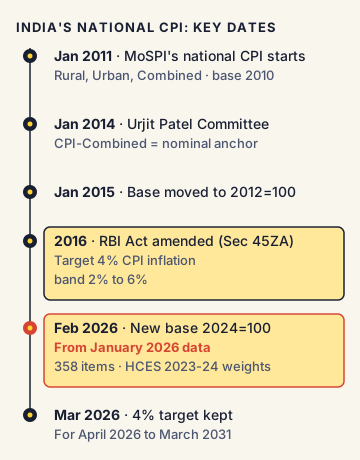
In 2016, Parliament amended the RBI Act, 1934 (Section 45ZA), and India adopted flexible inflation targeting. The target is 4% CPI inflation, with a band of 2% to 6%. In March 2026, the government kept this same target for April 2026 to March 2031.
How is the price data collected?
Field staff of the Field Operations Division of the National Sample Survey (NSS), under MoSPI, collect prices every month. In the 2024 series:
- They visit 1,465 rural markets and 1,395 urban markets spread across 434 towns.
- Prices are also collected from 12 online markets in 12 big towns (population above 25 lakh), every week. Airfares and OTT streaming prices (like Netflix or Amazon Prime Video) are also taken online.
- Some prices come from government records: rail fares from the Ministry of Railways, petrol, diesel, LPG, CNG and PNG prices from the Petroleum Planning and Analysis Cell (PPAC), and postal charges from the Department of Posts.
- Field staff use tablets to record prices (Computer Assisted Personal Interview, CAPI), replacing paper forms.
How are items weighted?
Not every item matters equally. A family spends far more on food than on, say, postage stamps. So each item gets a weight based on how much households actually spend on it. These weights come from the Household Consumption Expenditure Survey (HCES) 2023-24. The 2024 series follows the UN's COICOP 2018 classification (Classification of Individual Consumption According to Purpose). It has 12 divisions and 358 weighted items (308 goods and 50 services), up from 299 items in the 2012 series.
Main weights in the 2024 series (Combined, rounded):
- Food and beverages: 36.75% (rural 41.98%, urban 30.25%)
- Housing, water, electricity, gas and other fuels: 17.67%
- Transport: 8.80%
- Clothing and footwear: 6.38%
- Health: 6.10%
- Paan, tobacco and intoxicants: 2.99%
- Education services: 3.33%
The 2024 series also counts house rent in rural India for the first time. Earlier, house rent was counted only for towns and cities, so the housing costs of village families were left out.
Under the old 2012 grouping, food and beverages had a weight of 45.86%. The food share has fallen because, as incomes rise, families spend a smaller part of their budget on food and more on services. Free items given by the government (such as free ration grains) are not counted, because the CPI only includes things households actually pay for.
To join the old and new series, MoSPI uses a linking factor (0.5267 for the Combined index). Inflation under the 2012 series is available up to December 2025, and under the 2024 series from January 2026. The basket, weights, markets and method all changed, so inflation figures from the two series should not be compared directly.
Headline, food and core inflation
These three terms appear in every inflation news report:
- Headline inflation: the full CPI, with all items. This is what the RBI targets.
- Food inflation (CFPI): price rise for food items alone, measured by the Consumer Food Price Index.
- Core inflation: headline inflation after removing food and fuel, whose prices jump around with weather and world oil prices. Core shows the steady, underlying price trend.
Commonly confused concepts
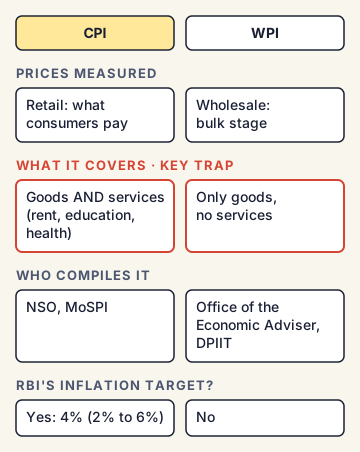
- CPI vs WPI: CPI measures retail prices that consumers pay and includes services (rent, education, health). The Wholesale Price Index (WPI) measures prices at the wholesale (bulk) stage, covers only goods, and is compiled by the Office of the Economic Adviser, Department for Promotion of Industry and Internal Trade (DPIIT). The RBI targets CPI, not WPI.
- CPI (MoSPI) vs CPI-IW/AL/RL (Labour Bureau): MoSPI's CPI covers all households and is used for inflation targeting. Labour Bureau indices cover specific worker groups and are used for DA and wages.
- Disinflation vs deflation: Disinflation means prices are still rising, but more slowly (inflation falls from 6% to 4%). Deflation means prices are actually falling (inflation below 0%).
- Base year vs base effect: The base year is the fixed reference year where the index is 100. The base effect is a different idea: if prices were unusually low in the same month last year, this year's inflation looks high even if prices did not rise much recently, and the other way round.
Issues, criticism and the way forward
- Food dominance: Food still has a large weight, especially in rural India. Food prices swing with rain, heat and supply problems. Interest rate changes cannot fix a poor onion harvest, so the RBI's tools have limited effect on this part of inflation.
- Rural-urban gap: Rural families spend a bigger share on food, so food price shocks hurt them more. This shows up as higher rural inflation.
- Exclusion of free transfers: Leaving out free government supplies follows the international (IMF) manual. Some experts argue it can make measured inflation differ from what poor households actually experience.
- Old weights: When weights are not updated for many years, the index stops matching how people really spend. The 2024 revision and the plan to revise every three to five years aim to fix this.
- Way forward: More online and administrative data, state-level indices released every month, and regular base revisions are expected to make the CPI more accurate and more useful for policy.
Concepts to Know
- Index number: A number that shows change compared with a fixed starting point set at 100. An index of 112 means a 12% rise from the base.
- Base year: The reference year in which the index equals 100. For the current CPI, it is 2024.
- Weight: The importance given to an item in the index, based on the share of household spending on it.
- Household Consumption Expenditure Survey (HCES): A large national survey that records what households spend money on. It tells statisticians how much weight each item should get.
- COICOP: A United Nations system for grouping household spending by purpose (food, health, transport and so on), so that India's CPI can be compared with other countries'.
- Nominal anchor: One clear target number that a central bank aims at, so that people can trust where prices are heading.
- Dearness allowance (DA): An extra payment to government employees and pensioners to make up for rising prices. It is revised using a CPI for workers.
- Compiled by: National Statistics Office (NSO), MoSPI; prices collected by the Field Operations Division of NSS
- Released: every month (around the 12th), for Rural, Urban and Combined India, at all-India and state level
- National CPI (R/U/C) started: January 2011 (base 2010); base 2012 from January 2015; base 2024=100 from January 2026 (released February 12, 2026)
- Weights from HCES 2023-24; COICOP 2018; 12 divisions; 358 weighted items (308 goods, 50 services)
- Coverage: 1,465 rural markets; 1,395 urban markets in 434 towns; 12 online markets in 12 towns
- Food and beverages weight: 36.75% (Combined); under old 2012 grouping it was 45.86%
- Rural house rent counted for the first time in the 2024 series
- Linking factor (Combined): 0.5267
- Labour Bureau indices: CPI-IW base 2016; CPI-AL and CPI-RL base 2019 (from June 2025)
- Urjit Patel Committee report (January 2014): CPI-Combined as nominal anchor
- Inflation target: 4% (band 2% to 6%), Section 45ZA of RBI Act; retained for April 2026 to March 2031
- 13 Oct 2026Added that the 2024 CPI series counts rural house rent for the first time, and that old and new series are not directly comparable.
● Tracked since February 06, 2026 · last seen October 13, 2026 · updates as the daily brief publishes
Plus 9 earlier mentions since February 06, 2026.