Monetary Policy Committee (MPC)
How RBI Sets the Repo Rate
Updated 8 Oct 2026: Explained what the calibrated tightening stance means: no rate cut for now, only a hike or a hold, first used in October 2018.
The Monetary Policy Committee (MPC) is a six-member committee that decides India's main interest rate, the repo rate. When the MPC changes this rate, borrowing across the country slowly becomes cheaper or costlier. Its legal job is to keep inflation (the general rise in prices) close to a target set by the government, while also keeping growth in mind.
Why does India need an MPC?
Think of the economy as a car. If it runs too fast, prices rise quickly and people's savings lose value. If it runs too slowly, businesses stop growing and jobs are lost. The MPC works like a driver with a brake and an accelerator. It brakes by making loans costlier and accelerates by making them cheaper.
Before the MPC, the RBI Governor alone took these decisions, and the RBI was chasing many goals at once. Experts felt that a committee with a clear target would be more transparent, more predictable and less dependent on one person.
Where did it come from?
- 2014: An RBI expert committee led by Urjit Patel (then Deputy Governor) recommended inflation targeting and a committee to set rates.
- 20 February 2015: The government and the RBI signed the Monetary Policy Framework Agreement.
- 2016: The Finance Act, 2016 amended the RBI Act, 1934 and added a new chapter (Chapter IIIF) on monetary policy. Section 45ZB provides for the MPC.
- October 2016: The first MPC met on 3 and 4 October 2016.
What is the inflation target? (Section 45ZA)
The government sets the target once every five years, after talking to the RBI. The target is 4% retail inflation, measured by the Consumer Price Index (CPI). The MPC must keep inflation within a band of 2% (lower limit) to 6% (upper limit). On 25 March 2026, the government kept the same 4% target and 2% to 6% band for 1 April 2026 to 31 March 2031.
What if the RBI misses the target? (Section 45ZN)
The RBI is said to have failed if average CPI inflation stays above 6% or below 2% for three quarters in a row. A quarter is a block of three months. If this happens, the RBI must send a report to the government. The report explains why the target was missed, what the RBI will do to fix it, and how long it expects that to take. This happened for the first time in 2022, when inflation stayed above 6% from January to September 2022.
Who is in the MPC? (Section 45ZB)
- The RBI Governor, who is the chairperson
- The Deputy Governor in charge of monetary policy
- One RBI officer nominated by the RBI's Central Board
- Three outside experts appointed by the Central Government
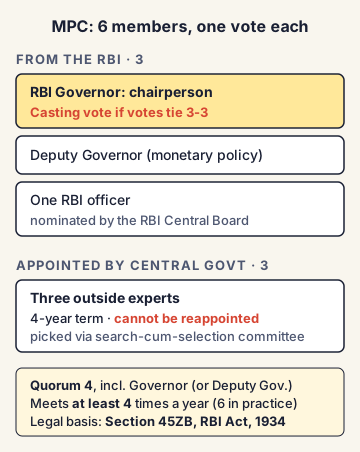
The three outside members are chosen on the advice of a search-cum-selection committee. They hold office for four years and cannot be reappointed.
As of October 2026, the members are Governor Sanjay Malhotra (chair), Deputy Governor Poonam Gupta, RBI officer Indranil Bhattacharyya, and outside members Nagesh Kumar, Ram Singh and Saugata Bhattacharya.
How does a meeting work?
- The MPC must meet at least four times a year; in practice it meets six times a year, about every two months.
- Quorum (minimum members needed): four, including the Governor (or the Deputy Governor in the Governor's absence).
- Each member has one vote. If the votes tie (3-3), the Governor has a second or casting vote.
- The decision is announced in a resolution after the meeting.
- The minutes, including how each member voted and why, are published on the 14th day after the meeting (Section 45ZL).
- Every six months, the RBI publishes a Monetary Policy Report explaining the sources of inflation and its forecasts (Section 45ZM).
What tools does the MPC control?
The MPC itself decides only the policy repo rate. The other rates are set at fixed gaps from it, and the RBI manages the rest.
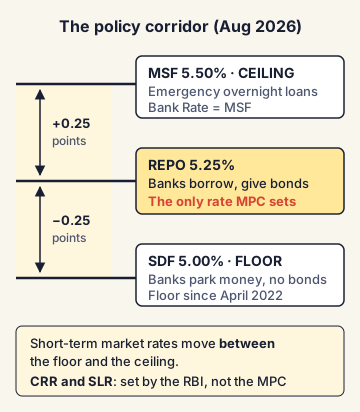
- Repo rate: The rate at which banks borrow short-term money from the RBI by giving government bonds as security. You can think of it as the wholesale price of money for banks.
- Standing Deposit Facility (SDF): The rate at which banks can park extra money with the RBI without the RBI giving bonds in return. Set at repo minus 0.25 percentage points. Since April 2022, it is the floor of the system.
- Marginal Standing Facility (MSF): An emergency window where banks can borrow overnight at repo plus 0.25 percentage points. It is the ceiling. The Bank Rate is kept equal to the MSF rate.
- Together, SDF (floor), repo (middle) and MSF (ceiling) form the policy corridor. Short-term market rates move within it. After the 7 October 2026 meeting: SDF 5.25%, repo 5.50%, MSF and Bank Rate 5.75%.
- Rate hikes in 2022-23: The MPC raised the repo rate six times from May 2022 (an unscheduled meeting) to February 2023. The total rise was 250 basis points, from 4.00% to 6.50%.
- Rate cuts in 2025: The MPC cut the repo rate four times in 2025 (February, April, June and December). The total cut was 125 basis points, from 6.50% to 5.25%.
- Rate hike in October 2026: At its 5 to 7 October 2026 meeting, the MPC raised the repo rate by 25 basis points, from 5.25% to 5.50%. This was its first hike since February 2023.
- Cash Reserve Ratio (CRR) and Statutory Liquidity Ratio (SLR) are set by the RBI, not the MPC.
How does a repo rate change reach you? (Transmission)
- If the RBI raises the repo rate, banks pay more to borrow. They raise loan rates, so your home-loan and car-loan EMIs go up. People and businesses borrow and spend less. Demand cools, and price rise slows.
- If the RBI cuts the rate, the opposite happens: loans get cheaper and spending picks up.
- Since 1 October 2019, banks must link new floating-rate loans to retail borrowers and small businesses to an external benchmark, such as the repo rate. This was done to make transmission faster.
What is the "stance"?
Along with the rate, the MPC announces a stance: a signal of its likely next steps.
- Accommodative: ready to cut rates or keep them low to support growth.
- Neutral: can move either way, depending on data.
- Withdrawal of accommodation / calibrated tightening: focused on controlling inflation; more likely to raise rates. The MPC used "calibrated tightening" in October 2018, and again from October 2026.
- What "calibrated tightening" means: a rate cut is ruled out for now, but the MPC is not bound to raise rates at every meeting. It has only two options: hike or hold. The MPC first used this stance on 5 October 2018, when it moved from neutral while keeping the repo rate at 6.50%.
Members vote separately on the rate and on the stance, so the two votes can differ. In October 2026, all six members voted for the hike, but two of them wanted to keep the stance neutral.
A "hawkish" tone means the MPC sounds worried about inflation. A "dovish" tone means it sounds more focused on growth.
Commonly confused concepts
- Repo vs reverse repo vs SDF: In a repo, the RBI lends to banks against bonds. In a reverse repo, the RBI borrows from banks and gives bonds. The SDF also absorbs money from banks but needs no bonds, and has replaced the reverse repo as the floor since April 2022.
- MSF vs Bank Rate: The MSF is a working overnight window. The Bank Rate is a reference rate used mainly for penalties. Today both are at the same level.
- MPC decides vs RBI decides: The MPC decides only the repo rate (and states the stance). CRR, SLR, open market operations and liquidity operations are decided by the RBI.
- Monetary policy vs fiscal policy: Monetary policy is about money supply and interest rates, run by the RBI. Fiscal policy is about government taxes and spending, run by the government through the Budget.
Issues, criticism and the way forward
- Slow transmission: Banks often take months to pass on rate changes, especially on old loans and fixed deposits.
- Supply-side inflation: Much of India's inflation comes from food and fuel prices, driven by weather, global oil prices or war. Interest rates cannot directly fix a bad monsoon or an oil shock. They can only stop these price rises from spreading to other goods.
- Global spillovers: When other central banks (like the US Federal Reserve) raise rates, money can flow out of India and weaken the rupee. This can force the RBI's hand.
- Independence: Some experts say the government's role in appointing three members could affect the MPC's independence. Others say it brings accountability and wider views.
- Way forward: Suggestions include faster transmission through external benchmarks, clearer forward guidance, and better coordination between monetary and fiscal policy during supply shocks.
Concepts to Know
- Inflation: A general rise in prices over time. If inflation is 5%, something that cost ₹100 last year costs about ₹105 now.
- Consumer Price Index (CPI): A measure of how the prices of things a family buys (food, fuel, clothes, rent and so on) change over time. India's inflation target uses CPI.
- Basis point: One-hundredth of a percentage point. 25 basis points = 0.25%.
- Liquidity: How much ready money banks have to lend. "Surplus liquidity" means banks have more spare money than they need.
- Government securities (bonds): Papers the government sells to borrow money. Banks hold them because they are very safe.
- Floating-rate loan: A loan whose interest rate goes up or down with a benchmark rate, so the EMI can change.
- EMI: Equated Monthly Instalment, the fixed monthly payment on a loan.
- MPC set up under Section 45ZB, RBI Act, 1934, as amended by the Finance Act, 2016
- Inflation target (Section 45ZA): 4% CPI, band 2% to 6%; kept on 25 March 2026 for April 2026 to March 2031
- Urjit Patel Committee (2014); Monetary Policy Framework Agreement signed 20 February 2015; first MPC meeting 3-4 October 2016
- 6 members: 3 from RBI (Governor as chair) + 3 appointed by the Central Government for 4 years, no reappointment
- Quorum 4; one vote each; Governor has a casting vote in a tie
- At least 4 meetings a year by law; 6 in practice
- Failure (Section 45ZN): average inflation above 6% or below 2% for three quarters in a row; RBI must report to the government (first time in 2022)
- Minutes published on the 14th day (Section 45ZL); Monetary Policy Report every 6 months (Section 45ZM)
- SDF = repo − 0.25%; MSF = repo + 0.25%; Bank Rate = MSF; SDF introduced April 2022
- External benchmark for new floating retail and MSE loans since 1 October 2019
- 2022-23: six hikes, 250 basis points in all (May 2022 to February 2023, 4.00% to 6.50%)
- 2025: four cuts, 125 basis points in all (6.50% to 5.25%, last cut December 2025)
- 7 October 2026: repo raised by 25 basis points to 5.50% (first hike since February 2023); stance changed from neutral to calibrated tightening
- After the October 2026 meeting: repo 5.50%, SDF 5.25%, MSF and Bank Rate 5.75%
- 8 Oct 2026Explained what the calibrated tightening stance means: no rate cut for now, only a hike or a hold, first used in October 2018.
- 7 Oct 2026Added the October 2026 repo rate hike to 5.50%, the new policy corridor, the calibrated tightening stance and current MPC members.
- 6 Oct 2026Added the Section 45ZN rule on when the RBI has failed its inflation target, and the 2022-23 rate hike cycle.
- 5 Oct 2026Added India's inflation target (4%, band 2% to 6%), kept for 2026 to 2031, and the 125 basis points of repo cuts in 2025.
● Tracked since February 06, 2026 · last seen October 15, 2026 · updates as the daily brief publishes
Plus 45 earlier mentions since February 06, 2026.