Liquidity Adjustment Facility (LAF)
The RBI's Interest Rate Corridor
The Liquidity Adjustment Facility, or LAF, is the set of daily tools the RBI uses to add money to the banking system or take extra money out of it. Banks need cash every day to meet withdrawals and make payments. Some days they have too little, some days too much. Through the LAF, the RBI lends to banks that are short of money and takes deposits from banks that have extra money, at rates linked to the repo rate. This keeps short-term interest rates in the market close to the repo rate that the MPC has decided.
Why does it exist?
The MPC only announces one number: the repo rate. But banks actually lend to each other overnight in the money market at whatever rate supply and demand decide. If there is too much money in the system, this rate falls far below the repo rate. If there is too little, it shoots above it. Either way, the MPC's decision would not reach the real economy.
The LAF is the RBI's way of making sure the rate the MPC chooses is the rate that actually works in the market. You can think of the repo rate as the speed limit the MPC sets, and the LAF as the traffic police who keep cars close to it.
Where did it come from?
Before 2000, the RBI relied more on blunt tools such as changing the Cash Reserve Ratio (CRR). The Narasimham Committee on banking sector reforms (1998) recommended a more market-based system. After an interim step in April 1999, the LAF was introduced in stages from June 2000. Over time, it was reshaped many times:
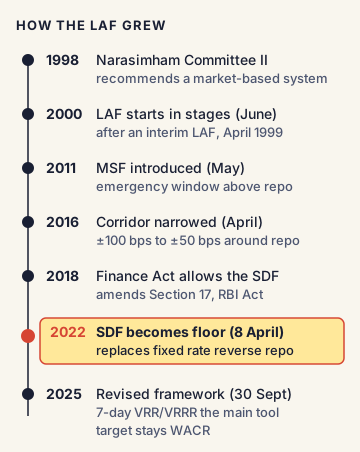
- May 2011: the Marginal Standing Facility (MSF) was introduced as an emergency borrowing window above the repo rate.
- 2013 onwards: term repos and variable rate auctions were added, so that the RBI could lend or absorb money for different periods at market-decided rates.
- 2014: the Urjit Patel Committee recommended a Standing Deposit Facility (SDF). The Finance Act, 2018 amended Section 17 of the RBI Act to allow it.
- April 2016: the corridor was narrowed from plus or minus 100 basis points to plus or minus 50 basis points around the repo rate, so that market rates stay closer to the policy rate.
- 8 April 2022: the SDF was started at 25 basis points below the repo rate and replaced the fixed rate reverse repo as the floor of the corridor.
- 30 September 2025: a revised liquidity management framework kept the weighted average call rate as the operating target and made 7-day variable rate operations the main tool for short-term liquidity, ending the 14-day operation as the main one.
How does the corridor work?
The LAF creates a "corridor" with a floor, a middle and a ceiling.
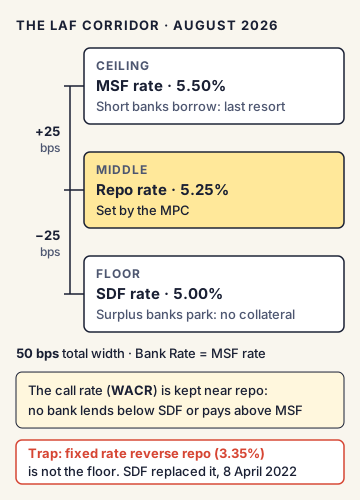
- Floor: Standing Deposit Facility (SDF) rate. Banks with extra money can park it with the RBI overnight at this rate, without the RBI having to give them any bonds as security (collateral). No bank will lend to another bank at less than this, because it can always get the SDF rate from the RBI.
- Middle: the policy repo rate. This is the rate set by the MPC. The RBI aims to keep the market rate close to it.
- Ceiling: Marginal Standing Facility (MSF) rate. Banks that are short of money can borrow overnight from the RBI at this higher rate, as a last resort. No bank will pay another bank more than this, because it can always borrow from the RBI at the MSF rate. The Bank Rate is kept equal to the MSF rate.
As of August 2026, the corridor was: SDF 5.00%, repo 5.25%, MSF 5.50%. So the total width is 50 basis points, with 25 basis points on each side of the repo rate. Whenever the MPC changes the repo rate, the SDF and MSF rates move with it automatically.
What is the operating target?
The RBI watches one market rate to see if the LAF is working: the Weighted Average Call Rate (WACR). This is the average interest rate on overnight, unsecured loans between banks (the "call money market"). The goal is to keep the WACR close to the repo rate.
The tools inside the LAF
- Variable Rate Repo (VRR): when banks are short of money, the RBI holds an auction and lends to them for a fixed period against government bonds. Banks bid the rate, which cannot go below the repo rate.
- Variable Rate Reverse Repo (VRRR): when banks have too much money, the RBI holds an auction to borrow it from them for a fixed period. Banks bid the rate, which cannot go above the repo rate.
- SDF and MSF: standing windows, always open, that banks can use on their own at fixed rates.
- Fixed rate reverse repo: an older tool kept at 3.35% since May 2020. It still exists but is no longer the floor.
What about long-lasting surpluses or shortages?
The LAF handles short-term ups and downs. For "durable" (long-lasting) changes in liquidity, the RBI uses other tools: open market operations (OMOs), where it buys government bonds to add money or sells them to remove money; forex swaps, where it exchanges dollars and rupees for a period; and changes in the CRR.
India's position and Indian examples
In 2025 and 2026, Indian banks often had large surplus money. In September 2026, the surplus was estimated at over ₹10 lakh crore at the start of the month and around ₹4.45 lakh crore later in the month. The RBI held dozens of VRRR auctions with tenors from overnight to 14 days, and also sold government bonds through OMOs, to pull money out and keep the call rate close to the repo rate.
Commonly confused concepts
- Repo vs reverse repo: in a repo, the RBI lends to banks against bonds. In a reverse repo, the RBI borrows from banks and gives them bonds. Remember: the name is from the RBI's point of view when it lends.
- SDF vs reverse repo: both absorb money from banks. But the SDF needs no collateral, so the RBI is not limited by how many bonds it holds. This is why the SDF, not the reverse repo, is now the floor.
- MSF vs repo: the repo window is the normal, cheaper way to borrow. The MSF is the costlier emergency window. Under the MSF, a bank can even use bonds it is required to keep for its Statutory Liquidity Ratio (SLR), up to 2% of its Net Demand and Time Liabilities (NDTL). This is called the "SLR dip".
- Bank Rate vs repo rate: the Bank Rate is the RBI's rate for long-term lending without bonds as security. Today it is used mainly as a penal reference rate and is kept equal to the MSF rate.
- LAF vs OMO: LAF manages short-term liquidity through repo-type deals that reverse after days. OMOs are outright purchases or sales of government bonds that change liquidity for the long term.
- Liquidity vs inflation: liquidity is the amount of ready money in the banking system day to day. Inflation is the rise in prices of goods and services. Too much liquidity for too long can push up inflation, but they are not the same thing.
Issues, criticism and the way forward
- Gap between the corridor and reality: when there is a very large surplus, the call rate can drift down to the SDF rate. Then the effective policy rate is lower than the repo rate the MPC chose, weakening its decision.
- Weak transmission: even if the call rate follows the repo rate, banks may be slow to change deposit and loan rates. One economist argued in 2026 that with surplus funds, deposit rates stay "sticky" even after a hike.
- Signals vs operations: the RBI sometimes tightens liquidity without changing the repo rate, or the reverse. Critics say this can confuse markets about the RBI's real stance; the RBI says flexibility helps it respond quickly.
- Way forward: the 2025 revised framework aims for better "fine-tuning" through 7-day and shorter variable rate operations. Experts also stress clearer communication and faster external-benchmark linking of loans and deposits.
Concepts to Know
- Liquidity: the amount of ready cash available with banks to lend and make payments.
- Basis point: one-hundredth of a percentage point. 25 basis points = 0.25%.
- Collateral: something of value, such as a government bond, given as security for a loan. If the borrower does not repay, the lender keeps it.
- Call money market: the market where banks lend to each other for one day, without collateral.
- Net Demand and Time Liabilities (NDTL): basically, the total deposits and similar money that a bank owes to the public and others.
- Statutory Liquidity Ratio (SLR): the share of NDTL that a bank must keep in safe assets such as cash, gold or government bonds.
- Cash Reserve Ratio (CRR): the share of NDTL that a bank must keep as cash with the RBI, earning no interest.
- LAF introduced in stages from June 2000 (after an interim LAF in April 1999), following the Narasimham Committee II (1998)
- Corridor: floor = SDF rate; middle = repo rate; ceiling = MSF rate (= Bank Rate)
- Corridor width: 50 basis points (plus or minus 25 around repo) since April 2022; narrowed from plus or minus 100 to plus or minus 50 in April 2016
- MSF introduced May 2011; SLR dip under MSF up to 2% of NDTL (restored from 3% on 1 January 2022)
- SDF recommended by the Urjit Patel Committee (2014); legal power via amendment of Section 17 of the RBI Act by the Finance Act, 2018; started 8 April 2022 at repo minus 25 basis points; needs no collateral
- Fixed rate reverse repo: 3.35% since May 2020; no longer the floor
- Operating target: Weighted Average Call Rate (WACR), reaffirmed in the revised framework of 30 September 2025
- Main short-term tool since that framework: 7-day VRR/VRRR, with other tenors from overnight to 14 days
- As of August 2026: SDF 5.00%, repo 5.25%, MSF 5.50%
● Tracked since February 26, 2026 · last seen October 05, 2026 · updates as the daily brief publishes