Base Effect
Why Inflation Can Jump Even When Prices Rise Slowly
The base effect is the impact that last year's number has on this year's growth rate. Inflation in India is reported as a year-on-year change: this month's prices are compared with prices in the same month last year. That earlier figure is called the base. If prices were unusually low last year, even a normal rise this year shows up as a high inflation rate. If prices were unusually high last year, this year's inflation can look low even when prices are still rising.
Why does this idea matter?
Headlines often say "inflation jumps" or "inflation falls sharply". A student, a policymaker or an investor needs to know whether prices are really rising faster now, or whether the number only looks big because of what happened last year. Without understanding the base effect, you can easily misread the economy. The RBI and the government both look at the base effect before deciding how worried they should be about a new inflation figure.
How is year-on-year inflation calculated?
The formula is simple:
- Inflation (%) = (Index this month − Index same month last year) ÷ Index same month last year × 100
- The bottom part of this fraction (last year's index) is the base.
- So inflation depends on two things: what happened to prices this year, and where prices stood last year.
A simple example
Imagine a kilo of tomatoes.
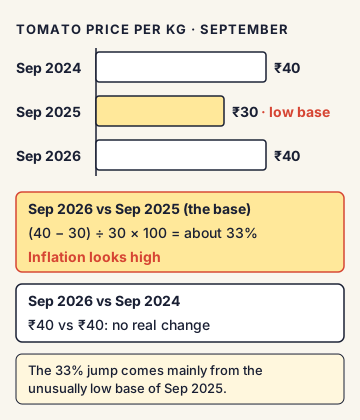
- September 2024: ₹40. September 2025: tomatoes crash to ₹30 because of a huge harvest. September 2026: tomatoes go back to a normal ₹40.
- Inflation for September 2026 = (40 − 30) ÷ 30 × 100 = about 33%.
- But compared with two years ago, the price has not changed at all. The 33% "jump" comes mainly from the unusually low base of September 2025.
Favourable and adverse base effect
Economists use two terms:
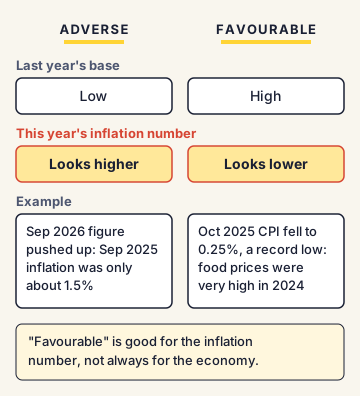
- Adverse (unfavourable) base effect: last year's base was low, so this year's inflation looks higher. This is what pushed up the September 2026 figure, because September 2025 inflation was only about 1.5%.
- Favourable base effect: last year's base was high, so this year's inflation looks lower. For example, food prices were very high in 2024, so many 2025 readings looked very low. In October 2025, CPI inflation fell to 0.25%, a record low for the series, helped partly by a favourable base effect along with falling food prices and GST rate cuts.
Note that "adverse" and "favourable" are used from the point of view of inflation control. A favourable base effect is good news for the inflation number, not necessarily for the economy.
How do experts separate base effect from real price pressure?
They use a second measure called momentum.
- Momentum is the month-on-month change: how much prices rose from last month to this month.
- Year-on-year inflation is roughly the sum of two parts: the base effect (what happened in the same month last year) and the momentum (what is happening now).
- If momentum is high, prices really are rising fast right now. If momentum is low and inflation still jumps, the base effect is doing most of the work.
- Economists also use the "seasonally adjusted" month-on-month rate and a three-month moving average, because some items (like vegetables) always rise or fall in certain months.
In September 2026, experts said the low base made the headline number bigger, but the steady month-on-month rise in food prices showed that real price pressure was also present.
Where else does the base effect show up?
It is not only about inflation. Any growth rate can be affected:
- GDP growth: After India's economy shrank sharply in 2020-21 because of the COVID-19 lockdown, the growth rate in 2021-22 looked very high. Part of that high growth was simply recovery from a very low base.
- Industrial production (IIP), exports, tax collections: A month with a strike, a flood or a festival shift can create a low or high base for the next year.
- Company profits and stock markets: A company that made very low profits last year can show "200% profit growth" this year without being very strong.
Base effect vs base year: commonly confused concepts
- Base effect: the effect of last year's value on this year's growth rate. It changes every month.
- Base year: the fixed reference year in which an index is set equal to 100. India's new CPI series uses 2024 as its base year. It was launched with January 2026 data, replacing the older series with base 2012. Changing the base year updates the basket of goods and their weights. It does not create a base effect by itself.
- Inflation vs price level: When inflation falls, prices do not fall. They only rise more slowly. Falling prices are called deflation.
- Headline vs core inflation: Headline inflation covers all items. Core inflation leaves out volatile food and fuel. Base effects are usually strongest in headline and food inflation, because food prices swing the most.
Why does the RBI care?
The RBI's Monetary Policy Committee targets 4% CPI inflation, with a band of 2% to 6%. Its decisions affect the economy with a delay of several quarters. So the MPC looks ahead. If it knows that a coming base effect will push inflation up for only a few months, it may wait. If it sees that momentum is also strong and price rise is spreading across many items, it may raise interest rates even when part of the jump is a base effect. RBI's projections of future inflation always include an estimate of base effects.
Issues, criticism and the way forward
- Misleading headlines: Sharp jumps or falls driven by base effects can create panic or false comfort. Experts suggest reading the year-on-year number together with momentum and core inflation.
- Volatile food prices: In India, vegetables like onion and tomato swing wildly, so food creates big base effects. Better storage, cold chains and buffer stocks can smooth these swings.
- Policy timing: If policymakers react to a base effect as if it were a lasting trend, they may raise or cut rates too much. Using forward-looking projections, as the MPC does, reduces this risk.
- Communication: Statistical agencies and the RBI can help the public by explaining how much of each month's change comes from the base and how much from fresh price rise.
Concepts to Know
- Year-on-year (YoY): Comparing a figure with the same month or quarter of the previous year. Inflation in India is usually quoted this way.
- Month-on-month (MoM): Comparing a figure with the previous month. It shows what is happening right now.
- Index number: A number that shows the level of something compared with a base year, which is set at 100. If the CPI is 110, prices are 10% higher than in the base year.
- Deflation: When the general level of prices actually falls, so inflation becomes negative.
- Seasonal adjustment: A statistical method that removes the regular ups and downs that happen every year in certain months (for example, vegetables becoming cheap in winter), so that the real trend becomes visible.
- Year-on-year inflation = (current index − index a year ago) ÷ index a year ago × 100; the "index a year ago" is the base
- Adverse base effect: low base, inflation looks higher; favourable base effect: high base, inflation looks lower
- Momentum = month-on-month price change; YoY inflation ≈ base effect + momentum
- CPI inflation fell to a record low of 0.25% in October 2025, helped by a favourable base effect, falling food prices and GST cuts
- New CPI series: base year 2024, launched with January 2026 data (replacing base 2012)
- RBI inflation target: 4% CPI, band of 2% to 6%
● Tracked since October 12, 2026 · last seen October 12, 2026 · updates as the daily brief publishes