Imported Inflation
How Global Prices and a Weak Rupee Raise Prices at Home
Updated 16 Oct 2026: Added India's FY26 crude oil import dependence (about 88.7%) and the RBI's October 2026 repo rate hike to 5.50% as an example.
Imported inflation is a rise in prices inside a country that comes from outside the country. It happens when the things a country buys from abroad become costlier, either because their world price goes up or because the country's own currency becomes weaker. For India, the biggest example is crude oil: when oil becomes costly abroad, petrol, diesel, transport and many other things become costly at home. So Indian families pay more even though nothing changed inside India.
Why does this idea matter?
Inflation can start from two places. It can start at home, for example when people have more money and want to buy more than shops can supply. Or it can come from abroad through imports. The cure is different for each. If a central bank does not know where the price rise is coming from, it may use the wrong medicine. That is why economists and the RBI always try to separate "home-made" inflation from imported inflation.
Where did the idea come from?
The idea became very important after the oil shocks of the 1970s. In 1973 and again in 1979, world oil prices jumped many times over. Countries that bought oil from abroad saw prices of almost everything rise, even when their own economies were weak. Economists then started to study how prices "travel" across borders. India felt this pain too.
A sharp rise in oil prices during the Gulf War of 1990 widened India's import bill and was one of the triggers of the 1991 balance of payments crisis.
How does imported inflation reach your kitchen?
There are two main roads, called channels:
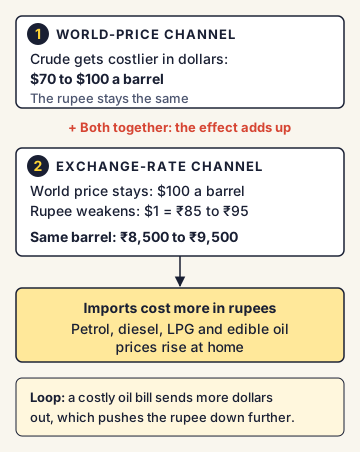
- The world-price channel: The dollar price of an imported item goes up. Example: crude oil rises from $70 to $100 a barrel. Indian oil companies now pay more for every barrel.
- The exchange-rate channel: The world price stays the same, but the rupee becomes weaker. Example: if one dollar costs ₹85 and then ₹95, a $100 barrel of oil costs ₹8,500 earlier and ₹9,500 later. The oil did not get costlier in dollars, but it got costlier in rupees.
When both happen together (costly oil and a weak rupee), the effect adds up. This is why a crude oil spike and a falling rupee are often seen together in bad times. A costly oil bill makes India pay out more dollars, which itself puts pressure on the rupee.
How does it spread inside the economy?
The effect comes in rounds:
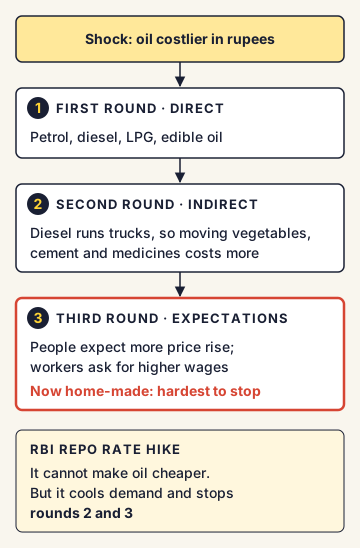
- First round (direct effect): Prices of the imported item itself go up. Petrol, diesel, cooking gas (LPG) and edible oil become costlier.
- Second round (indirect effect): Things that use the imported item become costlier. Diesel runs trucks, so the cost of moving vegetables, cement and medicines rises. Factories that use oil-based plastics or chemicals raise their prices.
- Third round (wage and expectation effect): When people see prices rising for months, they start expecting more price rise. Workers ask for higher wages. Shops raise prices in advance. Now the inflation has become home-made, and it is much harder to stop.
Central banks worry most about this third round. A one-time jump in oil prices may pass. But if it changes what people expect, it can keep inflation high for years.
What does India import that matters for prices?
India depends heavily on imports for some very common items:
- Crude oil: India imported about 88.2% of the crude oil it used in FY25, and the share went higher, to about 88.7% in FY26, according to the Petroleum Planning and Analysis Cell (PPAC) under the petroleum ministry.
- Edible oil: India imports roughly 60% of the edible (cooking) oil it uses, mainly palm oil, soybean oil and sunflower oil.
- Gold, electronics, fertilisers and coal: These also come largely from abroad, so a weak rupee makes them costlier too.
How much of a rupee fall shows up in inflation?
This is called exchange rate pass-through. If the rupee falls by 10% and import prices rise by the full 10%, pass-through is complete. In real life it is partial. Some importers absorb part of the cost, and many items in the Consumer Price Index (CPI), like services, rent and locally grown food, are not imported at all.
RBI research on emerging economies has found that pass-through is larger when a currency falls than when it rises, and that it has declined since the 2008 global financial crisis.
How does the government buffer the shock?
Since petrol prices were freed from government control in June 2010 and diesel prices in October 2014, oil marketing companies set fuel prices based on world prices. Since 16 June 2017, these prices can change every day. But the government still has a lever: excise duty (a central tax on fuel). It cut excise duty on petrol by ₹5 and diesel by ₹10 per litre in November 2021, and again by ₹8 (petrol) and ₹6 (diesel) per litre in May 2022, to soften high oil prices. Lower tax means part of the oil shock is taken by the government budget instead of the consumer.
How does the RBI respond?
The RBI has three main tools:
- Raising the repo rate: Costlier loans cool down demand at home. This cannot make oil cheaper. But it stops the second and third rounds, when businesses and workers start building in higher prices. A higher rate also helps the rupee. Foreign investors now earn more on Indian bonds and deposits, so more dollars flow into India. This slows the rupee's fall and weakens the exchange-rate channel.
- Example from October 2026: On 7 October 2026, the RBI's Monetary Policy Committee (MPC) raised the repo rate by 0.25 percentage points, from 5.25% to 5.50%. It was the RBI's first rate hike in nearly three years. High world crude oil prices were one of the main reasons. The MPC also changed its stance (its signal about future moves) from "neutral" to "calibrated tightening". This means it may raise rates further, step by step, if needed.
- Managing the rupee: The RBI can sell some of its dollar reserves to slow down a sharp fall in the rupee. A steadier rupee reduces the exchange-rate channel.
- Communication: By showing it is serious about inflation, the RBI keeps people's expectations calm, which is the cheapest way to stop the third round.
Commonly confused concepts
- Imported inflation vs cost-push inflation: Cost-push inflation is any price rise caused by higher costs of making things (raw materials, wages, energy). Imported inflation is one kind of cost-push inflation where the higher cost comes from abroad.
- Imported inflation vs demand-pull inflation: Demand-pull inflation happens when people want to buy more than the economy can produce ("too much money chasing too few goods"). Rate hikes work very well against demand-pull. They work less directly against imported inflation.
- Headline vs core inflation: Headline inflation is the full CPI number, including food and fuel. Core inflation leaves out food and fuel because their prices jump around. If core inflation starts rising after an oil shock, it is a sign that imported inflation is spreading into the whole economy.
- Depreciation vs devaluation: Depreciation is when a currency weakens because of market forces (demand and supply of dollars). Devaluation is when a government deliberately lowers the official value of its currency, as India did in 1966 and 1991. India's rupee today is market-driven, so it depreciates rather than being devalued.
Issues, criticism and the way forward
- The rate-hike dilemma: Raising rates to fight an oil shock can slow growth and jobs without making oil cheaper. Critics argue that hiking hurts borrowers for a problem that comes from abroad. Supporters reply that if the RBI waits, the shock may spread through wages and expectations and become harder to control.
- Who pays the cost? When the government cuts fuel taxes, it loses revenue, which can raise the fiscal deficit. When it does not, consumers pay more. There is no free option; the debate is about sharing the burden.
- Structural dependence: As long as India imports nearly nine-tenths of its crude oil, every global oil shock will reach Indian kitchens. Long-term answers include more renewable energy, electric vehicles, ethanol blending, more domestic oil and gas exploration, and strategic petroleum reserves.
- Edible oil: Raising domestic oilseed production (through missions such as the National Mission on Edible Oils) would reduce dependence on imported cooking oil.
- Exports matter too: A weaker rupee makes Indian exports cheaper abroad, which can help exporters. So a falling rupee is not only bad news. But for a country that imports more than it exports, the inflation effect usually worries policymakers more.
Concepts to Know
- Inflation: A general rise in prices over time. If inflation is 5%, something that cost ₹100 last year costs about ₹105 now.
- Exchange rate: The price of one currency in terms of another, for example how many rupees one US dollar costs.
- Rupee depreciation: The rupee becoming weaker, so you need more rupees to buy one dollar.
- Barrel: The standard unit for measuring crude oil. One barrel is about 159 litres.
- Consumer Price Index (CPI): A number that tracks how the prices of things a normal household buys change over time. It is released every month by the National Statistics Office (NSO).
- Excise duty: A tax the central government charges on certain goods made or sold in India, such as petrol and diesel (these fuels are still outside GST).
- Inflation expectations: What people think inflation will be in the future. If people expect high inflation, they act in ways (higher wages, higher prices) that can make it come true.
- Two channels of imported inflation: world-price channel and exchange-rate channel
- 1973 and 1979: global oil shocks; 1990 Gulf War oil spike: a trigger of India's 1991 balance of payments crisis
- India's crude oil import dependence: 88.2% in FY25 and about 88.7% in FY26 (PPAC)
- India imports about 60% of its edible oil needs
- Petrol prices deregulated: June 2010; diesel prices deregulated: October 2014; daily fuel price revision since 16 June 2017
- Excise duty cuts: November 2021 (petrol ₹5, diesel ₹10 per litre); May 2022 (petrol ₹8, diesel ₹6 per litre)
- India devalued the rupee in 1966 and 1991
- 7 October 2026: RBI raised the repo rate from 5.25% to 5.50% (first hike in nearly three years), with high crude oil prices among the reasons
- 16 Oct 2026Added India's FY26 crude oil import dependence (about 88.7%) and the RBI's October 2026 repo rate hike to 5.50% as an example.
- 7 Oct 2026Added how a repo rate hike also supports the rupee by drawing in foreign money, which limits imported inflation.
● Tracked since March 06, 2026 · last seen October 15, 2026 · updates as the daily brief publishes