Climate Change and Health
Climate change is the long-term warming of the Earth and the change in weather patterns, mainly because humans burn coal, oil and gas. This warming does not only hurt glaciers, forests and farms. It also hurts people's bodies: through heat, polluted air, dirty water, more mosquitoes and less food. That is why WHO calls the climate crisis a health crisis. Studying "climate change and health" means understanding how a warmer planet makes people sick, and what can be done about it.
Why does this link matter?
For many years, climate change was discussed only as an environmental or energy problem. But its biggest cost is felt in hospitals and homes. A heatwave can kill elderly people in a day. A flood can spread cholera. Warmer weather lets dengue mosquitoes live in new places. When governments see climate as a health issue, they can save lives quickly, often with cheap tools that already exist. It also gives a strong reason to cut emissions: cleaner air saves lives today, not only in the future.
How does climate change harm health?
Experts usually sort the harm into three pathways:
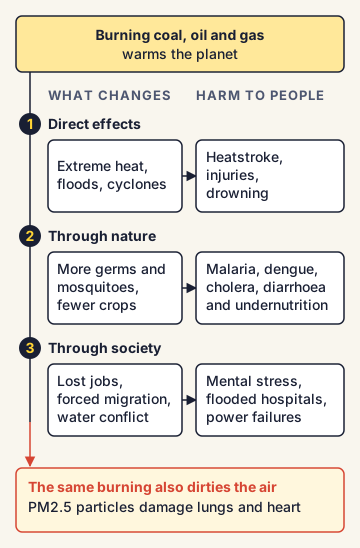
- Direct effects: extreme heat, heatwaves, floods, cyclones and storms. These cause heatstroke, injuries, drowning and deaths.
- Effects through nature (ecosystems): warmer and wetter conditions help mosquitoes and germs spread. This raises vector-borne diseases (malaria, dengue, chikungunya), water-borne diseases (cholera, diarrhoea) and food-borne diseases. Droughts and floods also reduce crops and lead to undernutrition.
- Effects through society: loss of jobs and income, forced migration, conflict over water, and mental stress. Health systems themselves get damaged when hospitals flood or power fails.
Air pollution is linked closely to all of this. The same burning of fossil fuels that warms the planet also fills the air with tiny particles called PM2.5, which damage the lungs and heart.
How big is the problem?
Some key numbers:
- A WHO assessment (2014) estimated that climate change would cause about 2,50,000 extra deaths every year between 2030 and 2050, from undernutrition, malaria, diarrhoea and heat stress alone. Children in developing countries carry most of this burden.
- WHO estimates the direct damage cost to health at $2 to 4 billion a year by 2030, not counting losses in sectors like farming and water.
- WHO's widely cited figure is about 7 million premature deaths every year from outdoor and household air pollution combined. Household air pollution, mainly from cooking with wood, dung and kerosene, caused about 3.2 million deaths in 2020, including about 2,37,000 children under five.
- The Lancet Countdown 2025 report found that heat-related deaths worldwide have risen by about 23% since the 1990s, to about 5,46,000 deaths a year. In India, each person faced on average about 20 heatwave days in 2024, and about 6.6 of these would not have happened without climate change. India also lost an estimated 247 billion potential labour hours to heat in 2024.
Where did the global response come from?
The idea grew slowly:
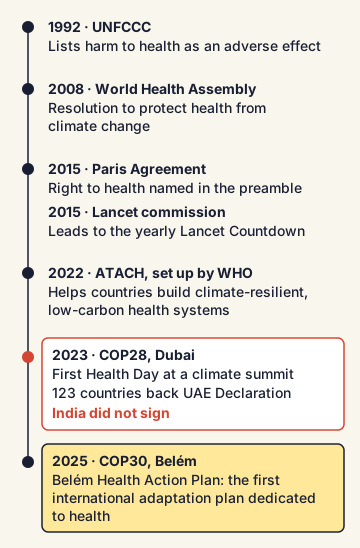
- 1992: The UN Framework Convention on Climate Change (UNFCCC) already listed harm to human health as one of the "adverse effects" of climate change.
- 2008: The World Health Assembly passed a resolution asking countries to protect health from climate change.
- 2015: The Paris Agreement mentioned the right to health in its preamble (introduction). In the same year, The Lancet medical journal's commission on health and climate change led to the Lancet Countdown, a yearly report that tracks dozens of indicators linking climate and health.
- 2022: WHO set up the Alliance for Transformative Action on Climate and Health (ATACH) to help countries build climate-resilient, low-carbon health systems.
- 2023 (COP28, Dubai): The first-ever Health Day at a climate summit. 123 countries backed the COP28 UAE Declaration on Climate and Health, a non-binding promise to build climate-resilient health systems. India did not sign it.
- 2025 (COP30, Belém, Brazil): The Belém Health Action Plan was launched as the first international adaptation plan dedicated to health. WHO acts as its secretariat.
What actions work?
Responses fall into two groups:
- Adaptation (living with the change): heat-health warning systems, heat action plans, cooler hospitals, disease surveillance, safe drinking water, sanitation and hand-washing.
- Mitigation (cutting the cause): clean cooking fuel, clean transport, cleaner power and correct pricing of fossil fuels. These cut emissions and improve health at the same time. Such gains are called health co-benefits.
The WHO report on six actions shows that many of these tools give very large returns. A heat warning system, for example, costs little but warns people in time to stay indoors, drink water and protect the elderly.
India's position and Indian examples
- India's National Action Plan on Climate Change (NAPCC) was released on 30 June 2008 with eight national missions (solar, energy efficiency, sustainable habitat, water, Himalayan ecosystem, Green India, sustainable agriculture and strategic knowledge). Health was not one of the original eight. A mission on health was later proposed among four new missions.
- The Ministry of Health and Family Welfare set up a National Expert Group on Climate Change and Health in 2015. Its work led to the National Action Plan on Climate Change and Human Health (NAPCCHH), drafted around 2018.
- The National Programme on Climate Change and Human Health (NPCCHH) was approved in February 2019 under the National Health Mission (NHM). Its technical nodal agency is the National Centre for Disease Control (NCDC). Every state prepares a State Action Plan on Climate Change and Human Health (SAPCCHH).
- Under NPCCHH, heat-related illness and deaths are tracked every summer from 1 March on the IHIP (Integrated Health Information Platform) portal.
- Schemes that bring health co-benefits include Pradhan Mantri Ujjwala Yojana (clean LPG for poor households, launched 1 May 2016), the National Clean Air Programme (2019), Jal Jeevan Mission (tap water) and Swachh Bharat Mission (sanitation).
- Many cities and states have Heat Action Plans, starting with Ahmedabad in 2013.
Commonly confused concepts
- Adaptation vs mitigation: Adaptation reduces the harm from climate change (an umbrella in the rain). Mitigation reduces the cause of climate change (stopping the rain clouds from forming). A heat warning system is adaptation. Clean cooking fuel is mainly mitigation, with health co-benefits.
- Vector-borne vs water-borne diseases: Vector-borne diseases spread through a living carrier like a mosquito or tick (malaria, dengue). Water-borne diseases spread through dirty water (cholera, typhoid, diarrhoea).
- NAPCC vs NPCCHH vs NAPCCHH: NAPCC (2008) is India's overall climate plan. NAPCCHH is the health ministry's action plan. NPCCHH (2019) is the programme that puts that plan into action through states under the NHM.
- Lancet Countdown vs IPCC: The Lancet Countdown is a yearly report by a group of research institutions, focused only on health. The IPCC is the UN body that assesses all climate science, mainly through large reports every few years.
- Ambient vs household air pollution: Ambient pollution is outdoor air pollution from vehicles, industry and dust. Household pollution comes mainly from burning solid fuels for cooking and heating inside homes.
Issues, criticism and the way forward
- Too little money: Only a small share of climate finance goes to health. Plans like the Belém Health Action Plan depend mostly on voluntary and philanthropic funding.
- Weak data: Many heat deaths are not recorded as heat deaths. Without good data, the true burden stays hidden. India's heat death counts are known to be lower than the real numbers.
- Unequal burden: Poor people, outdoor workers, women, children and the elderly suffer most, even though they contribute least to emissions.
- Health systems also pollute: Hospitals and the health sector themselves produce a share of global emissions. Experts suggest greener, energy-efficient hospitals.
- India's concerns on declarations: Countries like India have been cautious about health declarations that could indirectly limit cooling or energy use, which they need for development and for protecting people from heat.
- Way forward: WHO suggests early warning systems everywhere, building health into countries' climate plans (NDCs), strong disease surveillance, investment in water and sanitation, clean cooking for all, and better pricing of fossil fuels so the health cost of pollution is counted.
Concepts to Know
- Greenhouse gas: A gas such as carbon dioxide or methane that traps the sun's heat in the atmosphere, like a blanket around the Earth.
- CO2 equivalent (CO2e): A common unit that converts all greenhouse gases into the amount of carbon dioxide that would cause the same warming. It lets us add up different gases.
- PM2.5: Very tiny dust and smoke particles, 2.5 micrometres or smaller (about 30 times thinner than a human hair). They go deep into the lungs and blood. WHO's 2021 guideline for yearly average PM2.5 is 5 micrograms per cubic metre.
- Health co-benefit: An extra health gain that comes from a climate action. For example, cleaner cooking fuel cuts emissions and also stops women and children breathing smoke.
- Heat-health warning system: A system that uses weather forecasts to warn people and hospitals in advance of dangerous heat, so they can take simple steps to stay safe.
- Climate-resilient: Able to keep working during climate shocks. A climate-resilient water supply keeps giving safe water even in floods or droughts.
- Undernutrition: When a person does not get enough food or nutrients to grow and stay healthy, leading to stunting, wasting or being underweight.
- WHO estimate (2014): about 2,50,000 extra deaths a year from climate change between 2030 and 2050 (undernutrition, malaria, diarrhoea, heat stress)
- Direct damage cost to health: $2 to 4 billion a year by 2030 (WHO)
- Household air pollution: about 3.2 million deaths in 2020 (WHO)
- Lancet Countdown 2025: about 5,46,000 heat-related deaths a year globally; India about 20 heatwave days per person in 2024; 247 billion labour hours lost
- ATACH set up by WHO in 2022
- COP28 (2023): first Health Day; UAE Declaration on Climate and Health backed by 123 countries; India did not sign
- COP30 (2025): Belém Health Action Plan, the first international health adaptation plan
- NAPCC: 30 June 2008, eight missions
- NPCCHH: approved February 2019 under NHM; nodal agency NCDC; states prepare SAPCCHH
● Tracked since February 20, 2026 · last seen November 05, 2026 · updates as the daily brief publishes