Fossil Fuel Subsidy Reform
A fossil fuel subsidy is any help from the government that makes coal, oil, gas, petrol, diesel, LPG or kerosene cheaper than its true cost. Fossil fuel subsidy reform means reducing or removing such help, or changing it so it reaches only the people who truly need it. Many experts see it as one of the most powerful climate tools, because cheap fossil fuel encourages people to burn more of it. Reform also frees up public money for schools, hospitals and clean energy.
Why do subsidies exist at all?
Governments subsidise fuel for good reasons. Cheap kerosene and LPG help poor families cook and light homes. Cheap diesel keeps transport and food prices low. Fuel subsidies also protect people when world oil prices suddenly jump. The problem is that such subsidies are often "inefficient": most of the money goes to richer people who use more fuel, it strains the budget, and it encourages pollution.
The two types of subsidies
Students must understand this difference well:
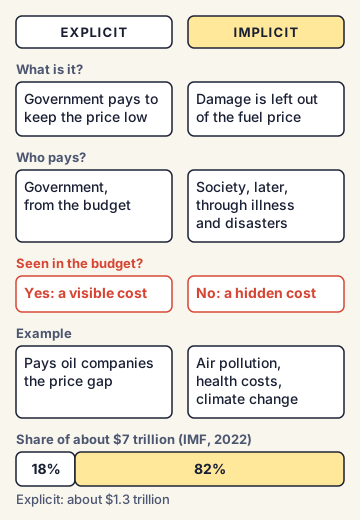
- Explicit subsidy: The government directly pays to keep the price low, for example by paying oil companies the gap between the cost price and the selling price. This is a visible cost in the budget.
- Implicit subsidy: The price does not include the damage fuel causes to society, such as air pollution, health costs, traffic accidents and climate change. Nobody pays this cost at the pump, so society pays it later through illness and disasters.
A simple example: if a factory dumps waste into a river and does not pay for the clean-up, the factory's goods are "cheap" only because villagers downstream pay the hidden cost. Fossil fuels are similar.
How big are these subsidies?
- The International Monetary Fund (IMF) estimated global fossil fuel subsidies at about $7 trillion in 2022, about 7.1% of world GDP. About 18% was explicit (about $1.3 trillion) and 82% was implicit.
- By the IMF's broad measure, India's subsidies were about $350 billion in 2022, behind China, the United States and Russia.
- The International Energy Agency (IEA), which counts only consumption subsidies, put the global figure at a record of over $1 trillion in 2022 during the energy crisis, falling to about $620 billion in 2023.
Where did global commitments come from?
- 2009, G20 Pittsburgh summit: G20 leaders promised to phase out inefficient fossil fuel subsidies over the medium term. However, the G20 never defined "inefficient", so each country decides for itself.
- 2015, Sustainable Development Goals: SDG target 12.c asks countries to rationalise (sensibly reduce) inefficient fossil fuel subsidies that encourage wasteful use, while protecting the poor.
- 2021, Glasgow Climate Pact (COP26): For the first time, a UN climate decision mentioned fossil fuels. Countries agreed to speed up efforts towards the phase-down of unabated coal power and the phase-out of inefficient fossil fuel subsidies.
- 2023, COP28 (Dubai): The first Global Stocktake decision repeated the call to phase out inefficient fossil fuel subsidies that do not address energy poverty or just transitions, as soon as possible.
How does reform work in practice?
Reform is not only about raising prices. It usually has several steps:
- Remove price controls so fuel prices follow world prices.
- Target help to the poor through direct cash transfers instead of cheap fuel for everyone.
- Tax pollution (for example a carbon tax or cess), so the price reflects the true damage.
- Use the money saved for health, education, clean energy or welfare.
- Communicate clearly and phase it in, because sudden price jumps can cause public protests.
India's experience with reform
India is often given as an example of successful reform:
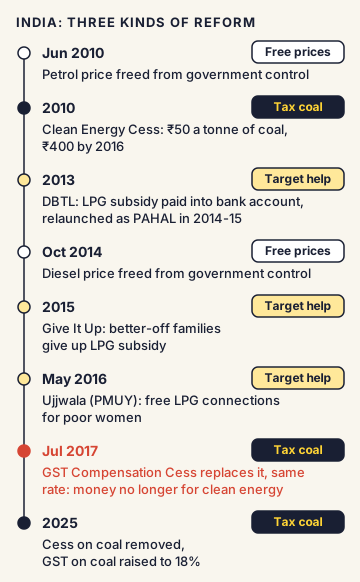
- Petrol prices were freed from government control in June 2010, and diesel prices in October 2014. Since then, oil companies set these prices in line with world prices.
- PAHAL (DBTL): Under this scheme, LPG cylinders are sold at market price and the subsidy is paid straight into the consumer's bank account. It started as DBTL in 2013 and was relaunched as PAHAL in 2014-15. In 2017, it was recognised by Guinness World Records as the world's largest direct benefit transfer scheme. It removed fake and duplicate connections.
- Give It Up campaign (2015): Better-off families were asked to give up their LPG subsidy voluntarily. The savings helped fund the Pradhan Mantri Ujjwala Yojana (PMUY), launched on 1 May 2016 in Ballia, Uttar Pradesh, which gives free LPG connections to poor women.
- Taxing coal: A Clean Energy Cess on coal began in 2010 at ₹50 per tonne and rose to ₹400 per tonne by 2016. From July 2017, it was replaced by the GST Compensation Cess at the same rate, and the money went to compensating states under GST instead of clean energy. In the 2025 GST changes, this cess on coal was removed and the GST rate on coal was raised to 18%.
- Fuel taxes: India collects high excise duties on petrol and diesel, which work partly like a carbon tax.
- Result: According to the International Institute for Sustainable Development (IISD), India cut its fossil fuel subsidies by about 59% between FY2014 and FY2023. Even so, fossil fuel subsidies in FY2023 were still about five times the subsidies for clean energy.
Commonly confused concepts
- Explicit vs implicit subsidy: Explicit is money actually spent by the government. Implicit is the hidden cost of pollution and climate damage not included in the price.
- Consumption vs production subsidy: A consumption subsidy lowers the price for the user (cheap LPG). A production subsidy helps the company that digs or refines fuel (tax breaks for coal mining).
- Phase-out vs phase-down: Phase-out means ending something completely. Phase-down means reducing it gradually. At COP26, the coal wording was changed from "phase-out" to "phase-down" at the last moment.
- Carbon tax vs cess: A carbon tax charges per tonne of carbon dioxide released. A cess is an extra tax collected for a specific purpose. India's coal cess was charged per tonne of coal, so it worked like a rough carbon tax.
- Subsidy reform vs subsidy removal: Reform can mean targeting the subsidy better (like PAHAL), not only removing it.
Issues, criticism and the way forward
- Hurts the poor if done badly: A sudden price rise for cooking fuel or kerosene can push poor families back to wood and dung, which harms health. Reform needs a safety net.
- Inflation and protests: Higher fuel prices raise transport and food costs. Many countries, such as Nigeria and Ecuador, have seen protests after fuel price hikes.
- Energy security vs climate: Developing countries argue they need affordable energy for growth and should not be forced to move at the same speed as rich countries, which caused most past emissions (the principle of common but differentiated responsibilities).
- No common definition: Since "inefficient" is not defined, countries can claim progress while keeping large subsidies.
- Way forward: WHO, the IMF and the IISD suggest phasing reform in slowly, giving targeted cash support to poor households, using savings for health and clean energy, and pricing in pollution damage. The new WHO report finds that fossil fuel pricing reform could give the largest health and welfare gains of all six climate-health actions.
Concepts to Know
- Subsidy: Money or help the government gives to make something cheaper for buyers or producers.
- Externality: A cost or benefit that falls on people who are not part of a deal. Pollution from a car is a negative externality, because others breathe it but the driver does not pay for it.
- Direct Benefit Transfer (DBT): Sending subsidy money straight into a beneficiary's bank account, instead of lowering the price for everyone.
- Excise duty: A tax charged on goods made in the country, such as petrol and diesel.
- GST Compensation Cess: An extra tax under GST, collected on certain goods to pay states for revenue they lost when GST began in 2017.
- Unabated coal: Coal burned without technology that captures and stores the carbon dioxide released.
- Common but differentiated responsibilities (CBDR): The idea in climate treaties that all countries must act, but rich countries, which polluted more in the past, must do more.
- IMF: global fossil fuel subsidies about $7 trillion in 2022 (7.1% of world GDP); 18% explicit, 82% implicit
- IEA: consumption subsidies over $1 trillion in 2022; about $620 billion in 2023
- G20 Pittsburgh, 2009: phase out inefficient fossil fuel subsidies over the medium term
- SDG target 12.c: rationalise inefficient fossil fuel subsidies
- Glasgow Climate Pact (COP26, 2021): phase-down of unabated coal power, phase-out of inefficient fossil fuel subsidies
- India: petrol deregulated June 2010; diesel deregulated October 2014
- PAHAL (DBTL): Guinness World Record (2017) as the world's largest DBT scheme
- PMUY: launched 1 May 2016, Ballia, Uttar Pradesh
- Clean Energy Cess on coal: 2010 at ₹50 per tonne, raised to ₹400 per tonne; became GST Compensation Cess in July 2017
- IISD: India cut fossil fuel subsidies by about 59% between FY2014 and FY2023
● Tracked since November 05, 2026 · last seen November 05, 2026 · updates as the daily brief publishes