Heatwave in India
IMD Criteria and Heat Action Plans
A heatwave is a period of unusually high air temperature that is much hotter than normal for that place and time of year, and that lasts for some days. It is dangerous because the human body can only cool itself up to a limit. India is one of the countries most exposed to heatwaves, mainly from March to June.
In India, the India Meteorological Department (IMD) decides when a heatwave is declared, and Heat Action Plans at the city, district and state level decide how to protect people.
Why are heatwaves so dangerous?
Our body stays cool mainly by sweating. When sweat dries from the skin, it takes heat away with it. In very hot weather, and especially when the air is also humid, sweat cannot dry fast enough. The body's core temperature then rises. This can lead to heat exhaustion (weakness, heavy sweating, dizziness) and then heat stroke, a medical emergency in which the body's cooling system fails and the person can die.
Heat also strains the heart and kidneys. Most heat deaths are not reported as "heat stroke" at all; they show up as extra deaths from heart attacks or kidney failure. That is why researchers speak of "excess" or "additional" deaths.
Who is most at risk?
Older people, small children, pregnant women and people with heart or kidney disease. Also outdoor workers such as construction workers, farm labourers, street vendors and traffic police, and poor families living in tin-roofed homes or crowded slums without fans or cooling.
How does IMD decide it is a heatwave?
IMD uses clear numbers. A heatwave is considered only when the maximum temperature of a station reaches at least:
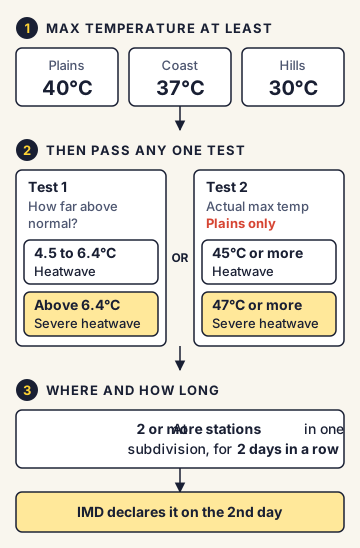
- 40°C in the plains
- 37°C at coastal stations
- 30°C in hilly areas
Once that basic level is crossed, IMD checks one of two tests.
Test 1: How much hotter than normal?
- Heatwave: the temperature is 4.5°C to 6.4°C above normal for that place.
- Severe heatwave: it is more than 6.4°C above normal.
Test 2: The actual temperature (plains only)
- Heatwave: the maximum temperature is 45°C or more, even if this is "normal" for that place.
- Severe heatwave: the maximum temperature is 47°C or more.
To declare a heatwave, these conditions must be met at at least two stations in a meteorological subdivision for at least two days in a row. IMD declares it on the second day.
IMD colour codes
IMD issues warnings by colour so that officials know what to do:
- Green: normal day, no action needed.
- Yellow: heat alert; be updated.
- Orange: heatwave or severe heatwave alert; be prepared.
- Red: extreme heat; take action, as the risk to health is very high.
Why humidity matters: the wet-bulb temperature
A thermometer alone does not tell the full story. Hot and humid air is far more dangerous than hot and dry air, because sweat does not dry in humid air. The wet-bulb temperature combines heat and humidity into one number. Scientists have long said that a wet-bulb temperature of 35°C (for example, 35°C air at 100% humidity, or about 46°C at 50% humidity) is the theoretical limit of human survival, even for a healthy person in the shade.
A later laboratory study at Penn State University found that young healthy people reached their limit at about 30.6°C wet-bulb, so the real danger point is lower. This is why coastal cities such as Mumbai, Chennai and Kolkata can be deadly even at temperatures below 40°C.
What is a Heat Action Plan?
A Heat Action Plan (HAP) is a written plan that tells a city or state exactly what to do before and during a heatwave. Think of it like a fire drill, but for heat. A typical HAP has:
- Early warning: linking IMD forecasts to local alerts sent by SMS, radio and loudspeakers.
- Heat thresholds: a local temperature level at which alerts are triggered, based on past deaths in that area.
- Public awareness: "do's and don'ts", such as drinking water often and avoiding the sun between noon and 3 pm.
- Health system readiness: training doctors to spot heat illness, keeping ORS and cool rooms in hospitals.
- Protection for workers: changing working hours, giving water and shade.
- Long-term steps: cool roofs, more trees, shaded bus stops, and drinking water points.
Where did Heat Action Plans come from?
In May 2010, a severe heatwave hit Ahmedabad, and studies found more than 1,300 extra deaths in the city that month. In response, the Ahmedabad Municipal Corporation, with public health experts, prepared the Ahmedabad Heat Action Plan in 2013. It was the first such plan in South Asia. Studies later estimated that it helped avoid more than 1,000 deaths a year. After its success, many other cities and states copied the model.
The national framework
- National Disaster Management Authority (NDMA): issued Guidelines for Preparation of Action Plan: Prevention and Management of Heat-Wave in 2016, and revised them later (the 2019 version is widely used). NDMA identified 23 heat-prone states in 2019.
- Ministry of Health: under the National Programme on Climate Change and Human Health (NPCCHH), states must report heat stroke cases and deaths every day during the season (on the IHIP portal since 1 March 2024).
- Disaster funding: For a long time, heatwaves were not on the national list of notified disasters. States could use at most 10% of their State Disaster Response Fund (SDRF) for such "local" disasters, and some states, such as Telangana and Tamil Nadu, declared heatwaves a state-specific disaster. In August 2026, acting on the 16th Finance Commission's recommendations, the Union government added heatwave and lightning to the list of notified natural calamities for 2026-31. This makes heatwave relief eligible for regular SDRF and NDRF funds.
Commonly confused concepts
- Heatwave vs hot day: A hot day is simply a high temperature. A heatwave must cross IMD's thresholds and last at least two days at two or more stations.
- Heatwave vs warm night: IMD also warns about warm nights, when the night temperature stays well above normal. Warm nights are dangerous because the body cannot recover from the day's heat.
- Heatwave vs marine heatwave: A marine heatwave is unusually warm sea water for days or weeks. It harms corals and fish, not people directly.
- Heat exhaustion vs heat stroke: Heat exhaustion is the earlier, milder stage; the person sweats heavily and feels weak. In heat stroke, the body's cooling fails, the person may stop sweating, become confused or faint, and needs emergency care.
- Heatwave vs urban heat island: A heatwave is a weather event over a wide area. An urban heat island is a city being hotter than nearby villages all the time, because concrete and roads trap heat. The two together make cities much more dangerous.
- Heat Action Plan vs India Cooling Action Plan (2019): A HAP is about protecting people during heat events. The India Cooling Action Plan is a long-term plan for cooling needs and energy use across sectors.
Issues, criticism and the way forward
- Under-counting deaths: Many heat deaths are recorded as heart or kidney failure, so official numbers are far lower than real numbers. This weakens the push for action.
- Weak plans: A 2023 review of 37 Heat Action Plans by the Centre for Policy Research (9 city, 13 district and 15 state plans across 18 states) found that none of them stated a legal source of authority. Only 11 discussed where the money would come from, and only 2 carried out a proper study of which groups were most vulnerable.
- Humidity is ignored: Many plans use only dry temperature, though humid heat is often more deadly.
- Workers and the poor: Informal workers often cannot stop work in the heat without losing their wages. Experts suggest paid rest breaks, shifted work hours and heat insurance.
- Long-term cooling: Planting trees, protecting water bodies, cool roofs (white or reflective roofs) and better building design can lower local temperatures.
- Way forward: use heat-and-humidity indices, set local thresholds, build health system capacity, use the new notified-disaster funding, and track deaths better with tools like real-time mortality data.
Concepts to Know
- Humidity: The amount of water vapour in the air. High humidity makes us feel hotter because sweat does not dry.
- Wet-bulb temperature: The temperature shown by a thermometer wrapped in a wet cloth. It shows how much cooling sweating can give. The closer it is to body skin temperature (about 35°C), the more dangerous the heat.
- Meteorological subdivision: IMD divides India into 36 weather regions, called subdivisions, for forecasts and warnings.
- Excess (additional) deaths: The number of deaths above what would normally be expected in that period. It shows the real toll of an event like a heatwave.
- ORS (Oral Rehydration Solution): A drink of water, salt and sugar that quickly replaces fluids lost through sweating.
- SDRF and NDRF: Disaster relief funds created under the Disaster Management Act, 2005. The state fund (SDRF) is the first source of relief money; the national fund (NDRF) helps when a disaster is severe.
- Notified disaster: A disaster officially listed by the Union government, so that relief for it can be paid from SDRF and NDRF under fixed rules.
- Heatwave basic thresholds: 40°C (plains), 37°C (coastal), 30°C (hills)
- Departure from normal: 4.5°C to 6.4°C = heatwave; more than 6.4°C = severe heatwave
- Actual maximum (plains): 45°C or more = heatwave; 47°C or more = severe heatwave
- Declared when met at 2 or more stations in a meteorological subdivision for at least 2 consecutive days
- IMD colour codes: green, yellow, orange, red
- Wet-bulb 35°C: theoretical survival limit; lab study found about 30.6°C in practice
- Ahmedabad Heat Action Plan (2013): first in South Asia, after the May 2010 heatwave
- NDMA heatwave guidelines: 2016, revised later (2019 version widely used); 23 heat-prone states identified (2019)
- Heatwave and lightning added to notified natural calamities for 2026-31 (August 2026), on 16th Finance Commission recommendations; earlier, states could use up to 10% of SDRF for local disasters
- Heat illness surveillance under NPCCHH (Ministry of Health and Family Welfare)
● Tracked since October 29, 2026 · last seen October 29, 2026 · updates as the daily brief publishes