Bharat 6G Vision and the Bharat 6G Alliance
The Bharat 6G Vision is India's official plan to design, develop and deploy 6G technology, released in March 2023. Its goal is for India to become a leading global supplier of affordable 6G technology, intellectual property (patents) and solutions by 2030. The Bharat 6G Alliance (B6GA), launched in July 2023, is the platform that brings together industry, start-ups, universities and research bodies to carry out this plan.
Why does India need this?
India was mostly a user of mobile technology from 2G to 4G. The standards were written abroad, and Indian companies paid royalties to foreign patent holders. With 5G, India began building its own technology stack (for example, indigenous 4G and 5G network equipment). With 6G, India wants to be part of writing the standard from the start. Countries that shape a standard own more of its patents, earn royalties, and make sure the technology suits their own needs, such as low cost and rural coverage.
Where did it come from?
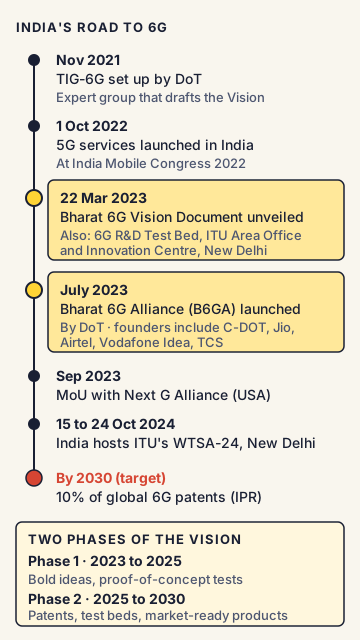
- November 2021: The Department of Telecommunications (DoT) set up the Technology Innovation Group on 6G (TIG-6G). It had members from ministries, research institutions, academia, standard-setting bodies, telecom companies and industry.
- 1 October 2022: 5G services were launched in India at India Mobile Congress 2022.
- 22 March 2023: At Vigyan Bhawan, New Delhi, the Prime Minister unveiled the Bharat 6G Vision Document prepared by TIG-6G. On the same day, the ITU Area Office and Innovation Centre in New Delhi was opened and a 6G R&D Test Bed was launched.
- July 2023: The Bharat 6G Alliance was launched by DoT. Founding members included C-DOT, Reliance Jio, Bharti Airtel, Vodafone Idea and Tata Consultancy Services.
- October 2024: India hosted the ITU's World Telecommunication Standardization Assembly (WTSA-24) in New Delhi (15 to 24 October 2024).
The three guiding principles
The Vision rests on three ideas:
- Affordability: 6G must be cheap enough for ordinary Indians, not only for the rich.
- Sustainability: It must use less energy and limit its carbon footprint, since billions of devices will run on batteries.
- Ubiquity: It must reach everyone and everywhere, including villages and remote areas.
How is it carried out? The two phases
- Phase 1 (2023 to 2025): Support bold, exploratory ideas and early proof-of-concept tests, accepting that some will fail.
- Phase 2 (2025 to 2030): Take the promising ideas forward into patents, test beds and products ready for the market.
An apex body oversees the mission. It sets phase-wise goals, consults the Bharat 6G Alliance, suggests research directions and monitors progress.
What does the Bharat 6G Alliance do?
Think of it as a team captain that brings all players onto one field. It:
- links telecom companies, equipment makers, start-ups, universities and research labs;
- supports and helps fund Indian 6G research;
- pushes Indian participation in global standard-making bodies such as ITU and 3GPP;
- signs partnerships with 6G alliances of other countries.
It works through seven working groups, covering areas such as 6G technologies, spectrum, devices and components, applications, use cases and revenue models, green and sustainable networks, and outreach. By July 2026 it had about 90 members. In September 2023 it signed an MoU with the Next G Alliance of the United States, one of its first international partnerships.
Key targets and support
At the Alliance's launch, the government set a target that India should hold 10% of global 6G intellectual property rights by 2029 to 2030. Funding support comes partly through the Telecom Technology Development Fund (TTDF), launched in 2022. TTDF is funded with 5% of the annual collections of the Universal Service Obligation Fund, now called Digital Bharat Nidhi.
India's position
India now presents itself as a contributor to global telecom standards, not only a buyer. Hosting WTSA-24, the ITU Area Office in New Delhi, the 6G test beds and the yearly International Bharat 6G Symposium are steps in that direction. India also stresses that 6G should serve developing countries through low cost and wide coverage.
Commonly confused concepts
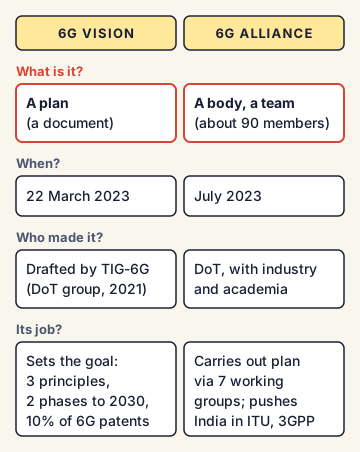
- Bharat 6G Vision vs Bharat 6G Alliance: The Vision (March 2023) is the plan document. The Alliance (July 2023) is the body of industry and academia that works to carry out the plan.
- TIG-6G vs B6GA: TIG-6G (November 2021) was the expert group that drafted the Vision. B6GA is the wider, long-term alliance.
- TTDF vs Digital Bharat Nidhi: Digital Bharat Nidhi (earlier USOF) is the larger fund for spreading telecom access. TTDF is a scheme funded from it to support home-grown telecom research and products.
- Bharat 6G Alliance vs Next G Alliance: B6GA is India's 6G alliance. Next G Alliance is the US industry's 6G alliance; the two signed an MoU in 2023.
Issues, criticism and the way forward
- Low research spending: India's overall spending on research and development is low compared with leading tech nations, which limits patent output.
- Patent gap: India's share of global 5G patents was small (estimated at around 1.5%). Moving to a 10% share in 6G is a big jump.
- Weak manufacturing base: Key components like advanced chips are mostly imported, which affects self-reliance.
- Non-binding partnerships: Many international MoUs are statements of intent without fixed funding. Their value depends on follow-up research and joint trials.
- Way forward: Experts suggest more funding for universities and start-ups, stronger links between academia and industry, early spectrum planning for 6G bands, and a larger, steady presence of Indian engineers in ITU and 3GPP meetings.
Concepts to Know
- Intellectual property rights (IPR): Legal ownership of new ideas and inventions, such as patents. The owner can charge others for using the idea.
- Test bed: A real setup where new technology can be tried and checked before it is sold or used widely.
- Proof of concept: A small early test to show that an idea can actually work.
- Universal Service Obligation Fund (USOF): A fund built from a levy on telecom companies' revenue, used to spread telecom services to rural and remote areas. It is now called Digital Bharat Nidhi.
- India Mobile Congress (IMC): India's largest yearly telecom and technology event, held in New Delhi.
- TIG-6G set up: November 2021
- Bharat 6G Vision Document unveiled: 22 March 2023, along with the 6G R&D Test Bed and the ITU Area Office and Innovation Centre, New Delhi
- Three principles: affordability, sustainability, ubiquity
- Two phases: 2023 to 2025 (exploration and proof of concept); 2025 to 2030 (patents, test beds, commercialisation)
- Bharat 6G Alliance launched: July 2023; about 90 members by July 2026; seven working groups
- Target: 10% of global 6G IPR by 2029 to 2030
- MoU with Next G Alliance (USA): September 2023
- TTDF: launched 2022; funded with 5% of annual USOF (Digital Bharat Nidhi) collections
- WTSA-24 hosted in New Delhi: 15 to 24 October 2024
- 5G launched in India: 1 October 2022
● Tracked since October 09, 2026 · last seen October 09, 2026 · updates as the daily brief publishes