6G Technology
The Next Generation of Mobile Networks
6G is the sixth generation of mobile network technology, the system that will come after today's 5G. It is expected to be much faster than 5G, respond almost instantly, connect far more devices, and use artificial intelligence (AI) inside the network itself. The international name for 6G is IMT-2030, given by the International Telecommunication Union (ITU). Commercial 6G networks are expected around 2030.
Why do we need a new generation?
Every 10 years or so, the way people use mobile networks changes. 2G was for calls and SMS, 3G brought basic internet, 4G brought video streaming, and 5G was built for very fast data and smart machines. By 2030, uses such as holographic video calls, self-driving vehicles, remote surgery, and millions of sensors in cities and farms will need even more speed and reliability.
6G is being designed for that world. It also aims to connect places that are still left out, like villages, oceans and mountains.
How did mobile generations grow?
Each generation is defined by an ITU framework and then turned into detailed technical rules by industry bodies.
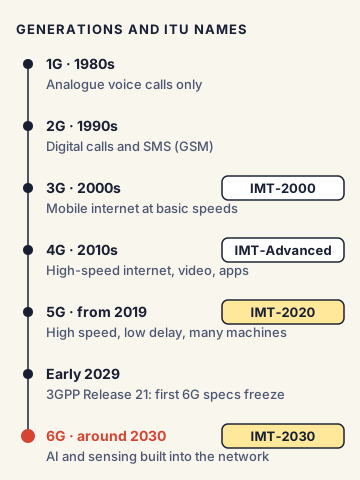
- 1G (1980s): Analogue voice calls only.
- 2G (1990s): Digital calls and SMS (for example, the GSM standard).
- 3G (2000s, IMT-2000): Mobile internet at basic speeds.
- 4G (2010s, IMT-Advanced): High-speed internet, video streaming, apps.
- 5G (from 2019, IMT-2020): Very high speed, low delay, and connections for many machines.
- 6G (expected around 2030, IMT-2030): Even higher performance, plus AI and sensing built into the network.
Who decides what 6G is?
Two kinds of bodies work together. The ITU, a United Nations agency based in Geneva, sets the broad goals and the minimum performance a technology must meet to be called IMT-2030. It also manages how radio frequencies are shared between countries. Then industry groups such as 3GPP (3rd Generation Partnership Project, a group of standard-making bodies from many countries) write the detailed technical specifications that phone and equipment makers follow. You can think of the ITU as setting the syllabus, and 3GPP as writing the textbook.
The IMT-2030 framework
In 2023, the ITU approved Recommendation ITU-R M.2160, the framework for IMT-2030. It names six usage scenarios, meaning the main types of use 6G must support:
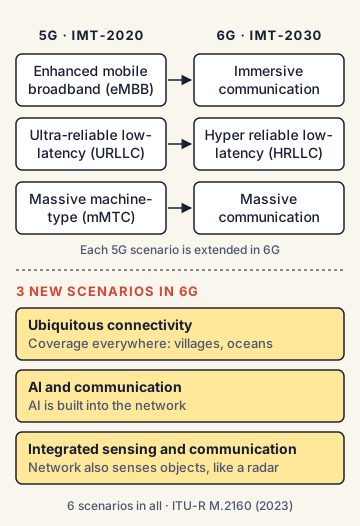
- Immersive communication: Very rich, real-time experiences like holograms and extended reality (an extension of 5G's enhanced mobile broadband).
- Hyper reliable and low-latency communication (HRLLC): Near-instant, almost never-failing links for things like factory robots and remote surgery.
- Massive communication: Connecting huge numbers of sensors and devices.
- Ubiquitous connectivity (new): Coverage everywhere, including remote and rural areas.
- AI and communication (new): The network uses and supports artificial intelligence.
- Integrated sensing and communication (new): The network not only carries data but also "senses" its surroundings, like a radar, to detect objects and movement.
The framework lists 15 capabilities (nine improved from 5G and six new). These are research targets, given as ranges, not fixed promises.
Key performance targets (research ranges in the ITU framework)
- Peak data rate: 50, 100 or 200 Gbit/s (gigabits per second)
- User experienced data rate: 300 to 500 Mbit/s
- Latency (delay over the air): 0.1 to 1 millisecond
- Connection density: 1 million to 100 million devices per square kilometre
- Mobility: 500 to 1,000 km per hour
- Positioning accuracy: 1 to 10 centimetres
What frequencies will 6G use?
Mobile signals travel on radio waves of different frequencies. Lower frequencies travel far but carry less data. Higher frequencies carry huge amounts of data but travel short distances and are easily blocked by walls. 6G will likely use a mix: existing low and mid bands, a new "upper mid-band" (roughly 7 to 24 GHz), and very high millimetre-wave and sub-terahertz bands for very fast, short-range links.
The World Radiocommunication Conference 2023 (WRC-23) put three bands on the agenda of WRC-27 for study for mobile (IMT) use: 4.4 to 4.8 GHz, 7.125 to 8.4 GHz, and 14.8 to 15.35 GHz (or parts of them).
The timeline
3GPP agreed in June 2026 that the first 6G specifications will come in its Release 21, with the final freeze targeted for early 2029. The ITU expects to complete the IMT-2030 radio interface specifications around 2030, and commercial 6G networks are expected around the same time.
Commonly confused concepts
- 5G vs 6G: 5G (IMT-2020) has three usage scenarios: enhanced mobile broadband, ultra-reliable low-latency communication, and massive machine-type communication. 6G (IMT-2030) extends these three and adds three new ones: ubiquitous connectivity, AI and communication, and integrated sensing and communication.
- ITU-R vs ITU-T vs 3GPP: ITU-R handles radio spectrum and the IMT frameworks. ITU-T sets wider telecom standards. 3GPP is not a UN body; it is an industry partnership that writes the detailed mobile specifications.
- WRC "identification" vs "study": A study only checks if a band can be shared safely. An identification at a WRC formally marks a band for mobile use. The bands listed for WRC-27 are only under study.
- MoU vs treaty: An MoU is a statement of intent to cooperate and is not legally binding. A treaty is legally binding.
Issues, criticism and the way forward
- Cost: Higher frequencies need many more towers and small cells, which makes networks costly. This can widen the digital divide unless affordability is built in.
- Energy use: Billions of connected devices and dense networks can use a lot of power. Energy-efficient design is a stated goal of 6G.
- Security and privacy: AI-run networks and sensing raise new risks of hacking and surveillance. Trusted supply chains and strong data protection are needed.
- Spectrum sharing: Some proposed 6G bands are already used by satellites and scientific services, and sharing them is debated.
- Standards and patents: Countries that contribute more to standards hold more "standard-essential patents" and earn royalties. Developing countries risk being only buyers unless they invest in research early.
Concepts to Know
- Latency: The delay between sending a signal and getting a response. Lower latency means the network reacts faster, which matters for things like remote surgery.
- Gbit/s and Mbit/s: Units of data speed. 1 gigabit per second (Gbit/s) is 1,000 megabits per second (Mbit/s).
- Spectrum: The range of radio frequencies used to send wireless signals. It is a limited natural resource, so governments allocate it carefully.
- Terahertz (THz): A very high radio frequency (1 THz is 1,000 GHz). It can carry huge data but over very short distances.
- Standard-essential patent (SEP): A patent on a technology that every maker must use to follow a standard. Its owner earns royalties from everyone using the standard.
- Integrated sensing: Using the same radio signals for both communication and detecting objects, similar to how a radar works.
- 6G = IMT-2030 (ITU name); 5G = IMT-2020; 4G = IMT-Advanced; 3G = IMT-2000
- IMT-2030 framework: Recommendation ITU-R M.2160, approved in 2023
- 6 usage scenarios (3 extended from 5G, 3 new) and 15 capabilities (9 enhanced, 6 new)
- Targets: peak data rate up to 200 Gbit/s; latency 0.1 to 1 ms; connection density 10^6 to 10^8 devices per sq km; mobility 500 to 1,000 km/h; positioning accuracy 1 to 10 cm
- WRC-27 study bands for IMT: 4.4 to 4.8 GHz, 7.125 to 8.4 GHz, 14.8 to 15.35 GHz
- 3GPP Release 21: first 6G specifications, final freeze targeted for early 2029; commercial 6G expected around 2030
● Tracked since February 18, 2026 · last seen October 09, 2026 · updates as the daily brief publishes