Article 14
Right to Equality and the Doctrine of Arbitrariness
Article 14 of the Constitution says: "The State shall not deny to any person equality before the law or the equal protection of the laws within the territory of India." In simple words, the government must treat people fairly and equally, and nobody is above the law. Over time, the Supreme Court has read one more idea into Article 14: the State must never act arbitrarily, meaning without good reason, fair rules or a proper process.
This idea is called the doctrine of arbitrariness, and it has become one of the most powerful tools for checking government action in India.
Why does Article 14 exist?
Before the Constitution, Indian society was deeply unequal. Caste, religion, gender, wealth and colonial privilege decided how people were treated, including by rulers and courts. The Constitution makers wanted a clear promise that the State itself would not play favourites. Article 14 is the first article of the Right to Equality (Articles 14 to 18) in Part III (Fundamental Rights). It is the general rule. The articles after it apply that rule to special areas.
What do the two phrases mean?
Article 14 joins two ideas from two countries:
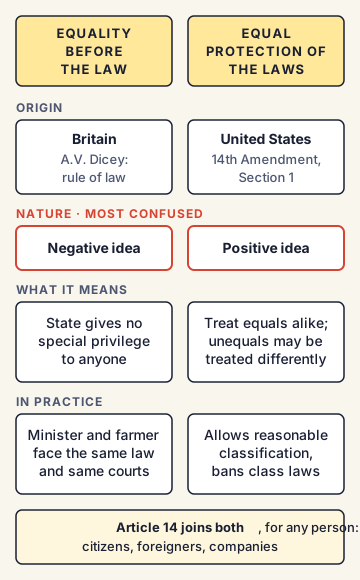
- Equality before the law comes from Britain. It is linked to the idea of the "rule of law" explained by the British jurist A.V. Dicey. It is a negative idea: the State must not give special privileges to anyone. A minister and a farmer are subject to the same ordinary law and the same courts.
- Equal protection of the laws comes from the United States, from Section 1 of the 14th Amendment of the US Constitution. It is a positive idea: people in similar situations must be treated alike, and the State may need to treat different people differently to make them truly equal.
Who gets this right?
Article 14 uses the words "any person", not "any citizen". So it protects citizens and foreigners (except enemy aliens), and also legal persons like companies and statutory corporations. Compare this with Articles 15, 16, 19 and 29, which protect only citizens. The right is enforced against "the State", which Article 12 defines widely to include the Union and state governments, Parliament, state legislatures, local bodies and other authorities under government control.
Is equal treatment always the same treatment?
No. Treating unequals equally can itself be unfair. A tax law that charges a rickshaw puller and a billionaire the same income tax would be "equal" but unjust. So Article 14 allows reasonable classification but forbids class legislation (laws that pick out a group to favour or harm without good reason).
How does the reasonable classification test work?
The Supreme Court set out the test in State of West Bengal v. Anwar Ali Sarkar (1952) and explained it in detail in Ram Krishna Dalmia v. Justice S.R. Tendolkar (1958). A classification is valid only if it passes two conditions:
- Intelligible differentia: there must be a clear, understandable difference between the people grouped together and those left out.
- Rational nexus: that difference must have a logical link with the purpose of the law.
Example: a law giving extra marks to candidates from remote hill areas for a medical college seat. The difference (living in remote hill areas) is clear. If the aim is to bring doctors to those areas, the link is rational. But a law giving extra marks only to people whose names start with "A" would fail: the difference is clear, but it has no link to any proper purpose.
In Anwar Ali Sarkar itself, the Court struck down a part of the West Bengal Special Courts Act, 1950, because it let the government send any case to special courts with harsher procedures without any clear basis for choosing.
Where did the doctrine of arbitrariness come from?
For about twenty years, courts tested Article 14 only through classification. Then the meaning grew:
- E.P. Royappa v. State of Tamil Nadu (1974): Justice P.N. Bhagwati said equality and arbitrariness are "sworn enemies". Equality is "antithetic to arbitrariness". An arbitrary act is unequal by its very nature, so it violates Article 14 even if no classification is involved.
- Maneka Gandhi v. Union of India (1978): the Court linked Articles 14, 19 and 21. Any procedure that takes away life or personal liberty must be "right, just and fair", not "arbitrary, fanciful or oppressive". This made fair procedure, including the right to be heard, part of equality.
- Ajay Hasia v. Khalid Mujib Sehravardi (1981): a Constitution Bench applied the arbitrariness test to admissions in a government-controlled college, and held that a body controlled by the government counts as "State" under Article 12.
The big debate: can a law itself be struck down for being arbitrary?
Using arbitrariness against executive action (orders, appointments, contracts) was accepted quickly. Using it against a law passed by Parliament was more controversial.
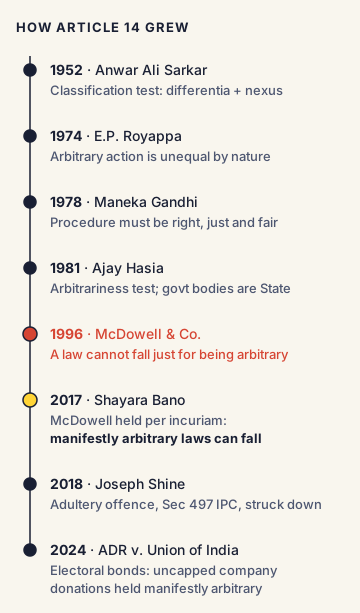
- State of Andhra Pradesh v. McDowell & Co. (1996): a three-judge bench said a law can be struck down only for two reasons: the legislature had no power to make it, or it violates a fundamental right or another provision of the Constitution. It said a law cannot be struck down just because a court finds it arbitrary or unwise.
- Shayara Bano v. Union of India (2017): in the instant triple talaq case, Justice R.F. Nariman held that the McDowell view was per incuriam (decided without noticing earlier binding judgments such as Ajay Hasia). He said a law can be struck down if it is "manifestly arbitrary", that is, made "capriciously, irrationally and/or without adequate determining principle", or if it is excessive and disproportionate. Instant triple talaq was held invalid.
- Joseph Shine v. Union of India (2018) used manifest arbitrariness to strike down the adultery offence in Section 497 of the Indian Penal Code.
- Association for Democratic Reforms v. Union of India (15 February 2024), the electoral bonds case: a five-judge bench held that removing the cap on company donations to political parties in Section 182 of the Companies Act, 2013 (earlier capped at 7.5% of average net profits) was manifestly arbitrary and violated Article 14.
Natural justice: the procedural side of non-arbitrariness
Courts treat a decision taken without hearing the affected person as a classic sign of arbitrariness. Two old rules of fair process apply:
- Audi alteram partem ("hear the other side"): no one should suffer a serious loss without notice and a chance to explain.
- Nemo judex in causa sua ("no one should be a judge in his own case"): the decision-maker must be unbiased.
So when an official removes a person's name from a list, cancels a licence or dismisses an employee, the action usually must come with notice, reasons and a hearing. This is why courts have repeatedly said that a voter's name should not be deleted without notice and a hearing.
Exceptions to Article 14
Some people or situations are treated differently by the Constitution or by international law:
- Article 361: the President and Governors are not answerable to any court for the exercise of their official powers, and no criminal case can be started against them during their term.
- Articles 105 and 194: members of Parliament and state legislatures cannot be taken to court for anything they say or any vote they give in the House.
- Article 31C: laws made to carry out certain Directive Principles (Article 39(b) and (c)) cannot be challenged on the ground of violating Article 14 or 19.
- Foreign diplomats and heads of state have immunity from Indian courts under international law.
Article 14 and the basic structure
Courts have treated equality and the rule of law as part of the basic structure of the Constitution. This means Parliament cannot remove the core of Article 14 even by a constitutional amendment.
Commonly confused concepts
- Equality before the law vs equal protection of the laws: The first is British and negative (no special privilege for anyone). The second is American and positive (treat equals alike, and allow reasonable differences).
- Reasonable classification vs arbitrariness: Classification asks, "Is the grouping fair and linked to the law's goal?" Arbitrariness asks a wider question, "Is this action fair, reasoned and principled at all?" An action can fail the arbitrariness test even when no group is singled out.
- Article 14 vs Articles 15 and 16: Article 14 is the general equality rule for any person. Article 15 bans discrimination by the State against citizens only on religion, race, caste, sex or place of birth. Article 16 gives citizens equality of opportunity in public employment.
- Arbitrariness vs unreasonableness under Article 19: Article 19 restrictions must be "reasonable" and only on listed grounds. Arbitrariness under Article 14 applies to all State action, not only to the freedoms in Article 19.
- McDowell (1996) vs Shayara Bano (2017): McDowell said laws cannot be struck down only for arbitrariness. Shayara Bano said they can, if they are manifestly arbitrary.
Issues, criticism and the way forward
- Too vague? Critics argue that "arbitrary" has no fixed meaning. It may let judges replace the choices of elected lawmakers with their own views. Some scholars warn this upsets the separation of powers.
- The defence: Supporters say the doctrine fills gaps the classification test cannot reach. It protects citizens from careless, unreasoned or excessive State action, which is common in a large administrative State.
- Unsettled law: Different benches have used the doctrine with different strictness. A larger bench may one day need to lay down a clear test for when a law is "manifestly arbitrary".
- Mass administrative exercises: Large drives such as voter roll revisions, welfare beneficiary checks or document verification can exclude many genuine people through errors. Courts have stressed notice, hearing, reasons and appeals as the safeguards against arbitrariness in such exercises.
- Way forward: Experts suggest written rules for every large exercise, publication of reasons for adverse decisions, easy appeals, and a clearer judicial standard so that the doctrine is used consistently.
Concepts to Know
- The State (Article 12): Not just the government. It includes Parliament, state legislatures, all governments, local bodies like municipalities, and other authorities under government control. Fundamental rights are mostly enforceable against "the State".
- Class legislation: A law that picks out a particular person or group for special favour or harm without any good reason. Article 14 forbids it.
- Per incuriam: A Latin term for a judgment given without noticing an earlier binding judgment or law. Such a judgment loses its value as a precedent on that point.
- Constitution Bench: A bench of at least five Supreme Court judges, needed to decide important questions about the meaning of the Constitution (Article 145(3)).
- Natural justice: Basic rules of fair decision-making: hear the affected person before deciding, and the judge must have no personal interest.
- Enemy alien: A citizen of a country that is at war with India. Such persons do not get certain protections.
- Article 14 text: "The State shall not deny to any person equality before the law or the equal protection of the laws within the territory of India"
- Article 14 applies to any person (citizens, foreigners except enemy aliens, companies); Articles 15, 16, 19 apply only to citizens
- "Equality before the law": British origin (A.V. Dicey, rule of law); "equal protection of the laws": US 14th Amendment
- Reasonable classification test: intelligible differentia + rational nexus (Anwar Ali Sarkar, 1952; Ram Krishna Dalmia, 1958)
- Doctrine of arbitrariness: E.P. Royappa (1974), Maneka Gandhi (1978), Ajay Hasia (1981)
- State of A.P. v. McDowell (1996): laws cannot be struck down merely as arbitrary; held per incuriam in Shayara Bano (2017), which set the "manifest arbitrariness" test
- Manifest arbitrariness applied in Joseph Shine (2018, Section 497 IPC) and the electoral bonds case (15 February 2024, Section 182 Companies Act)
- Exceptions: Article 361 (President, Governors), Articles 105 and 194 (legislators' privileges), Article 31C, diplomatic immunity
● Tracked since February 03, 2026 · last seen October 04, 2026 · updates as the daily brief publishes