Advisory Jurisdiction of the Supreme Court (Article 143)
Article 143 of the Constitution lets the President of India ask the Supreme Court for its opinion on an important question of law or fact. This is called the Supreme Court's advisory jurisdiction, and the request is called a Presidential Reference. In such a case there is no fight between two parties and no winner or loser; the Court only gives advice.
You can think of it like a family going to a trusted lawyer before taking a big step, to ask "Is this allowed?" instead of waiting to be sued.
Why does it exist?
Sometimes the government faces a legal doubt that could cause a crisis if it guesses wrong. For example: Can a state law override a tribunal's order? Can a piece of Indian territory be handed to another country by an ordinary law? Waiting for someone to file a case could take years and cause damage. Article 143 lets the government get the highest court's view early, before acting. It also helps settle big constitutional confusions that affect the whole country.
Where did it come from?
The idea came from the Government of India Act, 1935. Section 213 of that Act allowed the Governor-General to refer legal questions to the Federal Court (India's top court before 1950) for its opinion. The Federal Court used this power, for example, in a 1939 reference on a Central Provinces and Berar tax on motor spirit.
The Constitution makers kept this idea in Article 143 when the Supreme Court replaced the Federal Court in 1950. Canada's Supreme Court has a similar reference power. The United States Supreme Court, on the other hand, does not give advisory opinions at all.
What does Article 143 say?
It has two clauses, and the difference between them is a favourite exam question:
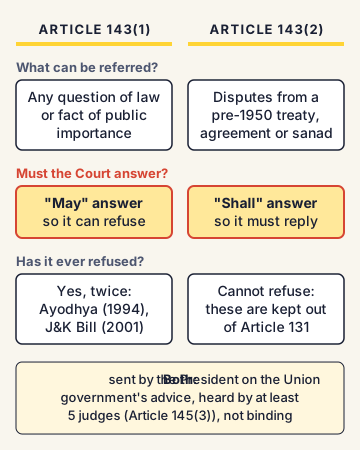
- Article 143(1): The President may refer any question of law or fact that has arisen or is likely to arise, if it is of such public importance that the Court's opinion is useful. The Court "may" give its opinion. So it can refuse.
- Article 143(2): The President may refer disputes arising out of a treaty, agreement, covenant, engagement, sanad or similar document made before the Constitution began. These disputes are kept out of the Court's normal Article 131 jurisdiction by the proviso to that Article. Here the Court "shall" give its opinion. So it must answer.
How does a reference work?
Step by step:
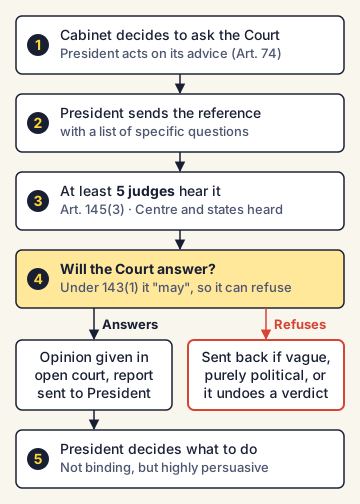
- The Union government decides it wants the Court's view. The President acts on the advice of the Council of Ministers (Article 74), so in practice a reference is the government's decision.
- The President sends the reference to the Supreme Court, with a list of specific questions.
- Under Article 145(3), a bench of at least five judges must hear it. The Court may hear the Centre, the states and other parties as it thinks fit.
- The Court gives its opinion in open court, and sends a report of its opinion to the President.
- The President, on the government's advice, then decides what to do. The opinion does not force any action.
Is the opinion binding?
The Supreme Court has said its Article 143 opinion is not binding in the way a judgment is, but it carries very high persuasive value (St. Xavier's College v. State of Gujarat, 1974). Whether it counts as "law declared" under Article 141, which binds all courts, has never been finally settled. In the Special Courts Bill reference (1978), the Court flagged this question but left it open. In practice, governments and courts treat these opinions with great respect.
When can the Court refuse?
Because Article 143(1) says "may", the Court can return a reference unanswered. It has done so twice:
- Ram Janmabhoomi–Babri Masjid reference (made 1993, returned 1994): The question was whether a temple existed before the mosque. The Court declined to answer it.
- Jammu and Kashmir Resettlement Bill reference (returned 2001): The Court returned it unanswered.
The Court has said it may refuse when the questions are vague, purely political, or not suitable for a legal answer. It has also said Article 143 cannot be used to overturn its own final judgments between parties. The proper way to do that is a review petition under Article 137. This point was stressed in the Cauvery Water Disputes Tribunal reference (1991) and in later references.
The important references (memorise these)
As of October 2026, there have been 16 Presidential References since 1950:
- Delhi Laws Act (1951): the first one; it explained how far Parliament can hand over (delegate) its law-making power to the government.
- Kerala Education Bill (1958): on minority educational institutions (Articles 29 and 30) and how Fundamental Rights relate to the Directive Principles.
- Berubari Union (1960): held that giving away Indian territory to another country (here, Pakistan) needs a constitutional amendment under Article 368, not just a law under Article 3.
- Keshav Singh / Special Reference No. 1 of 1964: a clash between the Uttar Pradesh Assembly and the Allahabad High Court over legislative privilege. Seven judges held that courts can hear petitions from people jailed by a legislature.
- Presidential Poll (1974): on whether the President's election can be held when some state assemblies are dissolved.
- Special Courts Bill (1978): upheld special courts for trying offences by people who held high office during the Emergency.
- Cauvery Water Disputes Tribunal (1991): held that a Karnataka ordinance that tried to override the Tribunal's interim order was unconstitutional.
- Special Reference No. 1 of 1998 (Third Judges case): set out the collegium of the Chief Justice and four senior-most judges for Supreme Court appointments.
- Gujarat Assembly elections (2002): on the Election Commission's duty when an assembly is dissolved early (Articles 174 and 324).
- Natural Resources Allocation (2012): after the 2G spectrum judgment, held that auction is not the only constitutionally allowed way to give out natural resources.
- Assent to Bills (Special Reference No. 1 of 2025): after an April 2025 judgment had set deadlines for Governors and the President to act on state Bills, the President sent 14 questions. On 20 November 2025, a five-judge bench led by Chief Justice B.R. Gavai said courts cannot fix timelines for Governors or the President under Articles 200 and 201 and there is no "deemed assent", though courts can give a limited direction to decide in cases of very long delay.
India's practice
References are rare: about 16 in more than 75 years. They are usually made on big federal or constitutional questions: Centre-state disputes, water-sharing, elections, appointments of judges and assent to Bills. Since only the President (on the Union government's advice) can make a reference, states cannot use Article 143 directly. They can only take part in the hearing.
Commonly confused concepts
- Article 143 vs Article 131: Article 131 is the Supreme Court's original jurisdiction, a real case between the Centre and states (or between states), ending in a binding judgment. Article 143 is advisory, with no parties in dispute and no binding decree.
- Article 143(1) vs 143(2): 143(1) is any question of public importance and the Court may answer; 143(2) is only pre-Constitution treaty and agreement disputes and the Court must answer.
- Article 143 vs Article 137: Article 137 is the power to review the Court's own judgment on a petition. Article 143 cannot be used as a back door to review a judgment.
- Article 143 vs Article 141: Article 141 says law declared by the Supreme Court binds all courts. Whether an advisory opinion is "law declared" is still unsettled.
- Article 143 vs Article 145(3): Article 145(3) is not a separate power. It only says that a 143 reference (and any case on a substantial question of constitutional interpretation) must be heard by at least five judges.
Issues, criticism and the way forward
- Political use: Critics say governments sometimes use references to pass a political problem to the Court, as many argued in the 1993 Ayodhya reference. The Court's power to refuse acts as a check.
- Overturning judgments indirectly: In 2025, some states objected that a reference was being used to undo a recent judgment. The Court has said a reference cannot reverse a decision between parties, but it can clarify the law going forward. Experts debate where this line lies.
- Unclear binding force: Since it is not settled whether an opinion binds lower courts, there can be confusion about its legal weight.
- Delay: Like other large-bench matters, references and referred questions can wait for years, and important questions may stay undecided.
- Way forward: Experts suggest clear rules on when references are appropriate, time-bound hearings, and a final ruling from a large bench on whether advisory opinions bind under Article 141.
Concepts to Know
- Jurisdiction: The power of a court to hear and decide a particular kind of matter.
- Original jurisdiction: When a case starts directly in the Supreme Court, without first going to a lower court (for example, Article 131 Centre-state disputes).
- Sanad: An old grant or charter, often given by the British to princely rulers, recording rights or territory.
- Persuasive value: The opinion is not legally compulsory, but judges and governments give it great weight and usually follow it.
- Deemed assent: The idea that if a Governor or President does not act on a Bill within a time limit, the Bill is treated as approved. The 2025 opinion rejected this idea.
- Collegium: The group of the Chief Justice of India and senior Supreme Court judges that recommends judges for appointment.
- Article 143(1): question of law or fact of public importance; Court "may" give opinion
- Article 143(2): pre-Constitution treaty/agreement disputes excluded by the proviso to Article 131; Court "shall" give opinion
- Origin: Section 213, Government of India Act, 1935 (Federal Court advisory power)
- Article 145(3): minimum five judges to hear a reference
- Opinion not binding like a judgment, but highly persuasive (St. Xavier's College, 1974)
- 16 references since 1950; 2 returned unanswered (Ayodhya, returned 1994; J&K Resettlement Bill, 2001)
- Berubari (1960): ceding territory needs an amendment under Article 368
- Special Reference No. 1 of 1964 (Keshav Singh): seven judges, legislative privilege vs courts
- Special Reference No. 1 of 1998: Third Judges case, collegium of CJI + four senior-most judges
- Special Reference No. 1 of 2025: opinion on 20 November 2025, no judicial timelines and no deemed assent under Articles 200 and 201
● Tracked since October 08, 2026 · last seen October 08, 2026 · updates as the daily brief publishes