Freedom of Speech and Expression
Article 19(1)(a)
Article 19(1)(a) of the Constitution gives every citizen of India the right to freedom of speech and expression. This means you can share your views and ideas by speaking, writing, printing, pictures, films, the internet or any other medium. It is one of the most important fundamental rights in a democracy, because people can only choose and question their government if they can speak freely. But the right is not absolute: Article 19(2) lets the State place "reasonable restrictions" on it for certain fixed reasons.
Why does it exist?
Democracy runs on open debate. Voters need information, and citizens must be able to criticise those in power without fear. Free speech also helps truth come out, because wrong ideas can be challenged openly. It lets each person develop and express who they are.
Where did it come from?
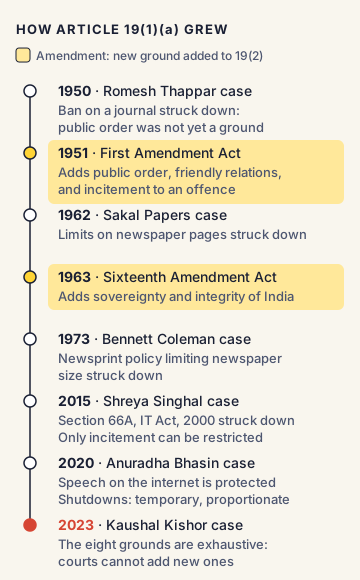
The Constituent Assembly placed free speech in Part III (Fundamental Rights). Soon after, in Romesh Thappar v. State of Madras (1950), the Supreme Court struck down a ban on a journal because "public order" was not then a ground for restriction. In response, the First Amendment Act, 1951 rewrote Article 19(2) and added three grounds: public order, friendly relations with foreign States and incitement to an offence. The Sixteenth Amendment Act, 1963 added sovereignty and integrity of India.
What are the eight grounds for restriction under Article 19(2)?
- Sovereignty and integrity of India
- Security of the State
- Friendly relations with foreign States
- Public order
- Decency or morality
- Contempt of court
- Defamation
- Incitement to an offence
The restriction must be made by a law, it must be reasonable, and it must be tied to one of these eight grounds. In Kaushal Kishor v. State of Uttar Pradesh (2023), a Constitution Bench said the list is exhaustive: no new ground can be added by courts or by using other rights.
What does the right include?
The Supreme Court has read many things into it:
- Freedom of the press: Not written in the text but part of Article 19(1)(a). In Sakal Papers v. Union of India (1962), the Court struck down limits on the number of pages a newspaper could print. In Bennett Coleman v. Union of India (1973), it struck down a newsprint policy that limited newspapers' size.
- Right to know and right to information: Citizens have a right to receive information, which supports laws like the RTI Act.
- Right to remain silent: Freedom of speech includes the freedom not to speak.
- Speech on the internet: In Anuradha Bhasin v. Union of India (2020), the Court held that expression through the internet is protected, and internet shutdowns must be temporary, necessary and proportionate.
- Commercial speech (advertising) and the right to fly the national flag are also protected.
How do courts test a restriction?
In Shreya Singhal v. Union of India (2015), the Court struck down Section 66A of the Information Technology Act, 2000, which punished "offensive" online messages. It drew three levels of speech:
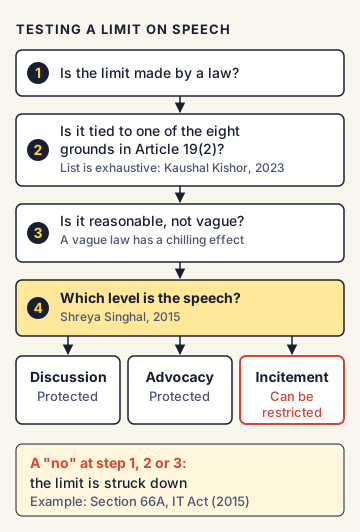
- Discussion: fully protected.
- Advocacy of a cause, even an unpopular one: protected.
- Incitement: only at this level, when speech is closely linked to causing disorder, can it be restricted.
A vague law that can catch innocent speech has a "chilling effect" (it scares people into silence) and is likely to be struck down.
Who has this right?
Only citizens, not foreigners. Companies cannot claim it directly, but their shareholders who are citizens can, as in the newspaper cases. The right is mainly enforced against the State, not private persons.
Commonly confused concepts
- Article 19(1)(a) vs Article 105(1)/194(1): Article 19(1)(a) is every citizen's right, subject to Article 19(2). Free speech of members inside the House comes from Articles 105 and 194 and is wider: they cannot be sued for what they say there.
- Article 19 vs Article 21: Article 19 rights belong only to citizens and can be restricted on eight grounds. Article 21 (life and personal liberty) belongs to everyone, and the law that limits it must be "just, fair and reasonable".
- Reasonable restriction vs ban: A restriction limits a right in a narrow, proportionate way; a total ban is rarely reasonable.
- Article 19 during Emergency: Under Article 358, Article 19 is automatically suspended when a National Emergency is declared on grounds of war or external aggression (not armed rebellion). Articles 20 and 21 can never be suspended.
Issues, criticism and the way forward
- Clash with legislative privilege: The Sharma case (1958) placed privilege above free speech, and no larger bench has revisited this. Journalists can still face privilege action for critical writing.
- Sedition and defamation: Critics argue that colonial-era offences like sedition and criminal defamation are used to silence critics. The Supreme Court put sedition cases on hold in 2022, and the Bharatiya Nyaya Sanhita, 2023 replaced the old sedition section with a new offence (Section 152) on acts endangering sovereignty, unity and integrity.
- Internet shutdowns and online rules: Frequent shutdowns and content-blocking orders raise concerns about proportionality.
- The other view: The State argues that some limits are needed to stop hate speech, fake news and violence, especially online.
- Way forward: Narrow, clearly written laws; independent review of blocking and shutdown orders; and codifying legislative privileges so that they are tested against Article 19.
Concepts to Know
- Fundamental Rights: Basic rights in Part III of the Constitution (Articles 12 to 35) that the courts protect. If they are violated, you can go directly to the Supreme Court under Article 32.
- Reasonable restriction: A limit on a right that is fair, not excessive, and linked to a valid purpose listed in the Constitution.
- Chilling effect: When a vague or harsh law makes people afraid to speak, even about lawful things.
- Proportionality: A test that asks whether a restriction is the least harmful way to reach a legitimate goal.
- Article 19(1)(a): freedom of speech and expression, for citizens only
- Article 19(2): eight grounds of reasonable restriction
- First Amendment Act, 1951: added public order, friendly relations with foreign States, incitement to an offence
- Sixteenth Amendment Act, 1963: added sovereignty and integrity of India
- Romesh Thappar (1950); Sakal Papers (1962); Bennett Coleman (1973); Shreya Singhal (2015, Section 66A struck down); Anuradha Bhasin (2020); Kaushal Kishor (2023, grounds exhaustive)
- Article 358: Article 19 suspended during a war/external aggression Emergency
● Tracked since July 20, 2026 · last seen October 05, 2026 · updates as the daily brief publishes