Parliamentary Privileges (Articles 105 and 194)
Parliamentary privileges are special rights and protections given to Parliament, the state legislatures, their members and their committees. They exist so that lawmakers can speak and work freely, without fear of being sued or punished for what they say in the House. Article 105 covers Parliament and Article 194 covers state legislatures. The two articles are almost word for word the same.
Why do privileges exist?
A legislature debates hard questions, often against powerful people. If an MP could be sued for defamation for every sharp speech, members would stay quiet. Privileges also let the House protect its own dignity and run its business without outside interference. Think of it like a referee's whistle in a match: the rules of the game protect the referee, so that the game can go on fairly. Privileges are given to help the House do its job, not to place members above the law.
Where did the idea come from?
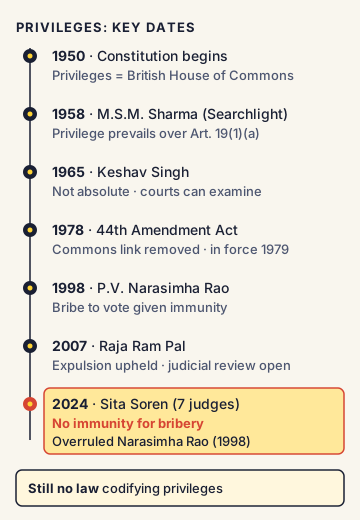
Privileges grew in the British Parliament over centuries, as it struggled for independence from the King. India's Constitution borrowed the idea. Originally, Articles 105(3) and 194(3) said that until a law was made, privileges would be the same as those of the British House of Commons on 26 January 1950. The 44th Amendment Act, 1978 removed the reference to the House of Commons.
Now privileges are those that the House had just before that amendment came into force (20 June 1979), until Parliament or the state legislature defines them by law. No such law has been made yet, so privileges are still largely uncodified (not written down in one place).
What do Articles 105 and 194 say?
- Clause (1): Freedom of speech in the House. Members have freedom of speech in the legislature, subject to the Constitution and the House's own rules.
- Clause (2): Immunity from courts. No member can be taken to court for anything said or any vote given in the House or its committees. No one can be sued for publishing a report or paper of the House under its authority.
- Clause (3): Other privileges. Powers and privileges as defined by law, and until then, those existing before the 44th Amendment.
- Clause (4): These protections also apply to non-members who have the right to speak in the House, such as the Attorney General (for Parliament) and the Advocate General (for a state).
What are the main privileges?
- Collective privileges (of the House as a whole): the right to publish or stop publication of its debates; to hold secret sittings; to make its own rules; to punish members and outsiders for breach of privilege or contempt; to be told at once when a member is arrested.
- Individual privileges (of each member): freedom of speech in the House; freedom from arrest in civil cases during a session and 40 days before and after it (not in criminal cases or preventive detention); exemption from jury service and from giving evidence in a court while the House is sitting.
Breach of privilege vs contempt of the House
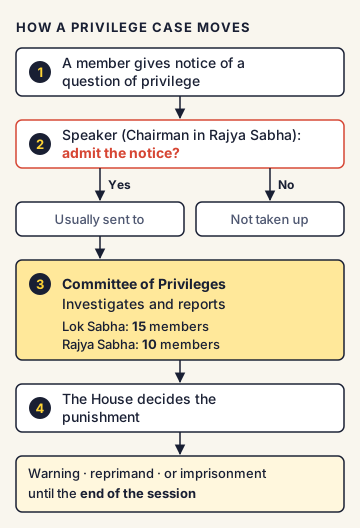
A breach of privilege is when someone ignores or attacks one of the specific privileges, for example, publishing false reports of proceedings. Contempt of the House is wider: any act that blocks the House in its work or lowers its dignity, even if no specific privilege is involved. The House can punish both, by a warning, a reprimand, or even imprisonment until the end of the session.
How is a privilege case handled?
A member gives a notice of a question of privilege. The Speaker (or Chairman in the Rajya Sabha) decides whether to admit it. The matter is usually sent to the Committee of Privileges, which investigates and reports. The House then decides on punishment. In the Lok Sabha, the Privileges Committee has 15 members; in the Rajya Sabha it has 10.
What have the courts said?
- Pandit M.S.M. Sharma v. Shri Krishna Sinha (1958, the "Searchlight" case): The editor of a Patna newspaper published parts of a Bihar Assembly debate that the Speaker had ordered removed. The Supreme Court said that legislative privileges under Article 194(3) prevail over the right to free speech under Article 19(1)(a).
- Keshav Singh case (Special Reference No. 1 of 1964, opinion 1965): The Uttar Pradesh Assembly jailed a man for contempt, and then tried to act against the High Court judges who granted him bail. The Court said privileges are not absolute. Courts can examine whether a privilege exists, and a legislature cannot punish judges for doing their judicial work.
- Raja Ram Pal v. Speaker, Lok Sabha (2007): The Court upheld the expulsion of MPs caught in a cash-for-questions sting. It also said the use of privileges is open to judicial review if it is grossly illegal or violates fundamental rights.
- Sita Soren v. Union of India (4 March 2024): A seven-judge bench unanimously said that taking a bribe to vote or speak in the House is not protected by Articles 105(2) and 194(2). It overruled the 1998 P.V. Narasimha Rao judgment, which had given such immunity.
The unresolved question
Sharma says privilege beats free speech. Later cases say privileges must respect fundamental rights such as Article 21 (life and personal liberty). Whether a House can jail a journalist for criticism, and how far courts can step in, has never been settled by a large bench. The N. Ravi reference was meant to answer this.
India's position and practice
Privilege notices are moved often in Parliament and state assemblies, for example against ministers for allegedly misleading the House, or against outsiders for remarks about members. The National Commission to Review the Working of the Constitution (NCRWC, report 2002) and others have recommended that privileges be codified so that everyone knows their limits.
Commonly confused concepts
- Article 105 vs Article 194: Same content; 105 is for Parliament, 194 is for state legislatures.
- Article 105 vs Article 122 (and 194 vs 212): Articles 105 and 194 protect members and the House. Articles 122 and 212 stop courts from questioning the validity of proceedings on grounds of mere irregularity of procedure.
- Article 105 vs Article 361A: Article 361A (added by the 44th Amendment) protects the media for publishing a substantially true report of proceedings, unless the report is malicious. It protects the press, not members.
- Civil vs criminal arrest: Freedom from arrest covers only civil cases, not criminal charges or preventive detention.
Issues, criticism and the way forward
- No codification: Because privileges are not listed in a law, the House decides for itself what counts as a breach. Critics say this makes the House a judge in its own cause.
- Use against the press: Sentences against journalists, like the 2003 Tamil Nadu case, are criticised as a threat to free speech and a free press.
- Democratic need: Supporters say legislatures need strong privileges to protect their independence from the executive and courts.
- Way forward: Codify privileges by law, so that they can be tested against fundamental rights; set clear limits on punishing outsiders; and use the power sparingly.
Concepts to Know
- Immunity: Protection from being sued or prosecuted.
- Codification: Writing rules down clearly in a law, instead of relying on old practice.
- Infructuous: A case that has lost its purpose, usually because the cause of the dispute has ended. Courts usually close such cases.
- Reference to a larger bench: When a smaller bench feels a question is important or earlier rulings conflict, it sends the case to a bench with more judges. Under Article 145(3), at least five judges must hear cases involving a substantial question about interpreting the Constitution.
- Simple imprisonment: Jail without hard labour.
- Article 105: Parliament; Article 194: state legislatures
- 44th Amendment Act, 1978 removed the House of Commons reference (in force 20 June 1979)
- Freedom from civil arrest: during session and 40 days before and after
- M.S.M. Sharma (1958): privileges prevail over Article 19(1)(a)
- Keshav Singh (1965): privileges not absolute, courts can review
- Raja Ram Pal (2007): expulsion upheld, judicial review available
- Sita Soren (2024, seven judges): no immunity for bribery; overruled P.V. Narasimha Rao (1998)
● Tracked since October 05, 2026 · last seen October 05, 2026 · updates as the daily brief publishes