Additional Tier 1 (AT1) Bonds
The Bank Capital That Can Be Written Off
Additional Tier 1 bonds, or AT1 bonds, are a special kind of bond that banks sell to raise money that counts as their own capital. They have no maturity date, so the bank never has to repay them on a fixed day. They pay a higher interest rate than normal bonds. In return, the buyer accepts a big risk: if the bank gets into serious trouble, the bond can be written off (cancelled, fully or partly) or converted into shares, and the investor can lose money.
Why do banks need such bonds?
A bank lends out mostly other people's money, the deposits. If some loans go bad, the bank needs a cushion of its own money to absorb the loss, so that depositors are not hurt. This cushion is called capital. The best capital is the owners' money (shares and saved profits), but raising new shares is costly and reduces the existing owners' stake.
AT1 bonds sit in between. They are bonds, but they are built to take losses like shares. So regulators allow a bank to count them as part of its core (Tier 1) capital.
Where did they come from?
Before the 2008 global financial crisis, banks issued many "hybrid" bonds that were supposed to be capital. When banks failed, these bonds did not actually absorb losses. Governments had to rescue the banks with taxpayers' money. To fix this, the Basel III rules, published by the Basel Committee on Banking Supervision in December 2010, made one demand: any bond counted as capital must be able to absorb losses before taxpayers pay.
AT1 bonds are the result. In India, the RBI brought in Basel III capital rules from 1 April 2013, and banks started issuing AT1 bonds after that.
How do AT1 bonds work?
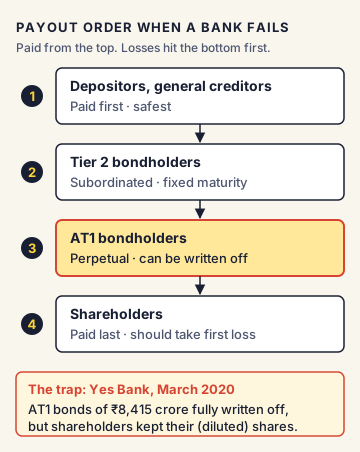
Think of a bank's money as a building with floors. Depositors stand on the top floor, safest of all. Normal lenders are on the floors below them. AT1 bondholders are near the bottom, only one floor above the shareholders. When floodwater (losses) enters, the lowest floors fill first. The RBI's rules for AT1 bonds in India include:
- Perpetual: no maturity date and no promise of repayment.
- Call option: the bank may buy back (call) the bond, but only after at least 5 years and only with RBI approval. Investors often expect a call at year 5, but it is not guaranteed.
- Discretionary interest: the bank can skip the interest (coupon) payment at any time, and a skipped payment is not carried forward (it is non-cumulative). Interest can be paid only out of distributable profits and reserves.
- Loss absorption at a trigger: if the bank's best-quality capital (Common Equity Tier 1, or CET1) falls below a set level, the bond must be written down or converted into shares. In India this trigger is set at a CET1 ratio of 6.125% of risk-weighted assets.
- Point of Non-Viability (PONV): the RBI can decide that a bank will fail without help. At this point, the RBI can order AT1 bonds to be written off, even if the CET1 trigger has not been hit.
Where do AT1 bonds rank?
If a bank is closed and its assets are sold, money is paid out in a fixed order. Depositors and general creditors are paid first. Then holders of subordinated Tier 2 bonds. Then AT1 holders. Shareholders come last. So AT1 bondholders rank just above shareholders.
India's experience: the Yes Bank case
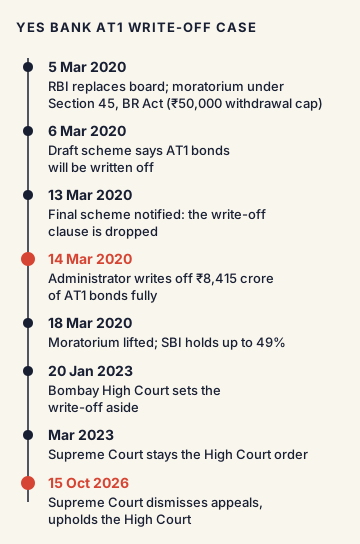
Yes Bank, a private bank, ran into trouble in 2019–20 because of large bad loans. On 5 March 2020, the RBI replaced its board and appointed an administrator, and the central government placed the bank under a moratorium (a temporary freeze, with withdrawals capped at ₹50,000 per depositor) under Section 45 of the Banking Regulation Act, 1949.
The draft rescue scheme, released on 6 March 2020, said the AT1 bonds would be written off. The final Yes Bank Limited Reconstruction Scheme, 2020, notified on 13 March 2020, did not have this clause. State Bank of India (SBI) put in fresh capital for up to 49% of the bank, and the moratorium was lifted on 18 March 2020.
On 14 March 2020, the administrator wrote off ₹8,415 crore of AT1 bonds fully. Shareholders, however, kept their shares (diluted, not wiped out).
What did the courts decide?
Bondholders challenged the write-off. On 20 January 2023, the Bombay High Court set it aside. It said the bank had already been reconstituted under the final scheme on 13 March 2020. After that, the administrator could not take such a major policy decision on his own, the RBI had not authorised it, and the final scheme had dropped the write-off clause. The Supreme Court stayed this order in March 2023. On 15 October 2026, it dismissed the appeals and upheld the High Court's view.
Who can buy AT1 bonds in India now?
Many small investors had bought Yes Bank's AT1 bonds believing they were as safe as a fixed deposit. After the write-off, there were complaints of mis-selling (selling a risky product without explaining the risk). On 6 October 2020, the Securities and Exchange Board of India (SEBI) said that fresh AT1 issues can be sold only to Qualified Institutional Buyers (large professional investors), with a minimum allotment and trading lot of ₹1 crore. This keeps ordinary retail investors out of new issues.
Commonly confused concepts
- AT1 bond vs Tier 2 bond: AT1 bonds are perpetual and count in Tier 1 capital. Tier 2 bonds have a fixed maturity (at least 5 years) and count only in the weaker Tier 2 capital. In a failure, Tier 2 holders are paid before AT1 holders.
- AT1 bond vs fixed deposit: A fixed deposit is a bank's debt to you, repaid on a date and insured up to ₹5 lakh per depositor per bank by the Deposit Insurance and Credit Guarantee Corporation (DICGC). An AT1 bond has no repayment date and no insurance, and can be written off.
- AT1 bond vs preference share: Both rank above ordinary shares and both may skip payouts. But a preference share is ownership, while an AT1 bond is a debt instrument designed to act like capital.
- Write-off vs conversion: In a write-off, the bond's value is cancelled. In a conversion, the bond is turned into ordinary shares, so the investor at least becomes an owner.
Issues, criticism and the way forward
- Order of losses: In both the Yes Bank case and the Swiss Credit Suisse case (March 2023, about CHF 16 billion of AT1 bonds wiped out while shareholders still got some value), AT1 holders lost more than shareholders. Critics say this breaks the normal rule that shareholders take the first loss. Regulators argue the bond contracts allowed it.
- Mis-selling: Retail investors, including senior citizens, were reportedly sold these bonds as safe products. This raised questions about bank sales practices and investor protection.
- Legal certainty vs speed of rescue: Regulators need to act fast to save a bank and protect depositors. The courts' view is that even in a crisis, a write-off must have clear legal authority under the scheme. Experts say future rescue schemes must spell out what happens to each class of investor.
- Effect on the market: If investors fear write-offs, banks must pay higher interest on AT1 bonds, making capital costlier. If write-offs can be undone by courts, the loss-absorbing role of AT1 bonds is weakened. The way forward suggested by many experts is clearer rules on PONV, a statutory bank resolution framework, and full risk disclosure to buyers.
Concepts to Know
- Bond: A paper that says you lent money to someone (a company, bank or government), who promises to pay you interest. Most bonds also promise to return your money on a fixed date.
- Coupon: The interest paid on a bond, usually once or twice a year.
- Risk-weighted assets (RWA): A bank's loans and investments, adjusted for how risky each one is. A safe government bond counts for little; a risky loan counts for more. Capital rules are written as a percentage of RWA.
- Common Equity Tier 1 (CET1): The strongest form of bank capital: the owners' share money plus profits the bank has saved.
- Moratorium: A temporary freeze ordered by the government on a troubled bank's business, such as limits on withdrawals, while a rescue plan is made.
- Administrator: An official appointed by the RBI to run a bank after its board of directors is removed.
- Subordinated: "Lower in the queue". A subordinated lender is paid only after senior lenders are paid in full.
- AT1 bonds: perpetual, non-cumulative discretionary coupons, call only after at least 5 years with RBI approval
- Loss-absorption: write-down or conversion at a CET1 trigger of 6.125% of RWA, or at the Point of Non-Viability decided by the RBI
- Basel III published December 2010; RBI implementation began 1 April 2013
- Yes Bank: moratorium from 5 March 2020 (Section 45, Banking Regulation Act, 1949); final reconstruction scheme notified 13 March 2020; moratorium lifted 18 March 2020; SBI took up to 49%
- AT1 write-off: ₹8,415 crore (₹3,000 crore of 2016 + ₹5,415 crore of 2017), ordered on 14 March 2020
- Bombay High Court set it aside on 20 January 2023; Supreme Court upheld this on 15 October 2026 (Justices Dipankar Datta and Augustine George Masih)
- SEBI circular, 6 October 2020: AT1 issues only for Qualified Institutional Buyers; minimum allotment and trading lot ₹1 crore
- Credit Suisse (March 2023): about CHF 16 billion of AT1 bonds written off
● Tracked since November 16, 2026 · last seen November 16, 2026 · updates as the daily brief publishes