Yalta Conference (1945)
The Yalta Conference was a meeting of the three main Allied leaders of the Second World War, held from 4 to 11 February 1945 at the Livadia Palace in Yalta, in Crimea (then part of the Soviet Union). The "Big Three" were US President Franklin D. Roosevelt, British Prime Minister Winston Churchill and Soviet leader Joseph Stalin.
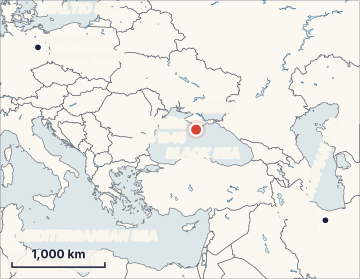
With Nazi Germany close to defeat, they met to decide what would happen to Germany, to Europe and to the world after the war. Many of their decisions shaped the world for the next 45 years, including the division of Europe and the creation of the United Nations.
Why was the conference needed?
By early 1945, Soviet armies were moving into Germany from the east, and American and British armies from the west. Germany was about to lose, but the war against Japan was still going on. The Allies had to agree on three big questions: how to deal with a defeated Germany, what to do with the countries of Eastern Europe that Soviet troops had freed from Germany, and how to stop another world war from happening.
Where does it fit in history?
Yalta was the second of three wartime summits of the Big Three:
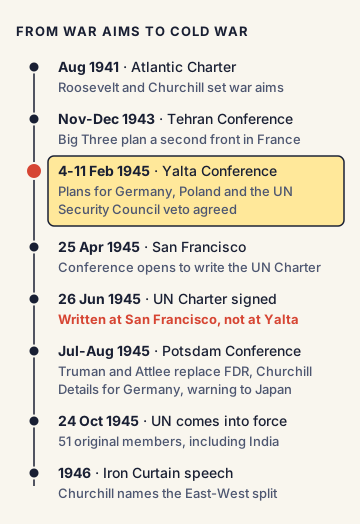
- Tehran Conference (28 November to 1 December 1943, Iran): the Western Allies promised to open a "second front" in France to take pressure off the Soviet Union.
- Yalta Conference (4 to 11 February 1945, Crimea): the plans for post-war Europe and the United Nations.
- Potsdam Conference (17 July to 2 August 1945, near Berlin): Harry Truman had replaced Roosevelt, who died in April 1945, and Clement Attlee replaced Churchill partway through after a British election. Potsdam worked out the details for Germany and issued a final warning to Japan.
What was decided at Yalta?
The main decisions were:
- Germany: It would be divided into four zones of occupation, run by the US, Britain, the Soviet Union and France. The capital, Berlin, which lay inside the Soviet zone, would also be split into four parts. Germany would be fully disarmed and "denazified" (Nazi leaders and ideas removed from public life).
- Reparations (war payments): The US and Soviet leaders accepted a figure of US$20 billion as the starting point for talks on what Germany should pay, with 50% to go to the Soviet Union, which had suffered the most damage. Britain did not agree to name any figure yet. A Reparations Commission was set up in Moscow to work out the details.
- Poland: The Soviet-Polish border would follow roughly the Curzon Line, with small shifts of 5 to 8 km in Poland's favour. So the Soviet Union kept the lands east of this line, which had belonged to Poland before 1939. Poland would be given German land in the west in return. The provisional Polish government already in power, which the Soviet Union backed, would be reorganised to include democratic leaders from inside Poland and from Poles living abroad. It would then hold "free and unfettered elections".
- Declaration on Liberated Europe: The three leaders promised that the peoples of Europe freed from Nazi rule could choose their own governments through free elections.
- War against Japan: Stalin agreed to enter the war against Japan two or three months after Germany's surrender. In return, the Soviet Union would get the southern half of Sakhalin island and the Kuril Islands from Japan.
- United Nations: They agreed to call a conference to open in San Francisco on 25 April 1945, to write the UN Charter. They settled how voting would work in the Security Council (the small UN body that decides on matters of war and peace): the five permanent members would each have a veto (the power to block a decision) on all matters except procedural ones. The Soviet Union had asked for all 16 of its republics to get seats in the General Assembly; it settled for three seats in total: the USSR itself, Ukraine and Byelorussia (now Belarus).
What happened next?
The UN Charter was signed on 26 June 1945 and came into force on 24 October 1945. India, though still a British colony, was one of the 51 original members. But the promises of free elections in Eastern Europe were not kept. Soviet-backed communist governments took power in Poland and other countries. Europe split into a Western bloc and a Soviet bloc, a division Churchill described in 1946 as an "Iron Curtain". This split became the Cold War, which lasted until 1991.
Why is Yalta still remembered today?
Yalta has become a symbol of great powers deciding the fate of smaller nations without asking them. Poland was not at the table when its borders were moved. Critics in Eastern Europe often call it a "betrayal". Others argue that the Soviet army already controlled Eastern Europe, so the Western leaders had little real choice. Historians also point out that Yalta did not, by itself, "carve up" Europe; it was later events that turned zones and promises into a hard divide.
This is why the phrase "a new Yalta" is used whenever big powers meet to settle world issues among themselves. It raises the fear of spheres of influence: areas where one big power expects to have the final say over its smaller neighbours.
India's position and the Indian angle
India has always opposed the idea of a few powers deciding the world's future alone.
- India was a founding member of the Non-Aligned Movement (NAM), formally started at Belgrade in 1961, so that newly free countries would not have to join either Cold War bloc.
- India argues that the UN Security Council, whose permanent members and veto came out of the Yalta-era bargain, reflects the world of 1945, not today. It seeks reform and a permanent seat.
- India's foreign policy today stresses strategic autonomy (making its own choices based on national interest) and a multipolar world with many centres of power, including India.
Commonly confused concepts
- Yalta vs Potsdam vs Tehran: Tehran (1943) planned the war; Yalta (February 1945) planned post-war Europe and the UN; Potsdam (July-August 1945) settled details for Germany after it surrendered and warned Japan. Roosevelt and Churchill were at Yalta; Truman and, later, Attlee were at Potsdam.
- Yalta vs San Francisco Conference: Yalta only agreed to create the UN and settled Security Council voting; the UN Charter itself was written and signed at San Francisco (25 April to 26 June 1945).
- Yalta vs Atlantic Charter (1941): the Atlantic Charter was a statement of war aims by Roosevelt and Churchill alone, in August 1941, before the US entered the war.
- Sphere of influence vs alliance: an alliance is a formal agreement between equals to defend each other; a sphere of influence is an area where one big power dominates smaller states, often without their consent.
- Bipolar vs multipolar world: the Cold War world was bipolar (two superpowers). A multipolar world has several major powers.
Issues, criticism and the way forward
- Rights of smaller nations: Yalta is criticised because Poland and other Eastern European nations had no voice. Today, Ukraine fears a similar deal over its territory.
- Promises without enforcement: the promise of free elections had no way to be enforced, so it was broken. This is often cited as a lesson that agreements need checks and verification.
- The veto question: the Security Council veto agreed in the Yalta era still lets any one permanent member block action, which many countries, including India, see as unfair today.
- Defenders' view: some historians say Yalta reflected military reality and secured Soviet entry into the war against Japan and Soviet participation in the UN, which mattered at the time.
- Way forward: most countries, India included, call for a rules-based order with reformed global institutions, where big-power talks support, rather than replace, the voices of all nations.
Concepts to Know
- Allies (Second World War): the countries that fought against Germany, Italy and Japan, led by the US, Britain, the Soviet Union and China.
- Occupation zone: an area of a defeated country that is controlled and run by a foreign army for a period after a war.
- Reparations: money or goods that a defeated country is made to pay for the damage it caused in a war.
- Curzon Line: a line proposed in 1919-1920, named after British Foreign Secretary Lord Curzon, as a border between Poland and Soviet Russia. After 1945 it became, roughly, Poland's eastern border.
- Veto: the power of one member to block a decision, even if all others agree. In the UN Security Council, only the five permanent members (US, UK, Russia, China, France) have it. In 1945 the seat was held by the Soviet Union; Russia took it over in 1991.
- Cold War: the long period of rivalry (about 1947 to 1991) between the US-led West and the Soviet-led East, without direct full war between the two.
- Dates and venue: 4-11 February 1945, Livadia Palace, Yalta, Crimea
- Leaders: Franklin D. Roosevelt (US), Winston Churchill (UK), Joseph Stalin (USSR)
- Germany and Berlin each divided into 4 zones (US, UK, USSR, France)
- Reparations: US$20 billion as the basis for talks (agreed by the US and USSR; Britain named no figure), 50% to the USSR
- Soviet entry into war against Japan 2 or 3 months after Germany's surrender; reward: southern Sakhalin and the Kuril Islands
- San Francisco Conference to open on 25 April 1945; UN Charter signed 26 June 1945, in force 24 October 1945; 51 original members including India
- USSR got 3 General Assembly seats: USSR, Ukrainian SSR, Byelorussian SSR
- Tehran: 28 November to 1 December 1943; Potsdam: 17 July to 2 August 1945
● Tracked since November 19, 2026 · last seen November 19, 2026 · updates as the daily brief publishes