Spheres of Influence
How Great Powers Divide the World
A sphere of influence is an area outside a powerful country's borders where that country claims special rights to control or shape what happens. The smaller countries inside the area remain independent on paper. But in practice, the big power expects them to follow its lead in politics, security or trade, and it tries to keep rival powers out.
You can think of it like a big landlord who does not own the houses on a street, but still decides who can visit, who can open a shop and who can build a wall there.
Why does the idea exist?
Big powers worry most about threats close to home. A great power does not want a rival's army, bases or missiles next to its borders. So it tries to create a "safety belt" of friendly or obedient countries around itself. Spheres of influence also help big powers avoid fighting each other directly. If two powers quietly agree "this area is yours, that area is mine", they reduce the chance of a war between them. The problem is that the smaller countries inside these spheres usually have no say in the deal.
Where did it come from?
The idea is very old, but the term became common during the age of European empires in the 19th century. Its history shows a few clear stages:
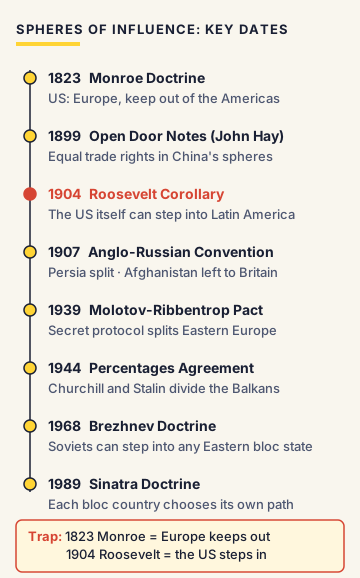
- Monroe Doctrine (1823): On 2 December 1823, US President James Monroe declared that the Americas (the "Western Hemisphere") were closed to new European colonisation, and that European meddling there would be seen as a threat to the US. In return, the US would stay out of European affairs. It is often called the first big sphere-of-influence claim.
- Roosevelt Corollary (1904): President Theodore Roosevelt added that the US could step into the internal affairs of Latin American countries in cases of "chronic wrongdoing". This turned the Monroe Doctrine from "Europe, keep out" into "the US can step in".
- The scramble for China (1890s): Britain, France, Germany, Russia and Japan each grabbed special trade and railway rights in parts of China. In 1899, US Secretary of State John Hay sent the Open Door Notes, asking all powers to give every country equal trading rights inside their Chinese spheres. A second note in 1900 asked them to respect China's territorial integrity (its borders staying whole).
- Anglo-Russian Convention (1907): Britain and Russia, rivals in the "Great Game" in Central Asia, signed this deal on 31 August 1907 in St Petersburg. They split Persia (Iran) into a Russian zone in the north, a British zone in the south-east and a neutral zone in between. Russia accepted that Afghanistan was outside its sphere and agreed to deal with Afghanistan only through Britain. Both agreed to deal with Tibet only through China. Britain's goal was to protect British India.
- Molotov-Ribbentrop Pact (23 August 1939): Nazi Germany and the Soviet Union signed a public non-aggression pact with a secret protocol that split Eastern Europe into German and Soviet spheres. Poland was to be divided along the Narew, Vistula and San rivers. Finland, Estonia and Latvia went to the Soviet sphere. Lithuania was first put in the German sphere and then moved to the Soviet sphere by a second secret protocol of 28 September 1939. The secret protocol first came to public notice at the Nuremberg trials after the war. The Soviet Union denied that it existed until December 1989.
- The "Percentages Agreement" (October 1944): At a meeting in Moscow that began on 9 October 1944, British Prime Minister Winston Churchill passed Soviet leader Joseph Stalin a note dividing influence in the Balkans by percentage. Churchill's note gave the Soviet Union 90% in Romania and 75% in Bulgaria, Britain 90% in Greece, and split Hungary and Yugoslavia 50-50. Historians still argue over how serious or binding this note was.
- Yalta (February 1945) and the Cold War: At Yalta and after, Europe ended up split into a Soviet-controlled East and a US-led West. The Brezhnev Doctrine (named after Soviet leader Leonid Brezhnev and set out in 1968, after the invasion of Czechoslovakia by the Warsaw Pact, the Soviet-led military alliance of Eastern Europe) said the Soviet Union could step in whenever socialism was threatened in a bloc country. In October 1989, a Soviet spokesman joked that this had been replaced by the "Sinatra Doctrine", after the song "My Way": each country could now choose its own path.
How does a sphere of influence work?
A big power rarely writes "you obey us" in a treaty. Instead it uses a mix of tools:
- Military: bases, alliances, arms supplies, or the threat of force. The Cuban Missile Crisis (October 1962) began when the Soviet Union placed missiles in Cuba, inside what the US saw as its own sphere.
- Economic: trade deals, loans, aid and control over key resources such as oil, ports and railways.
- Political: backing friendly governments, and pressure against unfriendly ones.
- Agreements among big powers: sometimes open, often secret, deals that "you stay out of my area, I stay out of yours".
What does international law say?
Modern international law does not recognise spheres of influence. The UN Charter (1945) and later agreements such as the Helsinki Final Act are built on the opposite ideas:
- UN Charter, Article 2(1): all member states have sovereign equality. A small country has the same legal rights as a big one.
- UN Charter, Article 2(4): members must not use or threaten force against the territorial integrity or political independence of any state.
- Helsinki Final Act (1 August 1975): this is a separate document, not part of the UN Charter. It is a political promise, not a binding treaty. It was signed by 35 countries (33 European states plus the US and Canada). It affirmed principles such as the inviolability of frontiers (borders must not be changed by force), territorial integrity and non-intervention in internal affairs.
So when people today talk of "a new Yalta", they mean a feared return to a world where big powers decide the fate of smaller ones, even though the law says all countries are equal.
Spheres of influence today
The idea has come back into debate in the 21st century:
- Russia's "near abroad": Russia sees the former Soviet countries around it as a special zone. In December 2021, it published draft treaties asking the US and NATO (the North Atlantic Treaty Organization, the US-led Western military alliance) to promise no further NATO enlargement, including to Ukraine. NATO and the US rejected the demand, and Russia's full invasion of Ukraine followed in February 2022.
- China and its neighbourhood: Critics say China seeks a sphere in the South China Sea and through the Belt and Road Initiative. China says it does not seek spheres and calls for a "community with a shared future".
- The United States: Commentators note the US still treats the Western Hemisphere as a zone where outside powers should not gain a strong foothold.
India's position and Indian examples
India has seen this idea from both sides:
- As a victim: India was a British colony, so Indians had no say in the deals Britain made around them. British India's frontier policy, the 1907 Anglo-Russian Convention and the "Great Game" also decided the fate of Afghanistan, Persia and Tibet without asking their people.
- As a regional power: Commentators use the term "Indira Doctrine" (named in a 1983 article by political scientist Bhabani Sen Gupta) for India's view that outside powers should not intervene in South Asia's conflicts in ways that harm India, and that regional disputes should be settled bilaterally. Indian governments never officially used this label.
- Bhutan: The 1949 India-Bhutan Friendship Treaty (Article 2) said Bhutan would be "guided by the advice" of India in its foreign relations. The revised treaty of 2007 removed this clause. The new Article 2 says the two countries will cooperate closely on their national interests, and that neither country will let its territory be used against the other's national security and interest.
- Official stand: India rejects spheres of influence. It calls for a multipolar world (many centres of power) and a rules-based order that respects sovereignty and territorial integrity. Its doctrine of strategic autonomy means India refuses to sit inside any great power's camp.
Commonly confused concepts
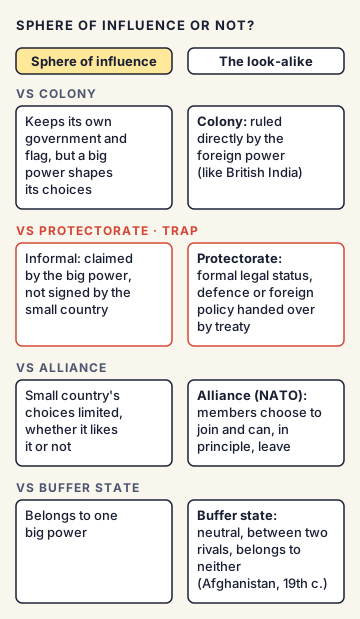
- Sphere of influence vs colony: A colony is ruled directly by the foreign power (like British India). In a sphere of influence, the country keeps its own government and flag, but a big power shapes its choices.
- Sphere of influence vs protectorate: A protectorate is a formal legal status. A weaker state hands over its defence or foreign policy to a stronger state by treaty. A sphere of influence is usually informal, claimed rather than signed by the smaller country.
- Sphere of influence vs alliance: In an alliance (like NATO), members choose to join and can, in principle, leave. In a sphere of influence, the smaller country's choices are limited by a big power whether it likes it or not.
- Sphere of influence vs buffer state: A buffer state is a neutral country placed between two rival powers to keep them apart (Afghanistan in the 19th century, Nepal between India and China in many accounts). A buffer is meant to belong to neither side; a sphere belongs to one.
- Monroe Doctrine vs Roosevelt Corollary: The Monroe Doctrine (1823) told Europe to keep out of the Americas. The Roosevelt Corollary (1904) said the US itself could step into Latin American countries. Students often swap them.
- Brezhnev Doctrine vs Sinatra Doctrine: The Brezhnev Doctrine (1968) allowed Soviet intervention in the Eastern bloc. The Sinatra Doctrine (1989) ended it.
- UN Charter vs Helsinki Final Act: Sovereign equality (Article 2(1)) and the ban on force (Article 2(4)) are in the UN Charter of 1945. The Helsinki Final Act of 1975 is a separate, non-binding agreement among 35 states. Do not mix up which document says what.
Issues, criticism and the way forward
- It ignores small countries: The biggest criticism is moral and legal. The people of Poland, Persia or Ukraine never agreed to be "in" someone's sphere. Spheres treat small nations as objects, not as sovereign states.
- The "realist" view: Some scholars argue that great powers will always want safe zones around them, and that openly accepting this can prevent major wars. Critics reply that past sphere deals (1939, 1944-45) led to occupation, repression and, later, new wars.
- Stability or appeasement? Supporters of great-power talks say leaders of nuclear powers must meet to avoid war. Critics warn that talks without the affected countries can turn into deals at their expense.
- The way forward: Most experts and the UN Charter point to dialogue that includes the affected countries, respect for borders, and stronger multilateral institutions, including reform of the UN Security Council so that it better reflects today's world.
Concepts to Know
- Great power: A country with enough military, economic and political strength to shape events far beyond its own borders, such as the US, China or Russia today.
- Sovereignty: A country's full right to run its own affairs inside its borders without outside control.
- Territorial integrity: The principle that a country's borders must stay whole and must not be changed by force.
- Non-aggression pact: A promise between two countries not to attack each other.
- Secret protocol: A hidden part of a treaty that is not made public when the treaty is signed.
- Realism (in International Relations): A school of thought that says countries act mainly to protect their own power and security, not out of ideals.
- Multipolar world: A world with several strong centres of power, instead of one (unipolar) or two (bipolar, as in the Cold War).
- The Great Game: The 19th-century rivalry between Britain and Russia for control and influence in Central Asia, Afghanistan and Persia.
- Appeasement: Giving a strong, aggressive power what it demands, often at a weaker country's cost, in the hope of keeping the peace.
- Monroe Doctrine: 2 December 1823, President James Monroe
- Roosevelt Corollary: 1904, President Theodore Roosevelt
- Open Door Notes: first note September 1899, second note July 1900 (US Secretary of State John Hay)
- Anglo-Russian Convention: 31 August 1907, St Petersburg; Persia split into Russian north, British south-east and a neutral middle; Afghanistan outside Russia's sphere, with Russia dealing with it only through Britain; Tibet to be dealt with through China
- Molotov-Ribbentrop Pact: 23 August 1939, with a secret protocol on spheres; Lithuania moved to the Soviet sphere on 28 September 1939; Soviet Union denied the secret protocol until December 1989
- Percentages Agreement: October 1944, Moscow (Churchill and Stalin)
- Brezhnev Doctrine: 1968 (after the invasion of Czechoslovakia); Sinatra Doctrine: October 1989
- UN Charter Article 2(1): sovereign equality; Article 2(4): no threat or use of force against territorial integrity or political independence
- Helsinki Final Act: 1 August 1975, 35 states (33 European states plus the US and Canada); a separate, non-binding document, not part of the UN Charter
- India-Bhutan Friendship Treaty 1949 (Article 2 "guided by the advice" clause) revised in 2007; the 2007 treaty removed the "guided by the advice" clause
● Tracked since March 06, 2026 · last seen November 19, 2026 · updates as the daily brief publishes