Asia-Pacific Economic Cooperation (APEC)
The Pacific Rim's Trade Forum
The Asia-Pacific Economic Cooperation, or APEC, is a forum of 21 economies around the Pacific Ocean. Its members meet regularly to make trade and investment between them freer, easier and cheaper. APEC does not sign binding treaties. Instead, members make voluntary promises and help each other carry them out. India is not a member.
Why does APEC exist?
In the 1980s, countries around the Pacific were trading with each other much more than before. Japan, South Korea and the Southeast Asian economies were growing fast. But there was no common place where their governments could sit together and discuss trade rules. At the same time, the world trade talks of that time (the Uruguay Round of the General Agreement on Tariffs and Trade, or GATT) were moving slowly.
Pacific countries wanted a regional platform to keep trade open and to stop the world from splitting into closed trading blocs.
Where did it come from?
The idea was first raised publicly by Australian Prime Minister Bob Hawke in Seoul on 31 January 1989. In November 1989, ministers from 12 economies met in Canberra, Australia, and set up APEC. The 12 founding members were:
- Australia, Brunei, Canada, Indonesia, Japan, South Korea
- Malaysia, New Zealand, the Philippines, Singapore, Thailand, the United States
From 1989 to 1992, APEC was only a meeting of officials and ministers. In 1993, US President Bill Clinton started the yearly APEC Economic Leaders' Meeting. The first one was held on Blake Island, near Seattle, in the United States. The same year, a permanent office called the APEC Secretariat was set up in Singapore.
How did membership grow?
Nine more economies joined after the founders:
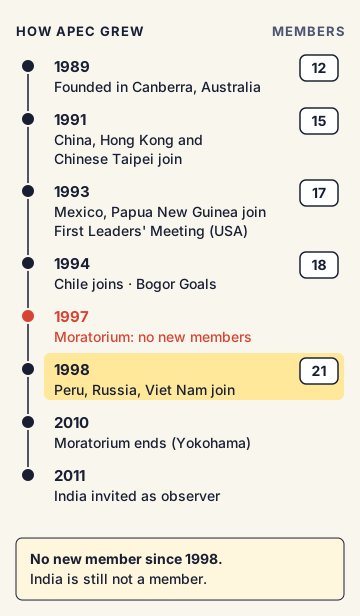
- 1991: China, Hong Kong (China) and Chinese Taipei (Taiwan)
- 1993: Mexico and Papua New Guinea
- 1994: Chile
- 1998: Peru, Russia and Viet Nam
That makes 21. In 1997, APEC decided to stop taking new members for 10 years. This pause is called a moratorium. In 2007 it was extended for three more years. In 2010, at the Yokohama summit in Japan, leaders did not extend it again. Even so, no new member has been admitted since 1998.
Why "economies" and not "countries"?
APEC calls its members "member economies". This is a deliberate choice. Membership is based on being a separate economy, not a sovereign (fully independent) country. This is how Hong Kong and Taiwan can sit at the same table as China. Taiwan takes part under the name "Chinese Taipei". Because of this, APEC meetings avoid political topics like sovereignty and focus on trade and the economy.
How does APEC work?
Think of APEC like a group of shopkeepers in a market who agree, on their own, to make business easier for each other. Nobody can be punished for not following the plan. Peer pressure and shared goals do the work. In practice:
- Decisions are taken by consensus, which means all members must agree. There is no voting.
- Commitments are non-binding. Each economy decides how and when to act.
- The host (chair) changes every year. The host economy runs a full year of meetings that ends with the Leaders' Meeting, usually in November.
- Work is done through committees and working groups. Examples are the Committee on Trade and Investment and the Economic Committee.
- The APEC Business Advisory Council (ABAC) brings business voices in. It was agreed in 1995 and set up in 1996, with three business leaders from each member economy.
- Three bodies are official observers: the ASEAN Secretariat, the Pacific Economic Cooperation Council and the Pacific Islands Forum Secretariat.
The big goals: Bogor to Putrajaya
APEC sets long-term targets for itself.
- Bogor Goals (1994): Adopted at Bogor, Indonesia. They aimed for free and open trade and investment in the region by 2010 for developed economies and by 2020 for developing economies.
- Putrajaya Vision 2040 (2020): Adopted at the virtual summit hosted by Malaysia, after the Bogor deadline ended. It aims for "an open, dynamic, resilient and peaceful Asia-Pacific community by 2040". It rests on three drivers: trade and investment; innovation and digital economy; and strong, balanced, secure, sustainable and inclusive growth.
- Free Trade Area of the Asia-Pacific (FTAAP): A long-term idea of one large free trade area covering all APEC members. It is still only a goal.
How big is APEC?
APEC is one of the largest economic groupings in the world. As of 2024, its 21 economies made up about 61% of world GDP (the total value of goods and services produced), about 46% of world trade in goods and services, and about 37% of the world's population. The three biggest economies in the world (the US, China and Japan) are all members.
Recent hosts
The host rotates among members:
- 2023: United States (San Francisco)
- 2024: Peru (Lima)
- 2025: South Korea (Gyeongju)
- 2026: China (Shenzhen), the 33rd Leaders' Meeting
India's position
India applied to join APEC in the 1990s, but the 1997 moratorium stopped new entries. India was first invited as an observer in 2011, when the United States hosted APEC in Hawaii. After the moratorium ended, membership talks got stuck. Some members worry that adding India would shift APEC away from its Pacific Rim focus.
Others have doubts because India has been cautious about opening its markets, for example when it stayed out of the Regional Comprehensive Economic Partnership (RCEP) in 2019. Supporters argue India's Act East Policy, its links with ASEAN and its large market make it a natural fit. For India, membership would mean a voice in setting trade rules for the region that drives much of world growth.
Commonly confused concepts
- APEC vs ASEAN: ASEAN (Association of Southeast Asian Nations) is a regional organisation of Southeast Asian countries with its own charter and treaties. APEC is a looser forum of 21 economies across the whole Pacific Rim, including the US, China, Russia and Latin American countries. Seven ASEAN countries are also APEC members, but Cambodia, Laos, Myanmar and Timor-Leste are not.
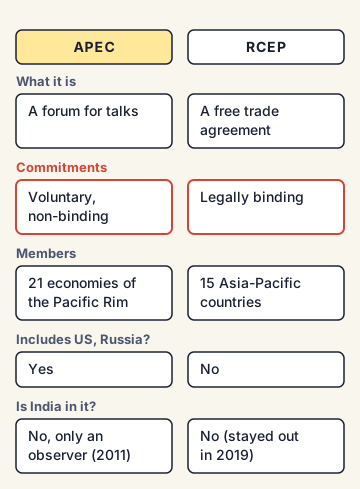
- APEC vs RCEP: RCEP is a legally binding free trade agreement of 15 Asia-Pacific countries. APEC is a forum with voluntary commitments, not a trade agreement.
- APEC vs G20: The G20 is a group of the world's largest economies from every continent, and India is a member. APEC covers only Pacific Rim economies, and India is not a member.
- APEC vs Indo-Pacific Economic Framework (IPEF): IPEF is a US-led framework launched in 2022 in which India takes part. APEC is a much older forum, from 1989.
- "Member economies" vs "member countries": APEC uses "economies" so that Hong Kong and Chinese Taipei can join. Most other bodies, like the UN, use "member states".
Issues, criticism and the way forward
- No teeth: Because commitments are voluntary, critics say APEC cannot force members to cut tariffs. The Bogor Goals were not fully met by 2020.
- Great-power rivalry: Tension between the US and China, and the Russia-Ukraine war, have made it hard to agree on joint statements in some years. Summits are often noticed more for side meetings between big powers than for APEC's own work.
- Overlapping deals: Many binding trade deals now exist in the region, like RCEP and the Comprehensive and Progressive Agreement for Trans-Pacific Partnership (CPTPP). Some experts say they make APEC less central.
- Membership freeze: Keeping India and others outside means APEC does not cover all major Asian economies.
- Way forward: Experts suggest using APEC as an "incubator" for ideas that later become binding rules, focusing on digital trade, supply chains and climate, and reopening the membership question.
Concepts to Know
- Forum: A meeting platform where members discuss and agree on goals, without a binding treaty or a strong central authority.
- Consensus: A way of deciding where everyone must agree. If even one member objects, the decision does not pass.
- Non-binding commitment: A promise that a member makes freely. No court or penalty can force it to keep the promise.
- Tariff: A tax a country puts on goods coming in from another country.
- Free trade area: A group of countries that remove most tariffs on goods traded among themselves.
- Sidelines of a summit: Side meetings between some leaders that happen alongside the main summit, outside its formal agenda.
- Founded: November 1989, Canberra, Australia, with 12 founding members; idea first raised by Australian PM Bob Hawke (Seoul, 31 January 1989)
- First Economic Leaders' Meeting: 1993, Blake Island (near Seattle), USA
- Secretariat: Singapore, set up in 1993
- Members: 21 economies; last joiners were Peru, Russia and Viet Nam in 1998
- Membership moratorium: 1997, extended in 2007, not extended at Yokohama in 2010
- India: not a member; first invited as observer in 2011
- Bogor Goals (1994); Putrajaya Vision 2040 (adopted 2020)
- Share (2024): about 61% of world GDP, 46% of world trade, 37% of world population
- 2026 host: China (Shenzhen), 33rd Leaders' Meeting, 18-19 November 2026
● Tracked since November 07, 2026 · last seen November 07, 2026 · updates as the daily brief publishes