Writ Jurisdiction of High Courts (Article 226)
Article 226 of the Constitution gives every High Court the power to issue orders and directions, called writs, to any person or authority, including any government, within its territory. A High Court can use this power to protect fundamental rights and also "for any other purpose", which means to protect ordinary legal rights and to keep government action within the law.
It is the main tool by which citizens in every state can quickly challenge illegal action by the state, without going all the way to the Supreme Court.
Why does it exist?
Rights on paper are useless if there is no quick way to enforce them. If a government officer acts beyond the law, a citizen needs a court that can order the officer to stop or to act properly. India is a large country, and the Supreme Court in Delhi is far for most people. So the Constitution makers gave every High Court a strong writ power, close to the people, so that illegal state action can be checked in every state.
Where did it come from?
Writs come from English law, where the King's courts issued such orders to keep officials in check. In British India, only the High Courts at Calcutta, Bombay and Madras had limited writ powers, and only within those cities. The Constitution of 1950 gave all High Courts a wide writ power through Article 226. Later changes:
- 15th Amendment, 1963: added what is now Article 226(2). A High Court can issue a writ against an authority located outside its territory if the cause of action (the facts giving rise to the case) arose wholly or partly within its territory.
- 42nd Amendment, 1976: cut down the writ power of High Courts during the Emergency period.
- 44th Amendment, 1978: largely restored it.
- L. Chandra Kumar v. Union of India (1997): a seven-judge bench of the Supreme Court held that the power of judicial review of High Courts under Articles 226 and 227 is part of the basic structure of the Constitution. No law can take it away, and tribunals can only supplement, not replace, the High Courts.
How does it work?
A person files a writ petition in the High Court. The court can issue five kinds of writs:
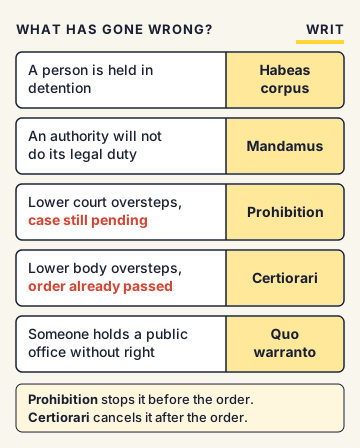
- Habeas corpus ("you may have the body"): orders that a detained person be produced before the court, to check if the detention is legal.
- Mandamus ("we command"): orders a public authority to perform a duty it is legally bound to perform.
- Prohibition: stops a lower court or tribunal from going beyond its jurisdiction in a case still pending.
- Certiorari: quashes (cancels) an order already passed by a lower court, tribunal or authority that acted without jurisdiction or with a clear legal error.
- Quo warranto ("by what authority"): asks a person holding a public office to show the legal right to hold it.
The High Court can also give "directions" and "orders" beyond these five forms, which makes the power very flexible.
Key provisions and rules
- "Any person or authority": writs usually go to the state, but in Andi Mukta Sadguru Trust v. V.R. Rudani (1989), the Supreme Court said a writ of mandamus can also go to a private body that performs a public duty.
- Article 226(3): if a High Court passes an interim stay or injunction without hearing the other side, and that side applies to cancel it, the court must decide within two weeks. If it does not, the stay is cancelled automatically.
- Discretionary remedy: the High Court may refuse to hear a case if there is an effective alternative remedy, like an appeal to a tribunal. But in Whirlpool Corporation v. Registrar of Trade Marks (1998), the Supreme Court said an alternative remedy is not a bar where (1) a fundamental right is to be enforced, (2) natural justice was violated, or (3) the order was wholly without jurisdiction or a law's validity is challenged.
- Article 227: gives the High Court a separate power of superintendence over all courts and tribunals in its territory (except military tribunals).
- Territory of a High Court: Parliament can extend a High Court's jurisdiction to a Union Territory (Article 230) and can create a common High Court for two or more states and a Union Territory (Article 231). The Calcutta High Court covers West Bengal and the Andaman and Nicobar Islands, with permanent circuit benches at Port Blair and Jalpaiguri.
Public Interest Litigation (PIL) under Article 226
Normally, only the person whose right is hurt can go to court. This is called locus standi (the right to be heard). From the early 1980s, the Supreme Court relaxed this rule so that any public-spirited person can file a case for people who cannot reach court themselves, such as poor, tribal or remote communities.
High Courts hear such PILs under Article 226. Before deciding the main dispute, a court first decides maintainability: is the petitioner genuine, is the issue truly public, and is the High Court the right forum?
India's position and Indian examples
High Courts use Article 226 in thousands of cases every year: against wrongful detention, illegal land acquisition, arbitrary government orders, and environmental harm. When a party is unhappy with a High Court order, it can ask the Supreme Court for permission to appeal through a Special Leave Petition under Article 136. The Supreme Court has full discretion to refuse to entertain such a petition, as it often does when the matter is still pending before the High Court.
Commonly confused concepts
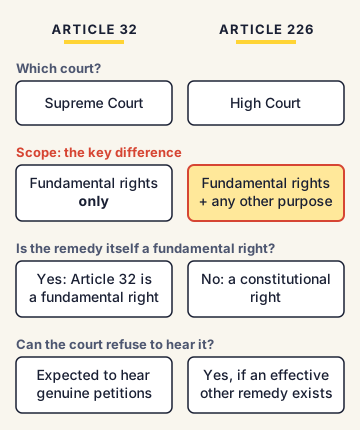
- Article 226 vs Article 32: Article 32 lets a person go directly to the Supreme Court, but only to enforce fundamental rights. Article 32 is itself a fundamental right. Article 226 lets a person go to a High Court for fundamental rights and "any other purpose", so it is wider in scope. But Article 226 is discretionary, while the Supreme Court is expected to hear genuine Article 32 petitions about fundamental rights.
- Article 226 vs Article 227: Article 226 is about issuing writs to "any person or authority", mainly to correct illegal action. Article 227 is about supervising lower courts and tribunals to keep them within their limits.
- Certiorari vs Prohibition: Prohibition is issued while a case is still pending, to stop the lower body. Certiorari is issued after the lower body has passed its order, to cancel it.
- Maintainability vs merits: Maintainability is about whether a court should hear the case at all. Merits are about who is right in the actual dispute. A ruling that a PIL is maintainable does not mean the petitioner has won.
Issues, criticism and the way forward
- Pending cases: High Courts carry a very large backlog, and writ petitions form a big share of it. Delays can make relief meaningless.
- Misuse of PILs: Courts have warned against "publicity interest" or "private interest" litigation. Courts now check the petitioner's good faith and the public nature of the issue at the maintainability stage.
- Parallel proceedings: When the same project is challenged in a tribunal and in a High Court, governments argue that this leads to delay and conflicting orders. Courts try to handle this by checking what exactly each case is about.
- Development vs rights: Large projects of strategic value often face challenges based on environmental and tribal rights. Courts have to balance national interest with legal safeguards, without deciding policy themselves.
- Way forward: Commissions and experts have suggested more judges, faster listing of urgent writs, clear PIL guidelines, and quicker hearing of challenges to big projects, so that both the rights of affected people and the timelines of projects are protected.
Concepts to Know
- Writ: A formal written order from a higher court telling a person or authority to do something or to stop doing something.
- Judicial review: The power of courts to examine whether a law or government action follows the Constitution and the law, and to cancel it if it does not.
- Cause of action: The set of facts that gives a person the right to go to court.
- Interim order: A temporary order, such as a stay, that a court passes while the case is still being heard.
- Natural justice: Basic fairness rules: no one should be a judge in their own case, and both sides must be heard before a decision.
- Basic structure: Core features of the Constitution that even a constitutional amendment cannot destroy (laid down in Kesavananda Bharati, 1973).
- Circuit bench: A bench of a High Court that sits at a place away from the High Court's main seat, so that people there do not have to travel far.
- Article 226: writs to "any person or authority", for fundamental rights "and for any other purpose"
- Article 226(2): added (as clause 1A) by the 15th Amendment, 1963; cause of action rule
- Article 226(3): ex parte stay cancelled automatically if a vacate application is not decided in two weeks
- 42nd Amendment (1976) curtailed; 44th Amendment (1978) restored
- L. Chandra Kumar v. Union of India (1997): Articles 226 and 227 judicial review is basic structure
- Whirlpool Corporation (1998): three exceptions to the alternative remedy rule
- Andi Mukta Sadguru Trust v. V.R. Rudani (1989): mandamus against bodies performing public duty
- Five writs: habeas corpus, mandamus, prohibition, certiorari, quo warranto
- Article 227: superintendence; Article 230: extension to UTs; Article 231: common High Court
- Calcutta High Court: West Bengal plus Andaman and Nicobar Islands; circuit benches at Port Blair and Jalpaiguri
● Tracked since February 19, 2026 · last seen October 05, 2026 · updates as the daily brief publishes