Women's Reservation in Local Bodies (Articles 243D and 243T)
The Constitution says that at least one-third of the seats in every panchayat and every municipality must be reserved for women. These seats are filled by direct election, and they rotate between different constituencies (wards) over time. Article 243D does this for panchayats (rural local bodies) and Article 243T does it for municipalities (urban local bodies). Because of this rule, India today has more than 12 lakh elected women in panchayats alone, one of the largest numbers of women representatives in the world.
Why does it exist?
For many years after independence, very few women were elected to any public body. Social customs, lack of money and male control over politics kept them out. Leaders felt that unless seats were reserved, women would not get a fair chance to take part in decisions about their own villages and towns: water, roads, schools, health centres. Local bodies were seen as the best place to start, because they are close to people's daily lives and can train new leaders.
Where did it come from?
- 1974: The Committee on the Status of Women in India, in its report Towards Equality, highlighted how few women were in politics.
- 1980s: Some states acted on their own. Karnataka reserved 25% of seats for women in its local bodies in the mid-1980s.
- 1988: A government committee drafted the National Perspective Plan for Women, which recommended reserving 30% of seats for women in elected bodies.
- 1989: The 64th Constitution Amendment Bill on panchayats was passed in the Lok Sabha but failed in the Rajya Sabha.
- 1992: Parliament passed the 73rd Amendment (panchayats, Part IX) and the 74th Amendment (municipalities, Part IXA). They came into force on 24 April 1993 and 1 June 1993. That is why 24 April is celebrated as National Panchayati Raj Day.
- 2006: Bihar became the first state to reserve 50% of panchayat seats for women. Many states followed.
- 2009: The Constitution (110th Amendment) Bill was introduced to raise women's reservation in panchayats from one-third to one-half across India. It lapsed when the 15th Lok Sabha was dissolved in 2014.
What do Articles 243D and 243T say?
Both articles are written in almost the same way:
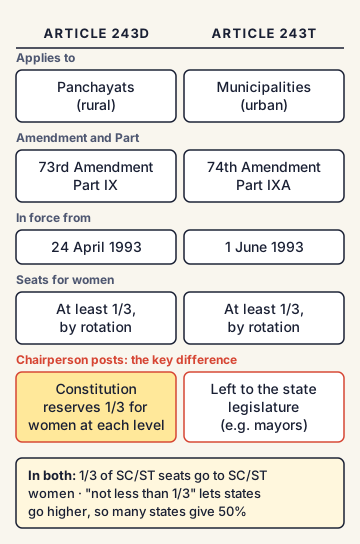
- Clause (2) and (3): Not less than one-third of all seats filled by direct election in every panchayat and municipality are reserved for women. These seats are allotted by rotation to different constituencies.
- Women within SC and ST seats: Seats are also reserved for Scheduled Castes (SCs) and Scheduled Tribes (STs) in proportion to their population. Of these SC/ST seats, not less than one-third are reserved for SC/ST women. These also count towards the overall one-third for women.
- Chairpersons (Article 243D(4)): For panchayats, the posts of chairperson (like sarpanch or zila panchayat president) at each level are also reserved for SCs, STs and women. At least one-third of chairperson posts at each level go to women.
- Chairpersons (Article 243T(4)): For municipalities, the Constitution leaves it to the state legislature to decide reservation of chairperson posts like mayors.
- The "at least" wording: Since the Constitution says "not less than one-third", states are free to go higher. That is how many states have moved to 50%.
How does rotation work? A simple example
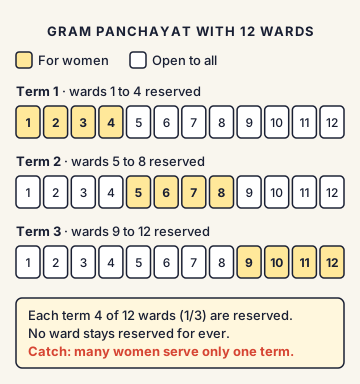
Imagine a gram panchayat with 12 wards. In this term, 4 wards (one-third) are reserved for women. At the next election, a different set of 4 wards is reserved. So over a few terms, every area gets a chance to elect a woman, and no ward is permanently reserved. Rotation is fair to all areas, but it also means many women serve only one term before their seat goes back to general category.
India's position and examples
- As of 2023, the Ministry of Panchayati Raj reported that 21 states and 2 UTs had raised women's reservation in panchayats to 50% through their own laws.
- As of November 2025, about 12.06 lakh of about 24.24 lakh elected panchayat representatives (roughly half) were women, according to the Ministry of Panchayati Raj.
- Nagaland held its first urban local body elections with 33% reservation for women in June 2024. Earlier attempts, especially in 2017, faced strong protests from tribal bodies who argued it went against Naga customary practices protected by Article 371A. The Supreme Court had pushed for the polls to be held with the reservation.
- Areas outside Part IX: Under Article 243M, the panchayat chapter does not automatically apply to Fifth Schedule (Scheduled) Areas, Sixth Schedule tribal areas, Nagaland, Meghalaya, Mizoram and certain hill areas. Parliament extended panchayats to Fifth Schedule areas through PESA (Panchayats (Extension to the Scheduled Areas) Act, 1996).
- Ladakh: Ladakh's Hill Councils (LAHDCs) are not panchayats under Part IX; they are set up by a separate law. In 2025, a Presidential regulation reserved one-third of LAHDC seats for women, by rotation.
Commonly confused concepts
- Article 243D vs Article 243T: 243D is for panchayats (rural), 243T for municipalities (urban). Under 243D, the Constitution itself reserves chairperson posts for women; under 243T, it is left to the state.
- Local body reservation vs the 106th Amendment (Nari Shakti Vandan Adhiniyam, 2023): The 106th Amendment reserves one-third of seats for women in the Lok Sabha, state Legislative Assemblies and the Delhi Assembly (new Articles 330A and 332A, and a change to Article 239AA). It applies only after a fresh delimitation based on the first census held after the Act, and lasts 15 years. It does not cover the Rajya Sabha or state Legislative Councils. Local body reservation, in contrast, has been in force since 1993.
- Vertical vs horizontal reservation: SC, ST and OBC reservation is "vertical" (separate blocks of seats). Women's reservation is "horizontal": it cuts across these blocks, so some general seats, some SC seats and some ST seats each go to women.
- K. Krishna Murthy v. Union of India (2010): A five-judge bench of the Supreme Court upheld reservation in local bodies, including reservation of chairperson posts. It also said that total vertical reservation (SC, ST and OBC) in local bodies should normally not cross 50%.
Issues, criticism and the way forward
- Proxy representation ("Pradhan Pati" or "Sarpanch Pati"): In many places, the husband or another male relative of the elected woman runs the panchayat in practice. In 2023, the Ministry of Panchayati Raj set up an advisory committee chaired by former Mines Secretary Sushil Kumar to study this. Its report, submitted in early 2025, suggested strict penalties for proven proxy cases, women-only ward and subject committees, public oath-taking in the Gram Sabha, women ombudspersons to hear complaints, peer networks of women leaders, and better training using technology.
- Rotation cuts short experience: Because reserved seats move every term, a woman who has learned the job may lose her seat. Some experts suggest rotating seats only after two terms.
- Weak powers and funds: Even when women are elected, panchayats in many states have limited money, staff and real powers. So representation does not always turn into real influence.
- Social barriers: Low literacy, household work, safety concerns and caste pressure can limit women's participation in meetings.
- The evidence of change: Studies have found that women-led panchayats often give more attention to issues like drinking water and basic services. This is a key argument used in favour of the system.
- Way forward: Experts and official committees stress capacity building and training, real devolution of funds, functions and functionaries (the "3 Fs"), action against proxy practices, and support networks for elected women.
Concepts to Know
- Panchayati Raj Institutions (PRIs): The three-tier system of rural local government: gram panchayat (village), panchayat samiti (block) and zila parishad (district).
- Municipality: An elected urban local body. Under Article 243Q there are three types: nagar panchayat (area moving from rural to urban), municipal council (smaller urban area) and municipal corporation (larger urban area).
- Rotation: Changing which seats are reserved at each election, so that the reservation moves from one area to another over time.
- Direct election: Voters choose the representative themselves, instead of the representative being picked by other elected members.
- Devolution: Handing real powers, money and staff from a higher level of government (the state) to a lower level (local bodies).
- Gram Sabha: The meeting of all adult voters of a village. It is the base of the panchayat system.
- 73rd Amendment Act, 1992 (panchayats, Part IX, Articles 243 to 243O): in force 24 April 1993
- 74th Amendment Act, 1992 (municipalities, Part IXA, Articles 243P to 243ZG): in force 1 June 1993
- Article 243D(3): not less than one-third of directly elected panchayat seats for women, by rotation (including one-third of SC/ST seats)
- Article 243D(4): reservation of panchayat chairperson posts; at least one-third for women at each level
- Article 243T(3): one-third of directly elected municipal seats for women; Article 243T(4): chairperson reservation left to state law
- Bihar: first state with 50% women's reservation in panchayats (2006)
- 21 states and 2 UTs with 50% reservation in panchayats (Ministry of Panchayati Raj, 2023)
- 110th Amendment Bill, 2009 (50% in panchayats): lapsed in 2014
- K. Krishna Murthy v. Union of India (2010): upheld local body reservation, including for chairpersons
- 106th Amendment Act, 2023: one-third for women in Lok Sabha, state assemblies and Delhi Assembly (after the next delimitation)
- Sushil Kumar committee (set up 2023) on proxy representation of elected women
● Tracked since October 20, 2026 · last seen October 20, 2026 · updates as the daily brief publishes