Delimitation in India (Articles 82 and 170)
Delimitation means fixing the number of seats each state gets in the Lok Sabha and in its Legislative Assembly, and drawing the boundaries of each constituency. It is done so that each elected member represents roughly the same number of people. It is carried out by an independent body called the Delimitation Commission, using population figures from a census.
Why is it needed?
Populations grow at different speeds in different places. If boundaries never change, one MP may represent 30 lakh people while another represents 15 lakh. Then one person's vote would count less than another's. Delimitation keeps the principle of "one person, one vote, one value".
What does the Constitution say?
- Article 81: Lok Sabha has a maximum of 550 elected members (up to 530 from states and up to 20 from Union Territories). Seats are given to states so that the ratio of seats to population is, as far as possible, the same for all states.
- Article 82: After every census, the number of Lok Sabha seats for each state and the division into constituencies shall be readjusted by an authority and in a manner set by a law of Parliament.
- Article 170: Does the same for State Legislative Assemblies.
- Articles 330 and 332: Seats for Scheduled Castes and Scheduled Tribes are reserved in proportion to their population, so delimitation also decides which constituencies are reserved.
- Article 329(a): Courts cannot question the validity of any law on delimitation or the allotment of seats made under such a law.
Where did it come from?
Parliament passed Delimitation Commission Acts, and Delimitation Commissions were set up in 1952, 1963, 1973 and 2002. Then came the freeze:
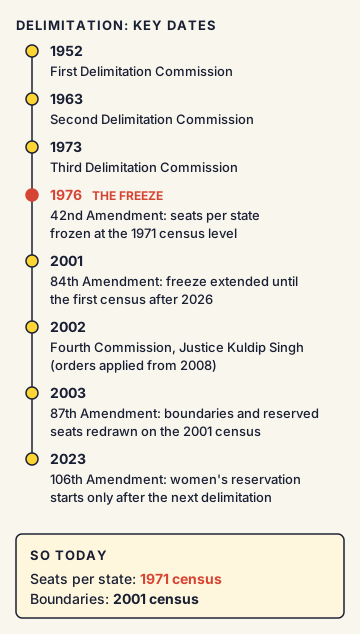
- 42nd Amendment Act, 1976: Froze the number of seats per state at the 1971 census level until the first census after 2000. The aim was to avoid punishing states that controlled population growth through family planning.
- 84th Amendment Act, 2001: Extended the freeze on seats per state until the first census taken after 2026. It allowed boundaries within a state to be redrawn using the 1991 census.
- 87th Amendment Act, 2003: Changed that base to the 2001 census for redrawing boundaries and fixing reserved seats.
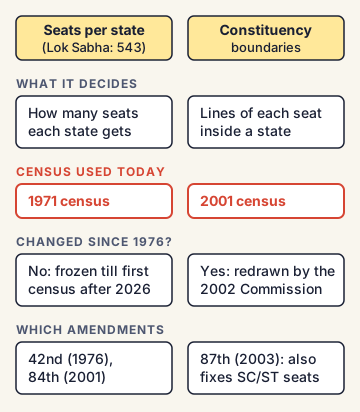
So today, each state's number of Lok Sabha seats (543 in total) is still based on the 1971 census, while constituency boundaries are based on the 2001 census.
How does the Delimitation Commission work?
Under the Delimitation Act, 2002, the Commission has three members:
- A retired or serving Supreme Court judge as chairperson.
- The Chief Election Commissioner, or an Election Commissioner nominated by the CEC.
- The State Election Commissioner of the state concerned.
It also has associate members: some MPs and MLAs from each state, who can give views but cannot vote. The Commission publishes draft proposals, invites public objections, holds public sittings, and then publishes its final orders in the Gazette. Its orders have the force of law, and Parliament or the Assembly cannot change them. The 2002 Commission was headed by Justice Kuldip Singh, and its orders were applied from 2008.
Recent examples
- Jammu and Kashmir: A Commission headed by Justice (retd.) Ranjana Prakash Desai (set up in 2020) gave its final order in May 2022, raising Assembly seats from 83 to 90.
- Assam: The Election Commission of India did delimitation in 2023 using the 2001 census, under Section 8A of the Representation of the People Act, 1950.
Can courts review it?
Article 329(a) limits court challenges. But in Kishorchandra Chhanganlal Rathod v. Union of India (2024), the Supreme Court held that delimitation orders are not completely immune. If an order is manifestly arbitrary and goes against constitutional values, courts can give a remedy.
The link with women's reservation
The 106th Constitutional Amendment Act, 2023 (Nari Shakti Vandan Adhiniyam) reserves one-third of seats for women in the Lok Sabha, State Assemblies and the Delhi Assembly. Under the new Article 334A, it will come into effect only after delimitation is done based on the first census after the Act begins. So Census 2027 and the delimitation after it are needed to start women's reservation.
Commonly confused concepts
- Delimitation Commission vs Election Commission: The ECI runs elections (Article 324). The Delimitation Commission is a temporary body set up by a law of Parliament to redraw seats. The CEC or an EC is a member of it.
- Reallocation of seats vs redrawing boundaries: The freeze stops changing the number of seats per state. Redrawing boundaries within a state was allowed using the 2001 census.
- Delimitation vs Finance Commission: Both use population data, but the Finance Commission (Article 280) shares money between the Centre and states, while delimitation shares political seats.
Issues, criticism and the way forward
- North-South concern: Southern states, which reduced population growth faster, fear losing relative seat share if seats are reallocated by current population, while northern states would gain.
- Federal balance: Critics argue that seat share should not punish states that followed national population policy. Others argue that "one person, one vote" requires equal representation.
- Options discussed: Raising the total number of Lok Sabha seats so no state loses seats, extending the freeze, or giving weight to other factors. Any choice needs a constitutional amendment and wide consultation.
- Timing: Delimitation after Census 2027 will decide when women's reservation starts, so delays affect it too.
Concepts to Know
- Constituency: The area whose voters elect one member to the Lok Sabha or an Assembly.
- Freeze: A legal stop on changing something (here, the number of seats per state) until a fixed time.
- Gazette: The official government publication in which laws and orders are published.
- Force of law: Something that must be obeyed just like a law passed by the legislature.
- Article 81 (Lok Sabha composition, max 550), Article 82 (Lok Sabha readjustment), Article 170 (Assemblies), Articles 330 and 332 (SC/ST seats), Article 329(a) (bar on courts)
- Delimitation Commissions: 1952, 1963, 1973, 2002 (Justice Kuldip Singh)
- 42nd Amendment (1976): froze seats on 1971 census till after 2001 census
- 84th Amendment (2001): freeze until first census after 2026
- 87th Amendment (2003): 2001 census as base for boundaries and reserved seats
- Delimitation Act, 2002: three members (SC judge chair, CEC or nominated EC, State Election Commissioner); associate members cannot vote
- Kishorchandra Chhanganlal Rathod v. Union of India (2024): delimitation orders open to review if manifestly arbitrary
- 106th Amendment Act, 2023 (Article 334A): women's reservation after delimitation based on the first census after the Act
● Tracked since October 09, 2026 · last seen October 09, 2026 · updates as the daily brief publishes