Viability Gap Funding (VGF)
How the Government Makes Infrastructure Projects Bankable
Updated 5 Nov 2026: Added the November 2026 ₹14,500 crore storage VGF scheme for 92 GWh, and corrected how the DEA grant is released alongside loans.
Viability Gap Funding, or VGF, is a one-time grant that the government gives to a project that is useful for the country but cannot earn enough money on its own to attract private investors. The "viability gap" is the shortfall between what the project costs and what it can earn. The government fills this gap with public money, so that a private company is willing to build and run the project.
It is mostly used in Public-Private Partnership (PPP) projects such as roads, water supply, hospitals, air routes and clean energy.
Why does it exist?
Many projects are good for society but poor as a business. A road to a remote village, a water treatment plant or a hospital in a small town costs a lot to build. But the people who use it cannot pay high charges, and the government does not want to charge them high fees either.
So a private company sees no profit and stays away. Without VGF, the government would have to build everything itself with its own money and staff. VGF lets the government pay only a part of the cost, and get private money, skills and efficiency for the rest.
Think of it like this. A shopkeeper is asked to open a shop in a small village. Rent and setup cost ₹10 lakh, but village sales can only repay ₹7 lakh. No shopkeeper will agree. If the panchayat gives a one-time help of ₹3 lakh, the shop becomes worth opening. That ₹3 lakh is the viability gap funding.
Where did it come from?
India's main VGF scheme is run by the Department of Economic Affairs (DEA) in the Ministry of Finance. Its full name is the Scheme for Financial Support to Public Private Partnerships in Infrastructure.
- The Cabinet Committee on Economic Affairs (CCEA) approved it on 25 July 2005, as a Central Sector Scheme (fully paid for by the Centre). It was formally notified by the DEA in 2006.
- On 11 November 2020, the CCEA approved the continuation and revamping of the scheme up to 2024-25, with a total outlay of ₹8,100 crore. The revamped guidelines were notified on 7 December 2020.
- The 2020 revamp added extra support for social infrastructure (like health and education), which earlier got the same help as roads and ports.
- Over time, the same idea has been copied by individual ministries for their own sectors, such as air routes (UDAN), offshore wind and battery storage.
How does it work, step by step?
In the DEA scheme, the process goes like this:
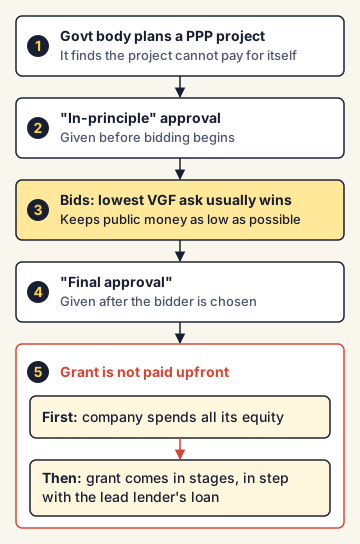
- A government body (a ministry, state government or local body) plans a PPP project and finds it cannot pay for itself.
- The project gets "in-principle" approval for VGF before bidding begins.
- The government invites bids from private companies. Usually, the company asking for the lowest VGF (the smallest grant) wins. This keeps the use of public money as low as possible.
- After the bidder is chosen, the project gets "final approval".
- The money is not given upfront. It is released only after the private company has put in and spent all its own equity (its own money). This makes sure the company has "skin in the game" (its own money at risk). After that, the grant comes in stages, in step with the loan money that the lead lender releases.
How much support can a project get?
Under the 2020 revamped DEA scheme, support is shown as a share of the Total Project Cost (TPC):
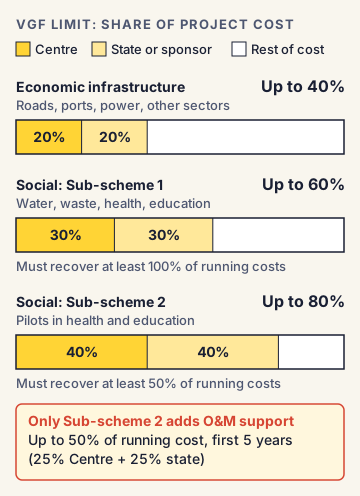
- Economic infrastructure (roads, ports, power and other sectors): up to 40% of TPC: up to 20% from the Centre and up to 20% from the state or sponsoring ministry.
- Social infrastructure, Sub-scheme 1 (water supply, waste water treatment, solid waste management, health, education): up to 60% of TPC: up to 30% from the Centre and 30% from the state. These projects must recover at least 100% of their running costs.
- Pilot or demonstration projects in health and education, Sub-scheme 2: up to 80% of TPC (40% Centre + 40% state), plus up to 50% of operation and maintenance costs for the first 5 years (25% Centre + 25% state). These projects must recover at least 50% of their running costs.
Who approves it?
An Empowered Committee (EC) headed by the Secretary, Department of Economic Affairs checks proposals. Its members include the Secretary (Expenditure), the CEO of NITI Aayog and the Secretary of the concerned ministry, with a Joint Secretary of DEA as Member Secretary. The EC can sanction VGF up to ₹200 crore. Proposals above ₹200 crore also need the Finance Minister's approval.
VGF beyond the DEA scheme: India's sector schemes
Several ministries now run their own VGF-style schemes:
- UDAN (Regional Connectivity Scheme, 2016), civil aviation: Airlines flying small, unserved routes get VGF for three years so that fares stay low. The Centre and states share it in the ratio 80:20; for North-Eastern states and Union Territories it is 90:10. The money comes from a fund built by a small levy on busy domestic routes.
- Battery Energy Storage, first scheme (approved September 2023), Ministry of Power: ₹9,400 crore initial outlay with ₹3,760 crore budget support, VGF up to 40% of capital cost, first target 4,000 MWh. At least 85% of the capacity is to be offered to discoms. As battery prices fell, the capacity was raised to 13,200 MWh within the same budget.
- Battery Energy Storage, second tranche (June 2025): ₹5,400 crore for 30 GWh, at ₹18 lakh per MWh. The money comes from the Power System Development Fund (PSDF), a fund built from charges collected on the national electricity grid.
- Grid-scale energy storage (approved by the Union Cabinet on 4 November 2026): ₹14,500 crore for 92 GWh of new storage, from 2026-27 to 2030-31. The split is 60 GWh of pumped storage, 30 GWh of batteries and 2 GWh of other new technologies. The two earlier schemes above covered batteries only. Capacity is given out through tariff-based competitive bidding. Public and private discoms can get the support for battery and pumped storage projects, and public or private bodies can run the other technologies. Battery projects must meet a 40% Domestic Content Requirement. The total investment is estimated at ₹97,600 crore. The government says India will need 411 GWh of grid-scale storage by 2031-32.
- Offshore wind (June 2024): ₹7,453 crore in total: ₹6,853 crore for 1 GW of offshore wind (500 MW each off Gujarat and Tamil Nadu) and ₹600 crore to upgrade two ports.
Commonly confused concepts
- VGF vs subsidy: A normal subsidy usually goes on and on (for example, a fertiliser subsidy every year). VGF is mostly a one-time capital grant to build an asset. Some schemes, like UDAN, give it for a fixed, short period only.
- VGF vs India Infrastructure Project Development Fund (IIPDF): VGF helps build a project. IIPDF, also run by the DEA (first set up in 2007), pays for preparing a PPP project: hiring consultants and transaction advisers before bidding. Under its 2022 version, this money does not have to be paid back.
- VGF vs Production Linked Incentive (PLI): PLI rewards a factory for producing and selling more, year by year. VGF pays to close the cost gap of building a project.
- Central Sector Scheme vs Centrally Sponsored Scheme: The DEA VGF scheme is a Central Sector Scheme (fully Central money). A Centrally Sponsored Scheme is run by states with cost shared between the Centre and states.
- VGF vs capital grant in general: VGF is a capital grant, but one that is decided by competitive bidding and released only after the private partner invests first.
Issues, criticism and the way forward
- Slow uptake: Many states and ministries do not use the scheme fully because projects need a lot of preparation, and approvals take time.
- Risk of over-paying: If bidding is weak (few bidders), companies may ask for more VGF than they really need. Strong competitive bidding is the safeguard.
- Weak PPP environment: VGF alone cannot fix problems like delayed land acquisition, disputes and poor contracts. The Vijay Kelkar Committee (2015) on revisiting and revitalising the PPP model suggested better risk sharing (not one contract model for all projects), a review committee for stressed projects, and a special tribunal for PPP disputes.
- Fiscal cost: VGF uses budget money. Critics ask the government to make sure it goes only to projects that are truly useful and cannot be funded any other way.
- Way forward: Experts suggest better project preparation (through IIPDF), wider use of VGF for social infrastructure, and linking the grant to performance and outcomes, not just construction.
Concepts to Know
- Public-Private Partnership (PPP): An arrangement where the government and a private company work together on a public project. Usually the private company builds and runs it, and the government sets the rules and shares some risk.
- Total Project Cost (TPC): The full cost of building a project, including construction, equipment and related expenses.
- Equity: The company's own money put into the project, as opposed to borrowed money (debt).
- Tariff-based competitive bidding: A method of choosing a company where many companies quote a price (tariff) for their service, and the one with the lowest price wins.
- Capital grant: Money given to help pay for building an asset (like a plant or a road), not for day-to-day running costs.
- Discom: An electricity distribution company, which buys power and supplies it to homes and businesses.
- Grid-scale storage: Very large storage connected to the national electricity grid. It saves power when there is plenty, like sunny afternoons, and gives it back when demand is high.
- Pumped storage: A way to store power using water and two reservoirs. When power is cheap, pumps push water up to the higher reservoir. When power is needed, the water flows down through turbines and makes electricity.
- GWh (gigawatt-hour): A measure of how much energy is stored. 1 GWh equals 1,000 MWh, or 10 lakh units of electricity (the units on your home bill).
- Domestic Content Requirement: A rule that a set share of a project's value must be made in India. Here, it means less dependence on imported battery parts.
- DEA scheme name: Scheme for Financial Support to PPPs in Infrastructure (VGF Scheme); Ministry of Finance
- Approved by CCEA on 25 July 2005; Central Sector Scheme
- Revamp approved 11 November 2020; notified 7 December 2020; outlay ₹8,100 crore up to 2024-25
- Economic infrastructure: up to 40% of TPC (20% Centre + 20% state/sponsor)
- Social Sub-scheme 1: up to 60% of TPC (30% + 30%)
- Social Sub-scheme 2 (health, education pilots): up to 80% of TPC (40% + 40%) and up to 50% of O&M for 5 years
- Empowered Committee (chaired by Secretary, DEA) sanctions up to ₹200 crore; above that, Finance Minister also approves
- Disbursed only after the private partner spends its equity
- UDAN VGF: 3 years; 80:20 Centre-state (90:10 for North East and UTs)
- Grid-scale storage VGF (Cabinet, 4 November 2026): ₹14,500 crore for 92 GWh (60 pumped storage, 30 batteries, 2 other) from 2026-27 to 2030-31; 40% domestic content for batteries
- 5 Nov 2026Added the November 2026 ₹14,500 crore storage VGF scheme for 92 GWh, and corrected how the DEA grant is released alongside loans.
● Tracked since March 01, 2026 · last seen November 05, 2026 · updates as the daily brief publishes