Battery Energy Storage Systems (BESS)
Updated 13 Oct 2026: Added India's operating battery storage (about 9 GWh, September 2026) and storage tenders issued (about 290 GWh by August 2026).
A Battery Energy Storage System (BESS) is a very large set of rechargeable batteries connected to the power grid. It stores electricity when there is too much and releases it when there is too little. It works like a giant power bank for the whole grid. Most BESS today use lithium-ion batteries, similar to those in mobile phones and electric cars, but in container-sized units.
Why is it needed?
Solar plants produce a lot of power at noon but none at night. Wind power rises and falls with the weather. But people's demand for power peaks in the evening, when the sun has already set. Without storage, the grid has extra solar power at midday (which may be wasted) and a shortage in the evening (which is often met by coal plants). A BESS can charge at noon and discharge in the evening, shifting clean power to the time it is needed.
BESS also helps the grid in other ways:
- Frequency control: India's grid runs at 50 Hz. If supply and demand do not match, the frequency moves away from 50 Hz, which can damage equipment or cause blackouts. Batteries can respond in milliseconds to correct this.
- Reducing curtailment and line congestion: If a line is full, batteries near the plant can store the extra power instead of wasting it.
- Peak shaving: Supplying power at peak hours so that costly extra plants are not needed.
- Backup: Supplying power quickly during sudden failures.
How does it work?
A BESS has three main parts:
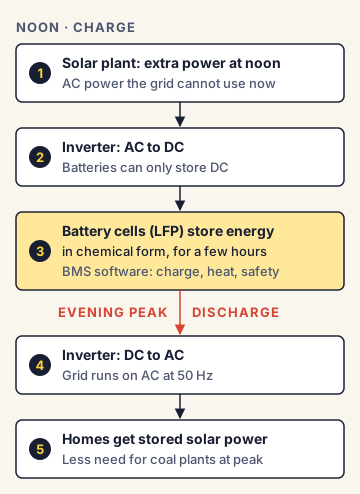
- Battery cells and packs: store energy in chemical form. Common chemistry today is lithium iron phosphate (LFP), which is safer and lasts longer than some other lithium types.
- Power conversion system (inverter): batteries store direct current (DC), but the grid uses alternating current (AC). The inverter converts between the two.
- Battery and energy management systems: software that controls charging, discharging, temperature and safety.
A BESS is described by two numbers: power in MW or GW (how fast it can give out energy) and energy in MWh or GWh (how much energy it holds). A 1 GW / 4 GWh battery can supply 1 GW for four hours. Batteries also lose some energy in each charge and discharge cycle; the share recovered is called round-trip efficiency.
Where did it come from?
Lithium-ion batteries became common in the 1990s through phones and laptops. As electric vehicles spread in the 2010s, battery prices fell sharply, and grid-scale battery storage became affordable. Today, BESS is one of the fastest-growing technologies for power grids worldwide.
India's policy steps
- Viability Gap Funding (VGF), September 2023: The Union Cabinet approved ₹3,760 crore to support 4,000 MWh of BESS projects, covering up to 40% of the capital cost, to be released in tranches up to 2030-31.
- Second VGF tranche, June 2025: The Ministry of Power approved about ₹5,400 crore from the Power System Development Fund (PSDF) to support about 30 GWh of BESS.
- Energy Storage Obligation (ESO): Electricity distribution companies and other large buyers must get a growing share of their power from storage, rising from 1% in 2023-24 to 4% by 2029-30, with at least 85% of the stored energy coming from renewable sources.
- Transmission charge waiver: The Ministry of Power waived inter-state transmission (ISTS) charges for co-located BESS (batteries placed with renewable plants) commissioned up to 30 June 2028, subject to conditions.
- PLI scheme for Advanced Chemistry Cell (ACC) batteries (2021): Supports making battery cells in India, to reduce imports.
- Storage requirement: The Central Electricity Authority has projected that India will need about 47 GW / 236 GWh of battery storage by 2031-32, along with pumped storage, to integrate renewable energy.
- GEC-III (2026): Adds 50 GWh of BESS to state grids alongside new power lines.
- Where India stands (as of September 2026): About 9 GWh of battery storage was operating, up from less than 1 GWh at the end of 2025. Tenders (government calls for bids to build projects) for about 290 GWh of storage had been issued by August 2026: about 151 GWh of BESS and about 142 GWh of pumped storage.
Commonly confused concepts
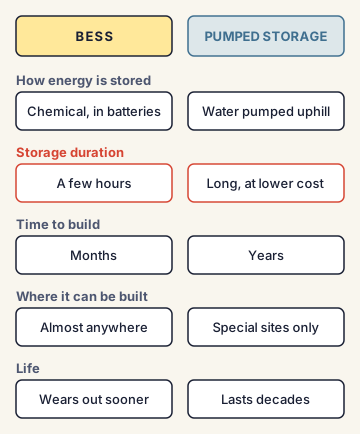
- BESS vs Pumped Storage Hydropower (PSP): PSP stores energy by pumping water uphill and releasing it through turbines later. It is cheaper for long-duration storage and lasts decades, but needs special sites and years to build. BESS can be built in months almost anywhere, but usually stores energy for a few hours.
- MW (power) vs MWh (energy): MW is like the width of a water pipe (how fast water can flow); MWh is like the size of the water tank (how much water is stored).
- Co-located vs standalone BESS: Co-located batteries sit with a solar or wind plant; standalone batteries are placed at a grid substation and serve the grid as a whole.
- Lithium-ion vs sodium-ion: Sodium-ion batteries use sodium (from common salt), which is cheaper and more widely available than lithium, but they currently store less energy per kilogram.
- VGF vs PLI: VGF reduces the cost of building a project so it becomes financially viable. PLI gives incentives to manufacturers based on how much they produce and sell.
Issues, criticism and the way forward
- Import dependence: India imports most lithium-ion cells and critical minerals (lithium, cobalt, nickel, graphite), largely linked to supply chains dominated by China. This creates price and security risks.
- Cost: Batteries are still costly for long durations (more than four hours), though prices have fallen a lot.
- Safety and degradation: Batteries can catch fire if poorly managed, and they lose capacity over time.
- Recycling: Used batteries contain hazardous materials. India's Battery Waste Management Rules, 2022 make producers responsible for collecting and recycling batteries (Extended Producer Responsibility).
- Market design: Battery projects need clear rules on how they will be paid for services like frequency control and peak supply.
- Way forward: Build domestic cell manufacturing, secure mineral supplies through partnerships (such as the Mineral Security Partnership and KABIL's overseas efforts), research alternatives like sodium-ion, and pair storage with transmission planning.
Concepts to Know
- Grid frequency: The speed at which alternating current changes direction, kept at 50 Hz in India. A stable frequency is a sign that supply and demand are balanced.
- Intermittency: The on-off nature of solar and wind power, which depends on weather and time of day.
- Viability Gap Funding (VGF): A one-time government grant that covers part of a project's cost so that a useful but costly project becomes worth investing in.
- Power System Development Fund (PSDF): A fund under the Ministry of Power, built from certain grid charges, used to strengthen the power system.
- Round-trip efficiency: The share of energy you get back out of a battery compared with what you put in. If you store 100 units and get 88 back, the efficiency is 88%.
- Critical minerals: Minerals that are essential for modern technology but whose supply is at risk, such as lithium and cobalt.
- BESS power is measured in MW/GW; energy in MWh/GWh; a 1 GW / 4 GWh battery gives 1 GW for 4 hours
- VGF (Cabinet, September 2023): ₹3,760 crore for 4,000 MWh; up to 40% of capital cost; tranches up to 2030-31
- Second VGF (June 2025): about ₹5,400 crore from PSDF for about 30 GWh
- Energy Storage Obligation: 1% (2023-24) rising to 4% (2029-30); at least 85% from renewables
- ISTS charge waiver for co-located BESS commissioned up to 30 June 2028
- CEA projection: about 47 GW / 236 GWh BESS needed by 2031-32
- GEC-III (2026): 50 GWh BESS with ₹50,000 crore outlay
- Operating battery storage: about 9 GWh as of September 2026; storage tenders about 290 GWh by August 2026 (about 151 GWh BESS)
- 13 Oct 2026Added India's operating battery storage (about 9 GWh, September 2026) and storage tenders issued (about 290 GWh by August 2026).
● Tracked since February 17, 2026 · last seen October 12, 2026 · updates as the daily brief publishes