Plant Load Factor (PLF)
Measuring How Hard a Power Plant Works
Plant Load Factor, or PLF, tells us how much electricity a power plant actually produced compared to the most it could have produced if it ran at full power all the time. It is written as a percentage. If a plant has a PLF of 70%, it produced 70% of its maximum possible output in that period. PLF is the standard way to judge how well a power plant, especially a coal plant, is being used.
Why does it matter?
Building a power plant costs thousands of crores of rupees. If the plant sits idle much of the time, that money is not earning anything, and the cost of each unit of electricity goes up. Think of an auto-rickshaw bought on loan. If it runs passengers 14 hours a day, the owner easily pays the EMI. If it runs only 4 hours a day, the EMI stays the same, but each trip becomes much costlier.
PLF tells the government, investors and regulators whether plants are being used well, and whether more plants are really needed.
How is PLF calculated?
The formula is simple:
PLF (%) = Actual electricity generated in a period ÷ (Installed capacity × number of hours in that period) × 100
A simple example: a 1,000 MW coal plant running at full power for a full year (8,760 hours) would produce 8,760 million units. If it actually produced 6,132 million units, its PLF is 6,132 ÷ 8,760 × 100 = 70%.
Why is PLF never 100%?
Several reasons pull it down:
- Maintenance: Plants must shut down for repairs and checks.
- Low demand: At night or in mild weather, people use less power, so plants are told to produce less.
- Fuel shortage: If coal does not arrive on time, the plant cannot run fully.
- Cheaper power available: Grid operators first use the cheapest power. When solar floods the grid at noon, coal plants are asked to reduce output.
PLF vs availability
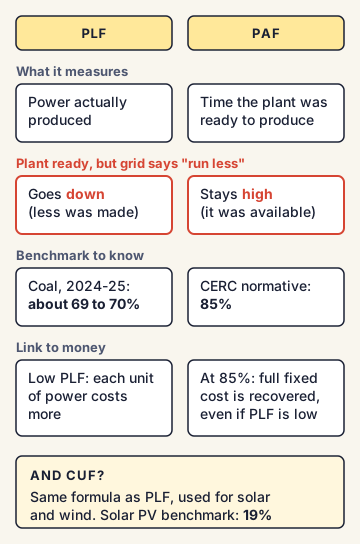
A plant can be fully ready to run but still produce less because it was not asked to. Being ready is measured by Plant Availability Factor (PAF). Under electricity tariff rules, the Central Electricity Regulatory Commission (CERC) uses a normative (standard) availability of 85% for most coal and gas plants. A plant that stays available at this level recovers its full fixed costs (like loan repayments), even if its actual PLF is lower. This is why low PLF still costs discoms and consumers money.
PLF vs Capacity Utilisation Factor (CUF)
For solar and wind plants, the same idea is usually called CUF. The formula is the same. But because the sun sets and the wind changes, CUF is naturally low. Regulators have long used a benchmark CUF of 19% for solar photovoltaic (PV) plants. So a 100 MW solar plant produces far less in a year than a 100 MW coal plant. This is the reason India's clean energy capacity share is much higher than its clean energy generation share.
India's coal PLF over time
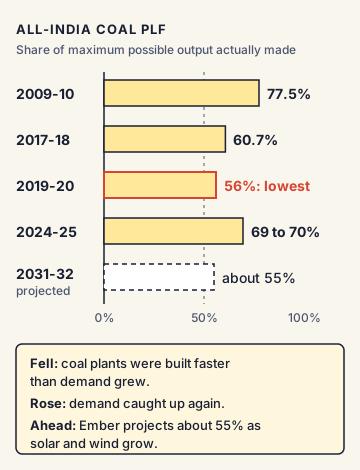
The all-India average PLF of coal plants was about 77.5% in 2009-10. It then fell for years, because many new coal plants were built faster than demand grew. It was about 60.7% in 2017-18 and about 56% in 2019-20. As demand rose again, it recovered to about 69 to 70% in 2024-25. In the July to September 2026 quarter it was 68%, up from 62% a year earlier.
Coal plants as "balancing" plants
Earlier, coal plants ran steadily all day as "baseload" plants. Now, as solar fills the grid at noon, coal plants must cut output in the day and increase it in the evening. To allow this, the Central Electricity Authority notified the CEA (Flexible Operation of Coal based Thermal Power Generating Units) Regulations, 2023. They require coal units to be able to run at a minimum power level of 40% (to be reached in phases) and to change output quickly.
An energy think tank, Ember, has projected that the PLF of Indian coal plants could fall from 69% in 2024-25 to about 55% by 2031-32 as renewables grow.
Coal stocks and PLF
To run at a good PLF, a coal plant must hold enough coal. The CEA sets normative coal stock levels. Since December 2021, plants near mines (pithead plants) must keep about 12 to 17 days of coal, and plants far from mines (non-pithead plants) about 20 to 26 days. These are worked out assuming the plant runs at an 85% PLF. When stocks fall below about a quarter of the norm, a plant is treated as being in a "critical" position.
Commonly confused concepts
- PLF vs PAF: PLF is what a plant actually produced; PAF is how much of the time it was ready to produce.
- PLF vs CUF: Both use the same formula. PLF is mostly used for thermal (coal, gas, nuclear) plants; CUF for solar and wind.
- Installed capacity vs generation: Capacity (in MW or GW) is the maximum possible output at one moment. Generation (in units or BU) is the energy actually made over time.
- Peak demand vs total consumption: Peak demand is the highest use at one moment (in GW). Consumption is the total energy used over a period (in BU).
Issues, criticism and the way forward
- Stranded assets: If new coal plants run at low PLF, their cost per unit rises and they may never earn back their investment. In August 2026, about 44 GW of coal capacity was under construction, and about 90% of it was less than half complete.
- Higher bills: Discoms must pay fixed costs to plants even when they run less, which raises the cost of power.
- Wear and tear: Running coal units up and down every day damages equipment and lowers efficiency.
- Coal supply: Low stocks force plants to cut output or import costly coal, as seen when stocks fell to 36% of the norm in September 2026.
- Way forward: Experts suggest planning new coal capacity only against realistic demand, adding storage, upgrading old plants for flexible running, and better coal logistics by rail.
Concepts to Know
- Baseload: The minimum level of electricity demand that exists all day and night. Plants that run steadily to meet it are called baseload plants.
- Normative: A standard or benchmark level set by a regulator, against which actual performance is measured.
- Fixed cost vs variable cost: Fixed cost (loan interest, salaries, maintenance) must be paid whether the plant runs or not. Variable cost (mainly fuel) is paid only when it produces power.
- Stranded asset: An investment that loses its value early because it can no longer be used profitably.
- PLF = actual generation ÷ (capacity × hours) × 100
- CERC normative plant availability for coal plants: 85%
- Benchmark solar PV CUF used by regulators: 19%
- All-India coal PLF: about 77.5% (2009-10), about 60.7% (2017-18), about 69 to 70% (2024-25)
- CEA Flexible Operation Regulations, 2023: minimum power level of 40% for coal units, in phases
- CEA coal stock norms (from December 2021): pithead 12 to 17 days; non-pithead 20 to 26 days
● Tracked since October 12, 2026 · last seen October 12, 2026 · updates as the daily brief publishes