National Critical Mineral Mission (NCMM)
India's Plan to Secure Minerals of the Future
The National Critical Mineral Mission (NCMM) is the Government of India's seven-year programme to make the country self-reliant in critical minerals: minerals like lithium, cobalt, nickel, graphite and rare earths that are vital for electric vehicles, solar panels, electronics and defence, but whose supply is risky. The mission covers the whole chain, from finding minerals underground to mining, processing, recycling and buying mines abroad. It was approved by the Union Cabinet on 29 January 2025 and is run by the Ministry of Mines.
Why does India need this mission?
India imports almost all of its lithium, cobalt and nickel, and depends heavily on imports for rare earth magnets. A very large share of the world's processing of these minerals happens in one country, China. For example, according to the International Energy Agency (IEA), China refines around 90% of the world's rare earths. When one country controls the supply, it can cut exports during a dispute.
China did this with gallium and germanium export controls in 2023 and with rare earth export controls in 2025, which hurt carmakers around the world. Think of it like a town where only one shop sells medicine: if that shop shuts, everyone suffers. NCMM is India's plan to open "more shops" and also keep a stock at home.
Where did it come from?
The steps came one after another:
- 2019: Khanij Bidesh India Ltd (KABIL) was formed to buy mineral assets abroad. It is a joint venture of three central public sector companies under the Ministry of Mines: NALCO (40%), Hindustan Copper Ltd (30%) and Mineral Exploration and Consultancy Ltd (MECL, 30%).
- June 2023: The Ministry of Mines released India's first list of 30 critical minerals, prepared by an expert committee.
- August 2023: The Mines and Minerals (Development and Regulation) Amendment Act, 2023 came into force (17 August 2023). It added 24 critical and strategic minerals to a new Part D of the First Schedule of the MMDR Act, 1957, and gave the Central Government the power to auction mining leases and composite licences for them. It also created a new exploration licence for deep-seated and critical minerals, so private companies can join exploration.
- November 2023: The first auction of critical mineral blocks began.
- July 2024: The Union Budget 2024-25 announced a Critical Mineral Mission and removed customs duty on most critical minerals.
- 29 January 2025: The Cabinet approved NCMM.
How big is the mission?
The government's own spending is ₹16,300 crore, and public sector companies are expected to invest another ₹18,000 crore. That makes a total of about ₹34,300 crore over seven years, from 2024-25 to 2030-31.
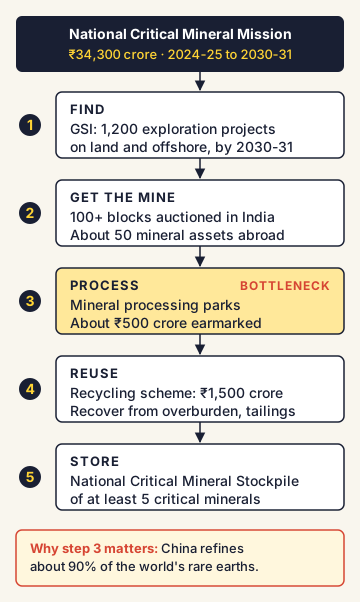
What will the mission do? (its main parts)
- Exploration: The Geological Survey of India (GSI) is to carry out 1,200 exploration projects by 2030-31, on land and in offshore areas. Exploration means searching underground to find out where minerals are and how much there is.
- Auctions: More than 100 critical mineral blocks are to be auctioned. A "block" is an area of land given for mining through bidding.
- Fast-track approvals: a quicker system for clearances for critical mineral mining projects.
- Recovery from waste: extracting minerals from mine overburden (the soil and rock removed to reach the ore) and tailings (the leftover waste after processing).
- Recycling: recovering minerals from old batteries and e-waste. On 3 September 2025, the Cabinet approved a ₹1,500 crore incentive scheme for critical mineral recycling, running from 2025-26 to 2030-31. Feedstock includes e-waste, lithium-ion battery scrap and parts like catalytic converters from old vehicles.
- Mineral processing parks: clusters where companies can process ore into usable materials using shared roads, power, water and waste treatment. About ₹500 crore has been earmarked for them.
- National Critical Mineral Stockpile: a reserve of at least five critical minerals inside the country, to protect against supply shocks.
- Overseas assets: Indian public and private companies are to acquire about 50 critical mineral assets abroad. KABIL, for example, has lithium blocks in Catamarca province of Argentina (about 15,703 hectares).
- Research and skills: Centres of Excellence on critical minerals, research support, and a target of generating about 1,000 patents by 2031.
How is the mission run?
It follows a "whole-of-government" approach, meaning all relevant ministries work together. An Empowered Committee chaired by the Cabinet Secretary coordinates it. A Mission Secretariat in the Ministry of Mines handles daily work.
What is a strategic stockpile, and why does it matter?
A strategic stockpile is a reserve that the government keeps for emergencies, not for daily trade. It works like a family keeping extra rice and dal before the monsoon, in case roads are blocked. If an exporting country suddenly stops supplies, factories making defence equipment, batteries or electronics can draw on the stockpile while new sources are arranged. Other countries already do this:
- United States: the National Defense Stockpile, set up under the Strategic and Critical Materials Stock Piling Act of 1939.
- Japan: its state agency JOGMEC keeps stockpiles of rare metals, with a general target of about 60 days of national use (higher for risky minerals).
- India's own example: India already keeps Strategic Petroleum Reserves of crude oil in underground caverns. A critical mineral stockpile applies the same idea to minerals.
Unlike oil, minerals come in many forms (ore, oxide, metal, alloy), and some can degrade or go out of date as technology changes. So deciding which minerals to store, in what form and how much is the hardest part of a stockpiling policy.
Linked schemes you should know
- Scheme to Promote Manufacturing of Sintered Rare Earth Permanent Magnets (approved 26 November 2025): outlay ₹7,280 crore, to create 6,000 tonnes per year of magnet-making capacity, split among up to five companies. These magnets are used in electric vehicle motors, wind turbines and defence systems.
- Production Linked Incentive (PLI) scheme for Advanced Chemistry Cell (ACC) batteries: supports battery-making in India, which creates demand for lithium, nickel and cobalt.
Commonly confused concepts
- Critical minerals vs strategic minerals: Critical minerals are important for the economy and have supply risk (lithium, cobalt). Strategic minerals are important mainly for defence and national security. Many minerals are both, which is why the MMDR Act uses the phrase "critical and strategic minerals" for Part D.
- Rare earth elements vs rare minerals: Rare earth elements are a specific group of 17 metals (the 15 lanthanides plus scandium and yttrium). They are not actually very rare in the earth's crust; they are hard to separate and refine.
- Atomic minerals vs critical minerals: Atomic minerals (like uranium and thorium) are handled by the Department of Atomic Energy. The 2023 amendment removed six minerals, including lithium, beryllium and zirconium-bearing minerals, from the "atomic" list so private companies could mine them.
- NCMM vs KABIL: NCMM is the overall national mission. KABIL is one company that buys mineral assets abroad.
- Exploration licence vs mining lease vs composite licence: An exploration licence lets you search for minerals. A mining lease lets you dig them out. A composite licence covers both prospecting and later mining.
- Strategic stockpile vs buffer stock: A strategic stockpile is kept for national emergencies and supply cuts. A buffer stock (like FCI's food grain stock) is used to keep prices stable and supply steady in normal times.
Issues, criticism and the way forward
- Weak processing base: Even if India finds or buys ore, it has very little capacity to refine it. Processing is the real bottleneck, which is why the processing parks matter.
- Slow auctions: Several critical mineral blocks put up for auction got few bidders or none, because exploration data was thin and the risk was high.
- Long time to mine: It can take 10 to 15 years to move from discovery to production.
- Environmental and social costs: Mining and processing can harm forests, water and local tribal communities. Laws like the Forest Rights Act, 2006 and environmental clearance rules must be followed.
- Stockpile design: Storing minerals is costly, and minerals may lose value if technology changes (for example, new battery chemistries that use less cobalt). Clear rules on what to store and when to release are needed.
- Way forward: Experts suggest better geological data, partnerships with mineral-rich countries (Australia, Argentina, Chile, African nations), groups like the Minerals Security Partnership (India joined in 2023), more recycling, and investing in research to develop alternatives to scarce minerals.
Concepts to Know
- Lithium-ion battery: The rechargeable battery used in phones and electric vehicles. It needs lithium, and often nickel, cobalt, manganese and graphite.
- Value addition: Turning a raw material into a more useful and valuable product. For example, turning lithium ore into battery-grade lithium chemicals.
- Beneficiation: Cleaning and concentrating raw ore to raise its mineral content before further processing.
- Supply chain: All the steps a product goes through, from raw material to finished product reaching the buyer.
- Export controls: Rules a country uses to limit or ban the sale of certain goods to other countries.
- Public sector undertaking (PSU): A company owned mainly by the government, such as NALCO or Coal India.
- E-waste: Thrown-away electronic items like old phones, laptops and chargers, which contain valuable metals.
- NCMM approved by the Union Cabinet on 29 January 2025; nodal ministry: Ministry of Mines
- Outlay: ₹16,300 crore (government) + ₹18,000 crore (PSUs) = about ₹34,300 crore; period 2024-25 to 2030-31
- Targets: 1,200 GSI exploration projects; 100+ blocks auctioned; about 50 overseas assets; stockpile of at least 5 critical minerals; about ₹500 crore for processing parks
- Governance: Empowered Committee chaired by the Cabinet Secretary
- List of 30 critical minerals: June 2023; 24 in Part D of the First Schedule of the MMDR Act, 1957 (MMDR Amendment Act, 2023, in force 17 August 2023)
- KABIL (2019): NALCO 40%, HCL 30%, MECL 30%; lithium blocks in Catamarca, Argentina
- Recycling incentive scheme: ₹1,500 crore (approved 3 September 2025)
- Rare earth permanent magnet scheme: ₹7,280 crore, 6,000 tonnes per year (approved 26 November 2025)
● Tracked since February 10, 2026 · last seen October 09, 2026 · updates as the daily brief publishes