US Farm Bill
How America Supports Its Farmers
The Farm Bill is a large US law, passed by the US Congress (the American Parliament) about once every five years. It decides almost everything about how the US government helps its farmers and feeds its poor. It sets the rules for crop price support, crop insurance, soil and water conservation, farm loans, farm research, and food aid for low-income families. In simple words, it is America's main rulebook and budget for farming and food.
Why does it exist?
Farming is a risky business everywhere. A farmer's income can crash because of a drought, a flood, a pest attack, or a sudden fall in world prices. In the 1930s, during the Great Depression (a very deep economic crisis), crop prices in the US collapsed and many farmers lost their land. The US government decided that farmers needed a steady safety net.
The Farm Bill is that safety net. Think of it like a family that keeps a fixed amount aside every month so that a bad month does not push anyone into debt.
Where did it come from?
The Farm Bill has grown over about 90 years:
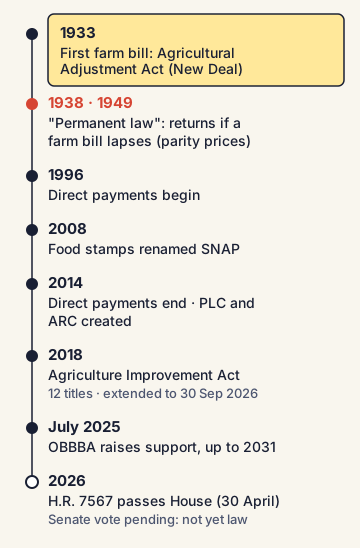
- 1933: The first farm bill, the Agricultural Adjustment Act of 1933, was passed as part of President Franklin D. Roosevelt's New Deal (a set of programmes to fight the Great Depression). It tried to raise farm prices by paying farmers to grow less, so supply would fall and prices would rise.
- 1933: The Commodity Credit Corporation (CCC) was created on 17 October 1933. It is a government-owned body that pays for farm programmes. Today it can borrow up to $30 billion at any one time (a limit set by Congress in 1987).
- 1938 and 1949: The Agricultural Adjustment Act of 1938 and the Agricultural Act of 1949 became the "permanent law". Every modern farm bill temporarily switches off this old law. If a farm bill expires and is not extended, the old 1938/1949 rules legally come back. These rules fix support prices using a very old formula called "parity", which compares prices with those of 1910-1914. People call this risk the "dairy cliff". Congress has never actually let permanent law take effect, so it works mainly as pressure to pass new farm bills on time.
- 1960s to 2008: Food aid for poor families was added to the farm bill. The 2008 farm bill renamed the food stamp programme the Supplemental Nutrition Assistance Program (SNAP).
- 1996: A farm law brought in fixed yearly payments to farmers based on their past production, not on what they grew now. These came to be called "direct payments".
- 2014: The farm bill ended direct payments and created two new programmes, Price Loss Coverage (PLC) and Agriculture Risk Coverage (ARC) (explained below).
- 2018: The Agriculture Improvement Act of 2018 (signed on 20 December 2018) had 12 titles (chapters). It was meant to run to 2023. The US Congressional Budget Office estimated its mandatory spending at about $428 billion over five years (2019-2023).
- 2023 to 2026: Congress could not agree on a new farm bill, so it extended the 2018 law three times. The third extension, passed on 12 November 2025, ran up to 30 September 2026.
- July 2025: A large budget law, the One Big Beautiful Bill Act (OBBBA), signed on 4 July 2025, rewrote many farm support programmes outside the normal farm bill process. It raised support levels and extended key programmes up to the 2031 crop year.
- 2026: A new farm bill, the Farm, Food, and National Security Act of 2026 (H.R. 7567), was passed by the House of Representatives on 30 April 2026 (224 votes to 200). The Senate Agriculture Committee approved its own version on 16 September 2026. As of October 2026, a full Senate vote was still pending, so it had not become law.
What does a Farm Bill contain?
The bill is divided into "titles", each covering one area. The most important ones are:
- Commodity title: price and income support for major crops such as corn (maize), soybeans, wheat, cotton and rice, and support for dairy.
- Crop insurance: the government pays a large share of the premium (the fee a farmer pays for insurance). Crop insurance is permanently authorised, so it does not expire with the farm bill.
- Conservation: payments to farmers who protect soil, water and wildlife, for example by leaving some land unplanted.
- Nutrition: SNAP, which gives food money to low-income families. This is by far the biggest part of spending, about three-quarters or more of the total.
- Trade, credit, rural development, research, forestry and horticulture: smaller titles for export promotion, farm loans and rural services.
So when people talk about "US farm subsidies", they mostly mean the commodity title and crop insurance, not the whole bill.
How does the farm support work?
Here is the basic system, step by step:
- Base acres: A farm's "base acres" is the land area on which it can receive support, worked out from what it planted in the past. The OBBBA allowed up to 30 million new base acres to be added from the 2026 crop year.
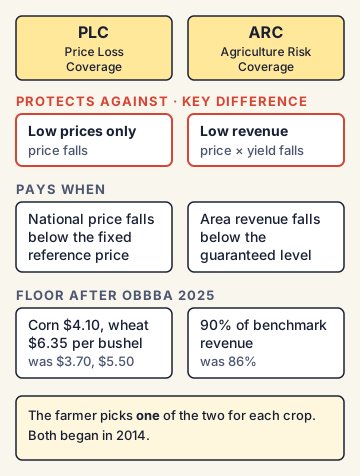
- Choice of programme: For each crop, a farmer picks either PLC or ARC.
- Price Loss Coverage (PLC): The law fixes a reference price for each crop. If the national average market price falls below it, the government pays the farmer the gap on part of his base acres. Example: if the reference price for corn is $4.10 a bushel (a unit of grain volume) and the market price falls to $3.60, the farmer gets paid for the 50-cent gap. The OBBBA raised reference prices by roughly 10-20%; for example, corn went from $3.70 to $4.10 and wheat from $5.50 to $6.35 per bushel.
- Agriculture Risk Coverage (ARC): This pays when a farmer's area's revenue (price multiplied by yield) falls below a guaranteed level. The OBBBA raised this guarantee from 86% to 90% of the benchmark revenue.
- Marketing loans: Farmers can take a short-term loan using their harvested crop as security. If prices are very low, they can repay at a lower rate, which works as another price floor.
- Crop insurance on top: Farmers also buy insurance against bad yields or falling revenue, and the government pays on average about 62% of the premium.
- Payment limits: There is a cap on how much one person can get from PLC, ARC and marketing loans. The OBBBA raised it from $125,000 to $155,000 per person, linked to inflation.
A simple comparison: PLC is like a promise that "you will never get less than ₹X per quintal", while ARC is like a promise that "your total earnings from this crop will not fall below Y".
Extra help outside the Farm Bill
The US government can also give one-time aid when farmers are hurt by trade fights. For example, in December 2025, the US Department of Agriculture announced $12 billion in "bridge" payments: $11 billion under the Farmer Bridge Assistance programme for row crops (such as corn, soybeans, wheat and cotton) and $1 billion for specialty crops and sugar. This was paid through the Commodity Credit Corporation.
How does this compare with India?
The size of farms is very different, and this explains why the issue is so sensitive.
- US: about 19 lakh (1.9 million) farms in 2022, with an average size of 463 acres (about 187 hectares), according to the 2022 US Census of Agriculture.
- India: the average operational landholding was 1.08 hectares in the Agriculture Census 2015-16, and 86.21% of holdings were small and marginal (below 2 hectares).
So a large, highly mechanised, insured and subsidised US farm can sell maize or soybean oil very cheaply. A small Indian farmer, with one or two hectares and little insurance, cannot easily compete with such imports. This is why trade deals with the US almost always raise questions about Indian farm prices.
What do world trade rules say?
Farm subsidies are controlled by the WTO Agreement on Agriculture (1995). It sorts subsidies into "boxes":
- Amber Box: support that distorts trade, such as price support. It is capped. The US committed to cap its total Amber Box support at about $19.1 billion a year.
- De minimis: a small amount of Amber Box support is allowed without counting against the cap: up to 5% of the value of production for developed countries like the US, and 10% for developing countries like India.
- Green Box: support that causes little or no trade distortion, such as research, conservation and food aid. It is not capped.
India and other developing countries have long argued that rich countries give very large total support to a small number of farmers, much of it in uncapped categories. The US has argued that India's price support for crops like wheat, rice and sugarcane goes above WTO limits.
Commonly confused concepts
- Farm Bill vs Agricultural Adjustment Act: The 1933 Agricultural Adjustment Act was the first farm bill. "Farm Bill" is the general name for each new law in this series.
- PLC vs ARC: PLC protects against low prices only. ARC protects against low revenue (price and yield together).
- PLC vs India's MSP: Both use a fixed price as a floor. But India's Minimum Support Price (MSP) works mainly through the government buying the crop at that price. US PLC simply pays the price gap in cash on base acres; the government does not buy the crop.
- Amber Box vs Green Box: Amber Box support distorts trade and is capped. Green Box support does not distort trade much and is not capped.
- Farm Bill vs OBBBA: The Farm Bill is the regular multi-year farm law. The OBBBA was a 2025 budget law that changed many farm programmes in between farm bills.
Issues, criticism and the way forward
- Unfair competition for poor countries: Critics in developing countries say heavily supported US crops can be sold abroad at low prices. This can push down prices for small farmers in countries like India if import taxes are cut.
- Benefits go to bigger farms: Studies and critics within the US often point out that most support goes to large farms and a few crops (like corn, soybeans, cotton, wheat and rice).
- Cost to taxpayers: Higher reference prices and new base acres raise the cost of support programmes.
- Supporters' view: Supporters say farming faces risks no other business faces, and that a stable farm sector protects food security and rural jobs. They also note that other countries, including India, support their farmers too.
- Way forward: Experts suggest that India use sensitive lists, tariff-rate quotas and safeguard clauses in trade deals to protect small farmers. At the WTO, developing countries continue to push for lower trade-distorting support by rich countries and for a permanent solution on food stockholding.
Concepts to Know
- Subsidy: Money or help given by the government to lower a producer's costs or raise their income, for example cheap insurance or a price guarantee.
- Commodity: A basic farm product traded in large amounts, such as wheat, maize, soybeans or cotton.
- Bushel: A US unit of volume for grain. A bushel of corn weighs about 25 kg.
- Premium: The fee a person pays to buy insurance.
- Row crops: Crops planted in rows on large fields with machines, such as maize, soybeans, cotton and wheat.
- Trade-distorting support: Help that changes how much is produced or traded, so that prices on the world market are no longer set by fair competition.
- US Congress: The US law-making body, with two houses: the House of Representatives and the Senate. A bill must pass both houses and be signed by the President to become law.
- First farm bill: Agricultural Adjustment Act of 1933 (New Deal)
- Commodity Credit Corporation: created 17 October 1933; borrowing limit $30 billion (set in 1987)
- "Permanent law": Agricultural Adjustment Act of 1938 and Agricultural Act of 1949; parity base period 1910-1914; risk of a "dairy cliff" if a farm bill lapses
- 2014 farm bill: ended direct payments (in place since 1996); created PLC and ARC
- Agriculture Improvement Act of 2018: signed 20 December 2018; 12 titles; about $428 billion over 2019-2023 (CBO estimate)
- 2018 law extended three times; last extension to 30 September 2026
- OBBBA: signed 4 July 2025; reference prices up about 10-20%; up to 30 million new base acres; ARC guarantee 86% to 90%; payment limit $125,000 to $155,000; programmes extended through crop year 2031
- Farm, Food, and National Security Act of 2026 (H.R. 7567): passed the House 30 April 2026 (224-200); Senate Agriculture Committee approved its version 16 September 2026
- Farmer Bridge Assistance (December 2025): $12 billion total ($11 billion row crops, $1 billion specialty crops and sugar)
- Average federal share of crop insurance premiums: about 62%
- US: about 1.9 million farms, average 463 acres (2022 Census of Agriculture); India: average holding 1.08 ha, 86.21% small and marginal (Agriculture Census 2015-16)
- WTO: US Amber Box cap about $19.1 billion; de minimis 5% (developed) and 10% (developing)
● Tracked since October 29, 2026 · last seen October 29, 2026 · updates as the daily brief publishes