Comparative Advantage
Ricardo's Theory of International Trade
Comparative advantage is the most important idea in the theory of international trade. It says that a country gains most by producing and exporting the goods it can make at a lower opportunity cost than other countries, and importing the rest. The surprising part is this: even if one country is better at making everything, both countries still gain from trade, as long as each focuses on what it is relatively best at. This idea explains why countries trade, why they specialise, and why most economists support open trade.
What does "opportunity cost" mean?
Opportunity cost is what you give up when you choose one thing over another. Suppose a farmer can use one field for either wheat or cotton. If she grows wheat, the cotton she could have grown is the opportunity cost of that wheat. Every country has limited workers, land and machines. So making more of one good always means making less of another. Comparative advantage compares countries using these "give-ups", not using raw efficiency.
A simple everyday example
Imagine a top lawyer who also types faster than her assistant. Should she do all her own typing? No. One hour of her time earns far more in legal work than it saves in typing. The assistant is slower at typing, but gives up much less by typing. So the lawyer focuses on law and the assistant on typing. Both together produce more. The lawyer has an absolute advantage in both tasks, but a comparative advantage only in law. Countries work the same way.
Where did the idea come from?
- Mercantilism (roughly 16th to 18th centuries): Rulers believed a country grows rich by exporting more than it imports and piling up gold and silver. Trade was seen as a contest where one side's gain is the other's loss.
- Adam Smith (1776): In The Wealth of Nations, Smith argued against this view. He gave the idea of absolute advantage: a country should export goods it makes with fewer inputs (such as fewer hours of labour) than other countries, and buy the rest. But this left a puzzle. What if one country is better at making everything? Would it gain nothing from trade?
- David Ricardo (1817): In his book On the Principles of Political Economy and Taxation, the British economist David Ricardo solved this puzzle. He showed that trade benefits both sides even when one country is better at everything. Ricardo's version is called the Ricardian model.
How does Ricardo's example work?
Ricardo used two countries, England and Portugal, and two goods, cloth and wine. He measured cost as the number of workers needed for one year to produce a fixed amount:
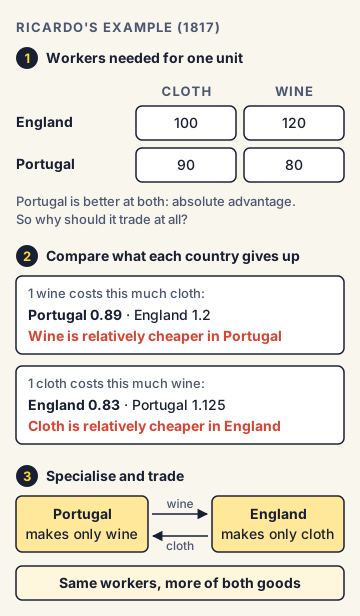
| Cloth | Wine | |
|---|---|---|
| England | 100 workers | 120 workers |
| Portugal | 90 workers | 80 workers |
Portugal needs fewer workers for both goods, so it has an absolute advantage in both. Now look at opportunity cost:
- In Portugal, making one unit of wine uses 80 workers, who could have made about 0.89 units of cloth (80 ÷ 90). In England, one unit of wine uses 120 workers, who could have made 1.2 units of cloth (120 ÷ 100). So wine is relatively cheaper in Portugal.
- In England, one unit of cloth costs about 0.83 units of wine (100 ÷ 120). In Portugal, one unit of cloth costs about 1.125 units of wine (90 ÷ 80). So cloth is relatively cheaper in England.
So Portugal has a comparative advantage in wine, and England in cloth. If Portugal makes only wine and England only cloth, and they trade, the world gets more of both goods from the same number of workers. Each country can then consume more than it could alone.
What came after Ricardo?
Ricardo explained that comparative advantage exists, using only labour. Later thinkers asked why it exists:
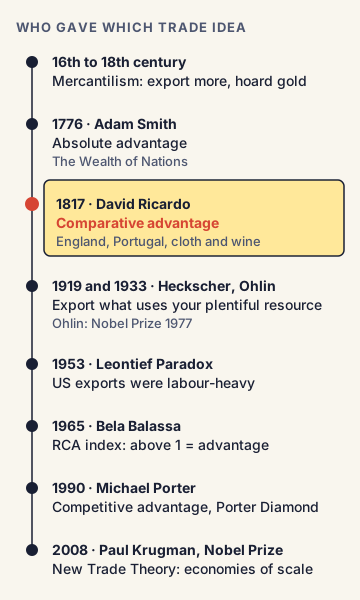
- Heckscher-Ohlin theory: Developed by two Swedish economists, Eli Heckscher (1919) and Bertil Ohlin (1933). It says a country exports goods that use a lot of the resource it has in plenty. A country with many workers (like India) will export labour-heavy goods such as garments. A country with a lot of capital (machines and money) will export capital-heavy goods. Ohlin shared the Nobel Prize in Economics in 1977.
- Leontief Paradox (1953): The economist Wassily Leontief tested Heckscher-Ohlin on US data. The US had more capital per worker than almost any country, so it should have exported capital-heavy goods. Instead, its exports were more labour-heavy than its imports. This "paradox" showed that real trade is more complicated than the simple theory.
- New Trade Theory: Paul Krugman showed that much trade happens between similar rich countries (for example, Germany and France both making and trading cars). He explained this using economies of scale (making something in very large amounts makes each unit cheaper) and consumers' love of variety. He won the Nobel Prize in Economics in 2008 for his analysis of trade patterns and the location of economic activity.
How is comparative advantage measured?
In real life, economists cannot see opportunity costs directly. So they look at what a country actually exports well. The most used tool is the Revealed Comparative Advantage (RCA) index, also called the Balassa index, given by the economist Bela Balassa in 1965.
- RCA = (share of a product in the country's total exports) ÷ (share of that product in total world exports).
- If RCA is more than 1, the country has a revealed comparative advantage in that product. If it is less than 1, it does not.
- Example: if rice is 4% of a country's exports but only 1% of world exports, its RCA in rice is 4, a strong advantage.
India's position and Indian examples
India has a large, young workforce, many English-speaking graduates and a big domestic market. Its comparative advantages show up in:
- IT and business services: software and IT-enabled services are among India's largest exports.
- Generic medicines: India is a leading supplier of low-cost generic medicines worldwide.
- Labour-heavy goods: textiles and garments, gems and jewellery, leather and footwear, and processed foods and marine products.
- Some farm goods: for example, rice, where India is the world's largest exporter.
These are also the sectors that gain or lose most when another country, such as the US, changes its tariffs on Indian goods.
Commonly confused concepts
- Absolute advantage vs comparative advantage: Absolute advantage means making a good using fewer inputs than another country (Adam Smith). Comparative advantage means making a good at a lower opportunity cost (Ricardo). A country can lack absolute advantage in everything and still have a comparative advantage in something. Trade is based on comparative, not absolute, advantage.
- Comparative advantage vs competitive advantage: Comparative advantage is an economic idea about opportunity costs between countries. Competitive advantage is about how well a country's firms can beat rivals in the market, through price, quality, technology or branding. The idea is linked to Harvard professor Michael Porter, whose 1990 book The Competitive Advantage of Nations gave the Porter Diamond with four parts: (1) factor conditions (skills, infrastructure), (2) demand conditions (demanding home buyers), (3) related and supporting industries, and (4) firm strategy, structure and rivalry. Porter also noted the roles of government and chance. Competitive advantage can be built by policy; comparative advantage comes from relative costs.
- Comparative advantage vs "tariff advantage" in trade talks: In trade negotiations, a "competitive advantage over peers" usually means getting a lower tariff than rival countries in the same market. Even if India makes garments as cheaply as a rival, a higher US tariff on Indian garments can wipe out that advantage at the shop counter.
- Comparative advantage vs trade surplus: Having a comparative advantage in some goods does not mean a country will have an overall trade surplus. The overall balance depends on savings, investment and exchange rates too.
Issues, criticism and the way forward
- Unrealistic assumptions: Ricardo's model assumes workers move easily between industries, there are no transport costs and full employment exists. In reality, a weaver who loses her job cannot easily become a software engineer.
- Winners and losers: Trade raises total income, but some groups lose, such as workers in industries that face cheaper imports. Economists argue that governments should help them with retraining and safety nets.
- Comparative advantage can be built: East Asian economies such as South Korea moved from cheap textiles to ships, steel and electronics through education, investment and industrial policy. Critics of a "static" view say poor countries should not stay stuck in low-value goods.
- Infant industry argument: Some argue that new industries need temporary protection until they grow strong enough to compete. Others warn that protection often becomes permanent and makes firms lazy.
- National security and resilience: After the COVID-19 pandemic and recent trade wars, many countries now value supply chains that are safe and diverse, not only cheap. This "friend-shoring" and "reshoring" can go against pure comparative advantage.
- Tariffs distort the picture: When a large importer such as the US sets different tariffs for different countries, firms may buy from the country with the lowest tariff, not the lowest cost. This is why trade talks increasingly focus on tariff gaps between rival exporters.
- Way forward for India: Experts commonly suggest improving logistics, skills, power supply and ease of doing business, so that India's natural comparative advantage in labour-heavy and skill-heavy goods turns into a real competitive advantage in world markets.
Concepts to Know
- Opportunity cost: What you give up when you choose one option. If one hour of work can give either 2 shirts or 1 pair of shoes, the opportunity cost of 1 pair of shoes is 2 shirts.
- Specialisation: Focusing on making a few things you are relatively good at, instead of making everything yourself.
- Tariff: A tax a country charges on goods coming in from abroad. It makes imported goods more costly for buyers.
- Economies of scale: When making a product in very large amounts lowers the cost of each unit, for example because the factory and machines are shared over more units.
- Mercantilism: An old belief that a nation becomes rich by exporting more than it imports and collecting gold and silver.
- Factors of production: The basic inputs used to make things: land, labour (workers), capital (machines, money) and entrepreneurship.
- Adam Smith, The Wealth of Nations (1776): absolute advantage
- David Ricardo, On the Principles of Political Economy and Taxation (1817): comparative advantage; example of England, Portugal, cloth and wine
- Heckscher (1919) and Ohlin (1933): trade based on factor abundance; Ohlin won the Nobel Prize in 1977
- Leontief Paradox: 1953, based on US trade data
- Paul Krugman: New Trade Theory; Nobel Prize 2008
- Balassa's Revealed Comparative Advantage index: 1965; RCA greater than 1 means a revealed advantage
- Michael Porter, The Competitive Advantage of Nations (1990): Porter Diamond with four determinants
● Tracked since October 15, 2026 · last seen October 15, 2026 · updates as the daily brief publishes