Unmanned Aerial Vehicles (UAVs)
Types, Uses and India's Drone Programme
An Unmanned Aerial Vehicle (UAV), commonly called a drone, is an aircraft that flies without a pilot sitting inside it. It is either flown by a person from the ground using a remote control, or it flies on its own using a pre-set computer program. The full set-up (the aircraft, the ground control station and the communication link between them) is called an Unmanned Aircraft System (UAS).
Drones range from toy-sized gadgets to large military aircraft that can fly for more than a day and fire missiles.
Why do armies and air forces use drones?
A pilot is the most precious and most expensive part of a fighter jet. Training one takes years, and losing one is a huge human cost. A drone removes the pilot from danger. It can be sent into risky areas, such as over enemy air defences, without risking a life. Drones can also stay in the air far longer than a tired human pilot, so they can watch one area for many hours.
Many drones are also much cheaper than fighter jets, so a force can afford to buy them in large numbers.
Where did drones come from?
Pilotless aircraft were tested as early as World War I and were used as target practice aircraft in the decades after. Their real military rise came with better computers, satellites and cameras. From the 1980s, Israel used small drones for spying on the battlefield, and the United States later used armed drones such as the MQ-1 Predator and MQ-9 Reaper.
In recent conflicts (Nagorno-Karabakh in 2020 and the Russia-Ukraine war from 2022), cheap drones and loitering munitions became central weapons. This made every military rethink how drones fit into war.
How does a drone work?
Think of a drone as having three parts working together:
- The aircraft (air vehicle): carries an engine or battery, sensors (cameras, radar) and sometimes weapons.
- The ground control station: where the operator sits, sees what the drone sees, and gives commands.
- The data link: a radio or satellite connection that carries commands up to the drone and pictures down to the operator. Small drones use direct radio within sight. Large drones use satellites to fly thousands of kilometres away. This is called beyond visual line of sight (BVLOS) flying.
How are military drones classified?
Military drones are often grouped by how high they fly and how long they stay up:
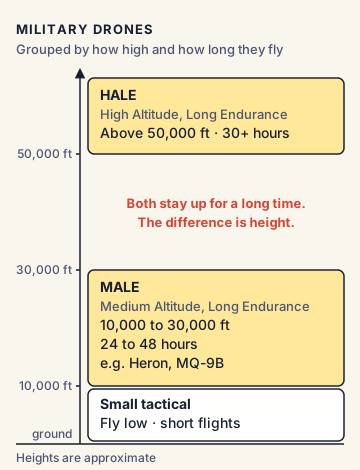
- Small tactical drones: fly low, for short periods, and are used by soldiers to look over the next hill.
- MALE (Medium Altitude, Long Endurance): usually fly between about 10,000 and 30,000 feet and can stay airborne for roughly 24 to 48 hours. The Israeli Heron and the American MQ-9B are examples.
- HALE (High Altitude, Long Endurance): fly above about 50,000 feet and can stay up for more than 30 hours, sometimes much longer.
- UCAV (Unmanned Combat Aerial Vehicle): a drone built mainly to attack, often fast and sometimes stealthy (hard to detect on radar).
- Loitering munition: a "suicide drone" that carries a warhead (an explosive charge). It circles (loiters) over an area, waits for the operator to choose a target, and then crashes into it and explodes. The Israeli Harop is a well-known example.
How does India classify civilian drones?
The Drone Rules, 2021, notified by the central government on 25 August 2021, sort drones by their maximum all-up weight (total weight including the load they carry):
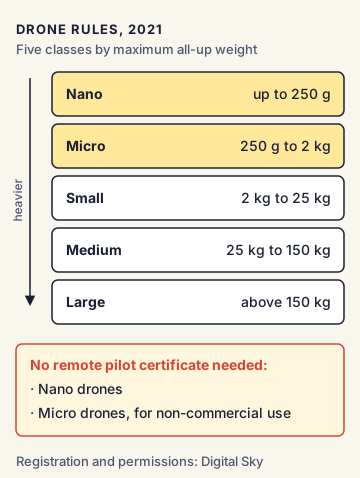
- Nano: up to 250 grams
- Micro: more than 250 grams, up to 2 kg
- Small: more than 2 kg, up to 25 kg
- Medium: more than 25 kg, up to 150 kg
- Large: more than 150 kg
Nano drones, and micro drones flown for non-commercial use, do not need a remote pilot certificate. These rules replaced the stricter Unmanned Aircraft System Rules, 2021 and made drone use much simpler. Registration and permissions are handled through the online Digital Sky platform.
India's military drone story
The Indian Army was the first Indian service to buy a UAV, the Israeli Searcher Mk I, in 1996. The IAF and Navy followed, and the IAF formally inducted UAVs in 2000. The Heron MALE drone entered Indian service from 2003. In October 2024, India signed a deal with the United States for 31 MQ-9B drones (SeaGuardian and SkyGuardian versions): reports put the Navy's share at 15 or 16, with 8 each for the Army and the IAF. Indian-made programmes include:
- TAPAS-BH-201 (earlier called Rustom-II): a MALE drone being developed by DRDO (Defence Research and Development Organisation).
- Ghatak: a stealthy unmanned combat aircraft being developed by DRDO's Aeronautical Development Agency (ADA). A scaled-down demonstrator first flew in July 2022.
- CATS Warrior: HAL's (Hindustan Aeronautics Limited) "loyal wingman" drone under the Combat Air Teaming System (CATS) programme, built with the private start-up NewSpace Research and Technologies. It is meant to fly alongside a manned fighter.
How is India building its drone industry?
The government has used a set of policies together:
- Drone Rules, 2021: simpler rules for flying and owning drones.
- Production Linked Incentive (PLI) scheme for drones: announced on 30 September 2021, with ₹120 crore spread over three financial years from 2021-22. Makers get an incentive of 20% of the value they add in India.
- Import ban (February 2022): the Directorate General of Foreign Trade (DGFT) banned imports of foreign-made drones, with exceptions for research, defence and security. Drone parts can still be imported.
- Drone Shakti: an initiative announced in the Union Budget 2022-23 to promote start-ups and "Drone-as-a-Service" businesses.
What is manned-unmanned teaming?
This is the idea the IAF chief was pointing to. In manned-unmanned teaming (MUM-T), a pilot in a fighter jet works with one or more drones as a team. The drones fly ahead to spot targets, jam enemy radars or draw enemy fire, while the pilot makes the key decisions. A drone built for this is called a loyal wingman (in the US Air Force, a Collaborative Combat Aircraft).
The idea is that each type does what it does best: humans judge and decide, drones take the risk and add numbers.
Commonly confused concepts
- UAV vs UAS: The UAV is only the aircraft. The UAS is the full system: aircraft, ground station and data link.
- Drone vs cruise missile: A drone is designed to come back and be used again (except loitering munitions). A cruise missile is a one-way weapon that flies straight to its target and explodes.
- Loitering munition vs armed drone (UCAV): An armed drone fires a missile and flies home. A loitering munition is itself the weapon; it is destroyed when it strikes.
- MALE vs HALE: Both stay up for a long time. MALE drones fly at medium height; HALE drones fly much higher, above most weather and many air defences.
- Remotely piloted vs autonomous: A remotely piloted drone has a human flying it from the ground. An autonomous drone makes some decisions itself using software, such as following a route or recognising a target.
Issues, criticism and the way forward
- Dependence on imports: Many key parts, such as engines, sensors and chips, are still imported. This can become a weakness in a war if supplies stop.
- Vulnerability: Drones can be jammed, hacked or shot down. Slow, large drones are easy targets for modern air defences.
- Separate force or integration: Some experts argue that drones need a separate command to grow fast. The IAF's position is that drones work best when fully joined with fighters, radars and missiles in one network.
- Counter-drone defence: Cheap enemy drones can attack costly targets. India needs more anti-drone systems, such as jammers, lasers and guns.
- Ethics and law: Armed autonomous drones raise questions about who is responsible if a machine wrongly kills civilians. Discussions on "lethal autonomous weapons" continue at the United Nations.
- Way forward: Experts suggest building Indian engines and sensors, more orders for Indian makers, joint training of drone and fighter crews, and strong counter-drone networks.
Concepts to Know
- Payload: Whatever the drone carries to do its job, such as a camera, radar or bomb.
- Endurance: How long an aircraft can keep flying before it has to land or refuel.
- Stealth: Design features that make an aircraft hard for enemy radar to see.
- Air defence: Weapons and radars on the ground (or at sea) used to detect and shoot down enemy aircraft, drones and missiles.
- Jamming: Sending strong radio noise to block the signals between a drone and its operator, or to blind a radar.
- DRDO: The Defence Research and Development Organisation, the government agency that designs weapons and military technology for India.
- Drone Rules, 2021 notified on 25 August 2021; five weight classes (nano up to 250 g; micro 250 g to 2 kg; small 2 to 25 kg; medium 25 to 150 kg; large above 150 kg)
- PLI scheme for drones: announced 30 September 2021; ₹120 crore over three financial years
- Import of foreign drones banned by DGFT in February 2022 (exceptions for R&D, defence, security)
- Indian Army bought the Searcher Mk I in 1996; IAF inducted UAVs in 2000; Heron entered service from 2003
- MQ-9B deal for 31 drones signed with the US in October 2024
- Indian programmes: TAPAS-BH-201 (DRDO), Ghatak UCAV (DRDO/ADA), CATS Warrior loyal wingman (HAL)
● Tracked since October 03, 2026 · last seen October 03, 2026 · updates as the daily brief publishes