Operation Sindoor (May 2025)
Operation Sindoor was India's military operation against terror camps in Pakistan and Pakistan-occupied Jammu and Kashmir (PoJK) in May 2025. It began in the early hours of 7 May 2025 with precision strikes on nine terror-linked sites. It grew into four days of fighting between India and Pakistan, using missiles, drones and aircraft, and ended with an understanding to stop firing from 17:00 IST on 10 May 2025.
Why did it happen?
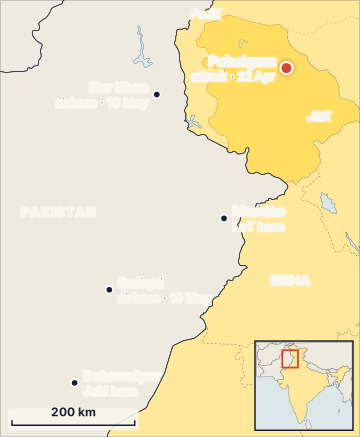
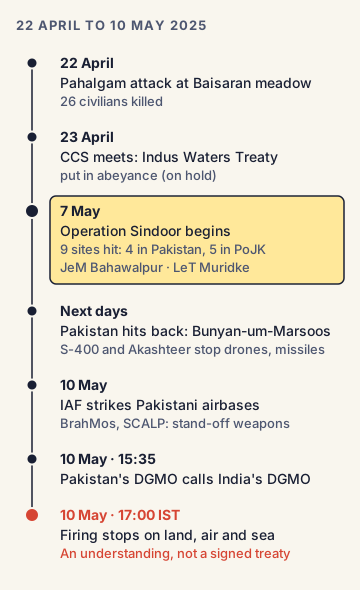
On 22 April 2025, terrorists attacked tourists at the Baisaran meadow near Pahalgam in Jammu and Kashmir. 26 civilians (25 Indians and one Nepali citizen) were killed. India said the attackers were linked to Pakistan-based groups. The operation was India's military answer to this attack. Its stated aim was to punish the terror groups and their bases, not to start a wider war.
What did India do before the strikes?
On 23 April 2025, a day after the attack, the Cabinet Committee on Security (CCS) met. India then announced non-military steps. The most important was putting the Indus Waters Treaty (1960) "in abeyance". This means India stopped carrying out its duties under the treaty for now, without formally ending it. Diplomatic and travel steps followed.
How did the operation unfold?
- 7 May 2025: India struck nine sites (four in Pakistan and five in PoJK). These included bases of Jaish-e-Mohammed (JeM) in Bahawalpur and Lashkar-e-Taiba (LeT) in Muridke. India's Director General of Military Operations (DGMO) later said more than 100 terrorists were killed.
- Pakistan's response: Pakistan launched drone, missile and artillery attacks on Indian military sites and border areas. It called its counter-operation "Bunyan-um-Marsoos".
- Indian air defence: India's layered air defence, including the Russian-made S-400 system and the Indian Akashteer air defence control and reporting network, intercepted many incoming drones and missiles.
- Strikes on air defences and airbases: India used loitering munitions such as the Israeli Harop against Pakistani air defence sites. On 10 May, the IAF struck Pakistani airbases (reports put the number at 11, including Nur Khan and Rafiqui) using long-range missiles like BrahMos and SCALP, launched without crossing into Pakistani airspace.
- Stopping the fighting: On 10 May, Pakistan's DGMO called India's DGMO at 15:35. The two sides agreed to stop all firing and military action on land, air and sea from 17:00 IST. The Foreign Secretary announced it in New Delhi.
Why is it important for India's security thinking?
The operation is studied for three lessons:
- Integrated air war: Drones, loitering munitions, fighter jets, missiles and air defence systems worked as one network. The IAF chief has used this to argue that drones must operate together with fighters.
- Stand-off weapons: Many strikes used weapons fired from far away, so aircraft did not need to fly into enemy air defences.
- Air defence matters: A strong, layered defence that can stop drones, rockets and missiles protected cities and bases.
Commonly confused concepts
- Operation Sindoor (2025) vs Balakot air strike (2019) vs surgical strikes (2016): In 2016, after the Uri attack, the Army carried out ground raids across the Line of Control. In 2019, after the Pulwama attack, the IAF struck a JeM camp at Balakot in Khyber Pakhtunkhwa. Operation Sindoor in 2025 was much larger: many targets, deep inside Pakistan, using all three services, followed by four days of fighting.
- Ceasefire agreement vs understanding to stop firing: What happened on 10 May was an understanding between the two DGMOs, not a signed treaty.
- Abeyance vs withdrawal (Indus Waters Treaty): Abeyance means the treaty is put on hold. Withdrawal would mean leaving it permanently.
- LoC vs International Border: The Line of Control (LoC) is the military line dividing Jammu and Kashmir between India and Pakistan. The International Border is the agreed, recognised boundary further south (Jammu to Gujarat).
Issues, criticism and the way forward
- Escalation risk: Both countries have nuclear weapons. Any armed clash carries the risk of growing out of control, so the speed of decisions matters a lot.
- Information war: Both sides made claims about losses that were hard to check at the time. False news spread quickly on social media.
- Drone and missile defence: The large number of enemy drones showed that India needs more cheap counter-drone weapons, not only costly missiles.
- Jointness: The operation added urgency to plans for joint theatre commands that put Army, Navy and Air Force units under one commander.
- Way forward: Experts point to more indigenous weapons, stronger air defence, faster joint decision-making and continued diplomatic pressure on cross-border terrorism.
Concepts to Know
- DGMO (Director General of Military Operations): A senior Army officer in charge of planning and running operations. The DGMOs of India and Pakistan have a hotline to talk directly.
- Precision strike: An attack using guided weapons that hit a small, exact target, reducing damage around it.
- Stand-off weapon: A missile or bomb fired from a long distance, so the aircraft stays out of the range of enemy air defences.
- Indus Waters Treaty (1960): A treaty signed with World Bank help that divides the six rivers of the Indus system between India and Pakistan.
- Cabinet Committee on Security (CCS): The top group of Union ministers, chaired by the Prime Minister, that takes decisions on defence and national security.
- Pahalgam attack: 22 April 2025, Baisaran meadow; 26 civilians killed (25 Indians, 1 Nepali)
- Indus Waters Treaty put in abeyance: 23 April 2025
- Operation Sindoor began: early hours of 7 May 2025; nine sites hit (4 in Pakistan, 5 in PoJK), including JeM (Bahawalpur) and LeT (Muridke)
- Pakistan's counter-operation: Bunyan-um-Marsoos
- Weapons named in reports: S-400, Akashteer, Harop loitering munitions, BrahMos, SCALP
- Fighting stopped: 17:00 IST, 10 May 2025, after a DGMO-level call at 15:35
● Tracked since March 06, 2026 · last seen October 03, 2026 · updates as the daily brief publishes