Union Budget (Annual Financial Statement)
How India Plans and Approves Its Money
The Union Budget is the Central Government's yearly plan of how much money it expects to earn and how much it plans to spend. It covers one financial year, from 1 April to 31 March. The Constitution does not use the word "budget". It calls it the Annual Financial Statement, under Article 112. Parliament must approve it before the government can collect taxes or spend money.
Why does the Budget exist?
Think of a family that sits down at the start of the month and writes down its salary, its rent, school fees and savings. The Budget does the same for the whole country, but on a huge scale. It also does something more important: it puts the people's money under the control of the people's representatives. Two rules of the Constitution make this clear:
- Article 265: No tax can be collected except by the authority of law.
- Article 114(3): No money can be taken out of the Consolidated Fund of India except under a law passed by Parliament (the Appropriation Act).
So the Budget is both an economic plan and a tool of democratic control over the government's money.
Where did it come from?
India's budget practice comes from British rule. Independent India's first budget was presented on 26 November 1947 by R.K. Shanmukham Chetty. Some major changes since then:
- Timing of the speech: Budgets were once presented at 5 pm, a colonial-era practice matching the British working day. In 1999, the speech was moved to 11 am.
- Railway Budget merged (2017): The separate Railway Budget began in 1924 on the advice of the Acworth Committee. Following a NITI Aayog committee led by Bibek Debroy, it was merged with the Union Budget from 2017-18.
- Date moved to 1 February (2017): Earlier, the Budget was presented on the last working day of February. From 2017, it is presented on 1 February. This gives Parliament time to pass it before 1 April, so ministries can start spending from the first day of the year.
How is the Budget made?
The Budget Division of the Department of Economic Affairs, in the Ministry of Finance, prepares it. Every ministry sends its spending needs. Ministries like Commerce also send policy suggestions, as in this news. Industry bodies, farmers' groups and economists are consulted in pre-budget meetings. The Finance Minister then presents the Budget in Lok Sabha. At the same time it is laid in Rajya Sabha.
How does Parliament pass the Budget?
It goes through six stages:
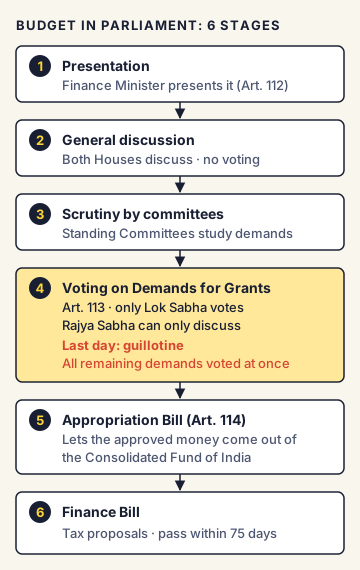
- Presentation: The Finance Minister presents the Annual Financial Statement with a Budget speech.
- General discussion: Both Houses discuss the Budget as a whole. No voting happens at this stage.
- Scrutiny by committees: The House goes into a short recess. The Departmentally Related Standing Committees study each ministry's spending demands in detail.
- Voting on Demands for Grants (Article 113): Lok Sabha votes on each ministry's demand for money, one by one. Only Lok Sabha votes on these demands; Rajya Sabha can only discuss them. On the last day, all remaining demands are put to vote together without discussion. This is called the guillotine.
- Appropriation Bill (Article 114): This bill gives legal permission to take the approved money out of the Consolidated Fund of India.
- Finance Bill: This bill gives legal effect to the tax proposals for the year. Under the Provisional Collection of Taxes Act, 1931, the Finance Bill must be passed within 75 days of its introduction.
Cut motions: how members question spending
While demands are being voted, members can move a motion to reduce a demand. There are three types:
- Policy cut: Asks to reduce the demand to ₹1. It shows disapproval of the policy behind the demand.
- Economy cut: Asks to reduce the demand by a specific amount, to suggest a saving.
- Token cut: Asks to reduce the demand by ₹100. It raises a specific grievance.
If a cut motion is passed in Lok Sabha, it is treated as a loss of confidence in the government. In practice, cut motions are mostly a way to debate, because the government usually has a majority.
Voted vs charged expenditure
Some spending is "charged" on the Consolidated Fund. Parliament can discuss it but cannot vote on it (Article 113(1)). This protects the independence of key offices. Examples (Article 112(3)) include the President's salary and allowances, salaries of Supreme Court judges, the CAG's salary, and interest on the government's debt. All other spending is "voted" expenditure.
What if the Budget is not passed by 1 April?
Under Article 116, Lok Sabha can pass a Vote on Account. This allows the government to spend money for a part of the year, usually two months, until the full Budget is passed. It is common in an election year. Do not confuse this with an Interim Budget, which is a temporary budget presented by an outgoing government before elections. An interim budget usually avoids major new policies.
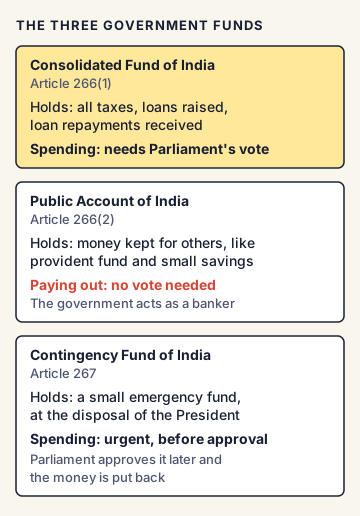
The three government funds
- Consolidated Fund of India (Article 266(1)): All tax money, loans raised and loan repayments received go here. Almost all spending comes from here, with Parliament's approval.
- Public Account of India (Article 266(2)): Money the government holds for others, like provident fund deposits and small savings. The government acts as a banker here, so no vote is needed to pay it out.
- Contingency Fund of India (Article 267): A small emergency fund placed at the disposal of the President, for urgent spending before Parliament approves it. Parliament later approves the spending and the money is put back.
Key terms in the Budget
- Revenue expenditure: Spending that does not create an asset, such as salaries, pensions, interest and subsidies.
- Capital expenditure (capex): Spending that creates assets or reduces liabilities, such as roads, railways, machinery or repaying loans.
- Fiscal deficit: Total spending minus total earnings (not counting new borrowings). It shows how much the government must borrow in a year. The Fiscal Responsibility and Budget Management (FRBM) Act, 2003 sets rules to keep this under control.
How the Budget helps manufacturing
The Budget is the main yearly tool for industrial policy. It can:
- Change customs duty (import tax) to protect or help domestic makers, for example by raising duty on finished goods and lowering duty on raw materials.
- Give money to schemes like the Production Linked Incentive (PLI) Scheme.
- Fund R&D, testing laboratories and industrial parks.
- Give tax relief to new factories.
Commonly confused concepts
- Money Bill (Article 110) vs Financial Bill (Article 117): A Money Bill deals only with matters listed in Article 110, like taxes and borrowing. The Speaker certifies it. Rajya Sabha cannot reject or amend it, and must return it within 14 days. A Financial Bill also deals with money but includes other matters too. Financial Bill (I) can be introduced only in Lok Sabha, but Rajya Sabha has full powers to amend or reject it.
- Vote on Account vs Interim Budget: A Vote on Account only allows spending. An Interim Budget is a full statement of accounts presented by an outgoing government, often with a Vote on Account.
- Budget vs Economic Survey: The Economic Survey is a review of the economy over the past year, prepared under the Chief Economic Adviser. It is presented just before the Budget. It is not a constitutional requirement.
- Charged vs voted expenditure: Charged can only be discussed; voted needs Lok Sabha's vote.
Issues, criticism and the way forward
- Weak scrutiny: Many demands are passed by the guillotine without any discussion. Experts suggest more days for budget debate and stronger committee review.
- Off-budget borrowing: In the past, some spending was moved to public sector bodies to make the deficit look smaller. The government has since disclosed such borrowing more clearly.
- Outcomes vs outlays: Announcing money is not the same as achieving results. India started an Outcome Budget in 2005-06 to link spending to measurable results.
- Tax uncertainty for industry: Frequent changes in customs duties can confuse investors. Industry often asks for stable, long-term tariff policy.
Concepts to Know
- Financial year: The 12-month period used for government accounts. In India, it runs from 1 April to 31 March.
- Demand for Grants: A ministry's formal request to Parliament for money for the year. Usually each ministry has one demand.
- Customs duty: A tax on goods brought into the country from abroad.
- Departmentally Related Standing Committees: Groups of MPs from both Houses, each watching over a set of ministries. They study the ministries' spending demands in detail.
- CAG (Comptroller and Auditor General): The constitutional officer who checks (audits) how the government spends public money.
- Annual Financial Statement: Article 112; charged expenditure list: Article 112(3)
- Demands for Grants: Article 113; Appropriation Bill: Article 114; Vote on Account: Article 116
- Money Bill: Article 110 (Rajya Sabha must return within 14 days); Financial Bills: Article 117
- No tax without law: Article 265; Consolidated Fund and Public Account: Article 266; Contingency Fund: Article 267
- First budget of independent India: 26 November 1947, R.K. Shanmukham Chetty
- Budget on 1 February and Railway Budget merger: from 2017
- Budget speech moved from 5 pm to 11 am: 1999
- Finance Bill must be passed within 75 days (Provisional Collection of Taxes Act, 1931)
- Cut motions: policy cut (to ₹1), economy cut (by a specific amount), token cut (by ₹100)
● Tracked since November 09, 2026 · last seen November 09, 2026 · updates as the daily brief publishes