Import Substitution Industrialisation (ISI)
Import Substitution Industrialisation (ISI) is a development strategy in which a country tries to make at home the goods it used to import. To help new local industries grow, the government protects them from foreign competition using high import taxes, limits on imports and other support. The idea is that, over time, the country will build its own industrial base and depend less on others.
India followed a strong form of ISI from the 1950s to 1991, and the idea is returning in a new, more careful form today.
Why did countries adopt ISI?
After the Second World War, many newly independent countries exported raw materials (like cotton, tea or minerals) and imported factory goods. Economists Raúl Prebisch and Hans Singer argued, around 1949-50, that the prices of raw materials tend to fall over time compared to the prices of manufactured goods. This is called the Prebisch-Singer hypothesis. If true, poor countries would keep getting less in return for their exports.
Their answer was: build your own factories. A second reason is the infant industry argument: a new industry is like a baby that needs protection until it can stand on its own against big foreign firms. This idea goes back to Alexander Hamilton (USA, 1791) and Friedrich List (Germany, 1841).
Where was it used?
Many Latin American countries used ISI from the 1930s to the 1960s, with Prebisch as a leading voice through the UN's Economic Commission for Latin America. In India, ISI became central with the Second Five Year Plan (1956-61), based on the Mahalanobis model, which focused on building heavy industries such as steel and machinery. The Industrial Policy Resolution, 1956 reserved 17 industries (Schedule A) for the public sector.
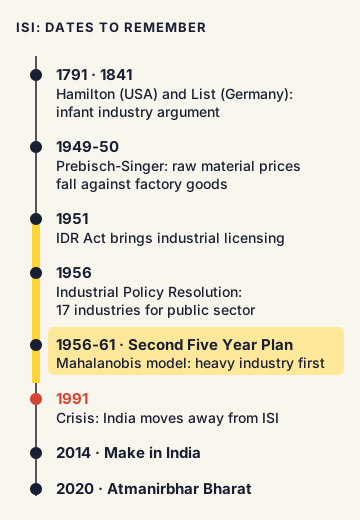
The Industries (Development and Regulation) Act, 1951 brought in industrial licensing. Big public sector plants were built, including the steel plants at Bhilai, Durgapur and Rourkela. Imports were tightly controlled through high tariffs and import licences.
How does ISI work in practice?
Governments use a mix of tools:
- High tariffs (import taxes) so foreign goods become costly.
- Quantitative restrictions (quotas): a fixed limit on how much of a product can be imported, or a ban.
- Import licensing: imports allowed only with government permission.
- Local content rules: a firm must use a certain share of locally made parts.
- Subsidies and cheap loans for domestic producers.
- Public sector investment in industries the private sector cannot or will not build.
A simple example: suppose imported bicycles cost ₹5,000 and a new Indian maker can make them for ₹6,000. If the government puts a 50% tariff on imports, the imported bicycle now costs ₹7,500. The Indian maker can sell at ₹6,000 and survive while it learns to make bicycles more cheaply.
What were the results in India?
ISI helped India build a wide industrial base: steel, heavy machinery, power equipment, chemicals and a strong pharmaceuticals industry. But there were serious costs. Protected firms had little pressure to improve quality or cut costs. Consumers paid high prices and waited years for products like scooters and phones. The licence raj encouraged corruption and lobbying.
Exports stayed weak, so India kept running short of foreign exchange. Economic growth was so slow from the 1950s to the 1970s, about 3.5% a year, that it was nicknamed the "Hindu rate of growth", a term coined by economist Raj Krishna. The 1991 crisis finally pushed India to move away from this model.
East Asia: a different path
South Korea and Taiwan also protected some industries, but they forced firms to export and compete globally. Firms that failed to export lost support. This approach is called export-oriented industrialisation. Many economists credit it for East Asia's much faster growth.
Import substitution today
Since 2014, India has again pushed domestic manufacturing, but with a stronger link to competitiveness:
- Make in India (2014): to make India a global manufacturing hub.
- Atmanirbhar Bharat (self-reliant India), 2020: to reduce dependence on imports for key goods.
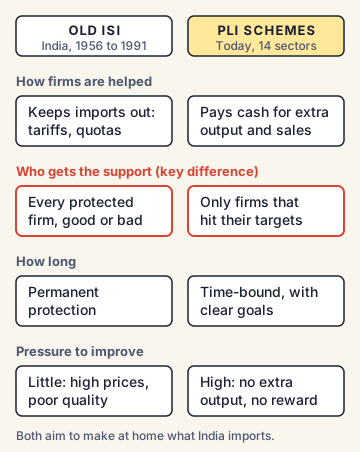
- Production Linked Incentive (PLI) schemes: cash rewards linked to extra production and sales, in 14 sectors with an outlay of ₹1.97 lakh crore, including electronics, pharmaceuticals, solar modules and auto parts.
- Higher customs duties on some items and phased manufacturing programmes that push firms to make more parts in India step by step.
The difference from old ISI is that support is meant to be tied to performance (output, exports, cost) rather than given as permanent protection.
Commonly confused concepts
- ISI vs export-led growth: ISI looks inward (replace imports for the home market); export-led growth looks outward (sell to the world). Modern policy often mixes both.
- Import substitution vs self-reliance vs autarky: self-reliance means being able to produce critical goods when needed, while still trading. Autarky means a closed economy that trades almost nothing. ISI is a tool that can serve self-reliance; it does not have to mean autarky.
- Tariff vs non-tariff barriers: a tariff is a tax on imports. Non-tariff barriers are other hurdles: quotas, licences, strict quality standards and lengthy customs checks.
- ISI vs PLI: old ISI protected firms mainly by keeping imports out. PLI pays firms for extra output and sales, so firms that do not perform get nothing.
- WTO limits: under the WTO's Agreement on Subsidies and Countervailing Measures, subsidies that depend on using domestic goods instead of imported goods are prohibited. The TRIMs Agreement also restricts local content requirements. So a modern ISI policy must be designed to fit trade rules.
Issues, criticism and the way forward
- Cost to consumers and other industries: higher tariffs on inputs (like steel or electronic parts) raise costs for Indian firms that use them, including exporters.
- Protection without performance: history shows that protected firms can become lazy. The CEA's condition that supported industries must export or match import prices is aimed at this risk.
- Rent-seeking: wherever the government decides who gets protection, firms may lobby for favours instead of improving.
- Supply security: supporters argue that recent shocks (the pandemic, wars, export controls by other countries) show that depending on one country for critical goods is dangerous. Some level of domestic production is a form of insurance.
- Way forward suggested by experts: target only critical and strategic goods, give time-bound support with clear goals, cut costs like energy and land that hurt all manufacturers, keep tariffs on inputs low, and combine import substitution with a strong push for exports.
Concepts to Know
- Terms of trade: How many imports a country can buy with a fixed amount of its exports. If export prices fall while import prices stay the same, the terms of trade get worse.
- Infant industry: A new industry that is still small and inefficient and cannot yet compete with established foreign firms.
- Quantitative restriction (QR): A limit on the amount of a product that can be imported, rather than a tax on it.
- Rent-seeking: Trying to earn profit by getting special favours from the government (like protection or licences) instead of by producing better or cheaper goods.
- Mahalanobis model: An economic plan design by statistician P.C. Mahalanobis that gave priority to heavy industries that make machines, so that India could later make its own consumer goods.
- Prebisch-Singer hypothesis: around 1949-50; raw material prices tend to fall relative to manufactured goods
- Infant industry argument: Alexander Hamilton (1791), Friedrich List (1841)
- India's ISI: Second Five Year Plan (1956-61), Mahalanobis model; IDR Act, 1951 (licensing); Industrial Policy Resolution, 1956 (17 industries in Schedule A)
- Public sector steel plants: Bhilai, Durgapur, Rourkela
- "Hindu rate of growth": about 3.5% a year; term by Raj Krishna
- Peak customs duty in 1990-91: 355%
- Make in India: 2014; Atmanirbhar Bharat: 2020; PLI: 14 sectors, ₹1.97 lakh crore
- WTO SCM Agreement prohibits subsidies contingent on using domestic over imported goods
● Tracked since March 11, 2026 · last seen October 30, 2026 · updates as the daily brief publishes