UNESCO Memory of the World Programme
Updated 7 Nov 2026: Added the November 2026 Jakarta inscriptions: Mahabharata, Arthashastra and Rajatarangini manuscripts, taking India to six Asia-Pacific regional entries.
The Memory of the World Programme is a UNESCO effort to protect the world's most important documents: old manuscripts, books, letters, maps, photographs, films and sound recordings. It keeps lists, called registers, of documents so valuable that they belong to all humanity. Getting on a register does not give money or legal protection. It gives global recognition, and it pushes countries to preserve these documents and make them easier for people to see and study.
Why does it exist?
Documents are fragile. Palm leaves crack, paper rots, ink fades, films decay, and wars, floods and fires can destroy whole libraries in a day. Many documents also sit locked away, so nobody can read them. UNESCO started this programme to fight what it calls "collective amnesia", meaning a whole society forgetting its own past. Think of it like a family photo album: if nobody looks after it, the family slowly loses its memories.
Where did it come from?
UNESCO (the United Nations Educational, Scientific and Cultural Organization) launched the programme in 1992. An expert body met from 1993, and the International Register was set up in 1995. The first documents were put on it (this is called inscription) in 1997. In 2015, UNESCO's member countries adopted a Recommendation on preserving and giving access to documentary heritage, including digital heritage. After disputes over some politically sensitive nominations in the 2010s, UNESCO reviewed the programme and its rules, and new cycles began after the reforms.
Who runs it?
- International Advisory Committee (IAC): A group of 14 experts appointed by UNESCO's Director-General. It studies nominations and recommends which ones should be inscribed.
- UNESCO Executive Board: It gives the final approval to the IAC's recommendations for the International Register.
- Regional committees: They keep their own regional registers. For Asia and the Pacific this is MOWCAP (Memory of the World Committee for Asia and the Pacific), set up in 1998.
- National committees: Some countries keep their own national registers too.
The three levels of registers
This is the part UNESCO-based questions test most often:
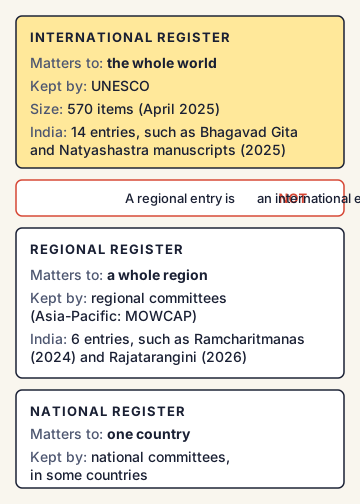
- International Register: Documents of world importance. As of April 2025, it has 570 items, after 74 were added in the 2024-25 cycle. It is updated about every two years.
- Regional Register: Documents important for a whole region, such as Asia-Pacific. MOWCAP's register is also updated about every two years at its general meeting.
- National Register: Documents important for one country.
A document on a regional register is not on the International Register. Students often mix these up.
How does a document get inscribed?
Step by step:
- A person or organisation (a library, museum, archive or university) prepares a nomination file, called a dossier. It explains what the document is, why it matters and how it is being kept safe.
- The nomination goes through the country's government, usually its National Commission for UNESCO. For the International Register, each country can send two nominations per cycle. Joint nominations by several countries have no limit.
- Experts check the main test: does the document have world significance and outstanding universal value? They also look at whether it is genuine, unique and in danger.
- The committee recommends, and the final decision is announced.
India's position
As of 2025, India has 14 entries on the International Register, including two joint entries with other countries. Some of them:
- 1997: I.A.S. Tamil Medical Manuscript Collection (India's first entry)
- 2005: Shaiva manuscripts in Puducherry
- 2007: Rigveda manuscripts (Bhandarkar Oriental Research Institute, Pune)
- 2011: Tarikh-e-Khandan-e-Timuriyah; Laghukalachakratantrarajatika (Vimalaprabha)
- 2013: Shantinatha Charitra
- 2017: Gilgit Manuscripts; Maitreyayvarakarana
- 2023: Abhinavagupta's works (collection of manuscripts); Archives of the First Summit of the Non-Aligned Movement (joint)
- 2025: Bhagavad Gita manuscripts and Bharata Muni's Natyashastra (both at Bhandarkar Oriental Research Institute, Pune)
On the Asia-Pacific Regional Register, India's first entries came in 2024, at MOWCAP's 10th general meeting in Ulaanbaatar, Mongolia: the Ramcharitmanas, Panchatantra and Sahrdayaloka-Locana. The IGNCA presented these nominations.
India added three more entries in November 2026, at MOWCAP's 11th general meeting in Jakarta, Indonesia. That meeting added 21 items from across the region. The IGNCA again prepared India's nominations. As of November 2026, India has six entries on this regional register. The three new ones are:
- Mahabharata: A birch-bark manuscript in the old Sharada script, kept at the Bhandarkar Oriental Research Institute, Pune.
- Kautilya's Arthashastra: A 16th-century palm-leaf manuscript of the ancient Indian book on statecraft (how to run a state), kept at the Oriental Research Institute, Mysuru.
- Kalhana's Rajatarangini: A manuscript of the 12th-century history of the kings of Kashmir, kept at the Oriental Research Library, Srinagar.
India's own manuscript work
India may have the largest collection of manuscripts in the world. The National Mission for Manuscripts was started in 2003 under the Ministry of Culture to find and record them. The Union Budget 2025-26 announced the Gyan Bharatam Mission, which builds on it and aims to survey, document and conserve more than one crore manuscripts held by museums, libraries, academic bodies and private owners.
Commonly confused concepts
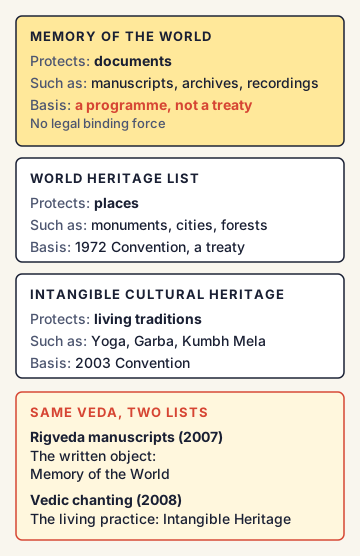
- Memory of the World vs World Heritage List: Memory of the World is about documents (texts, archives, recordings). The World Heritage List, under the 1972 World Heritage Convention, is about places (monuments, cities, forests). Memory of the World is a programme, not a treaty, so it has no legal binding force. The World Heritage Convention is a treaty.
- Memory of the World vs Intangible Cultural Heritage (ICH): ICH, under the 2003 Convention, is about living traditions like Yoga, Garba, Kumbh Mela and Durga Puja in Kolkata. A manuscript of a text is documentary heritage; the practice of reciting or performing it can be intangible heritage. For example, Vedic chanting is on the ICH list (2008), while Rigveda manuscripts are on the Memory of the World register (2007).
- International vs Regional Register: The 2025 Bhagavad Gita entry is on the International Register. The 2024 and 2026 entries (Ramcharitmanas, Rajatarangini and others) are on the Asia-Pacific Regional Register.
- The register lists a specific document, not the idea of the text. Usually a particular manuscript or collection, held in a particular library, is inscribed.
Issues, criticism and the way forward
- Politics: Some nominations have caused disputes between countries, for example over records of wartime events in East Asia. This led UNESCO to change its rules so that objections from other countries are heard.
- No money, no legal shield: Inscription brings attention but no funding or legal duty to protect the document.
- Poor condition of manuscripts: Many Indian manuscripts sit in temples, monasteries and private homes, without proper storage, climate control or catalogues.
- Language skills are fading: Few scholars can now read old scripts like Sharada, Grantha or old Persian, so many manuscripts cannot be studied even if saved.
- Way forward: Digitisation with open access, training young scholars in old scripts and languages, a national catalogue, and more nominations backed by good conservation plans.
Concepts to Know
- Documentary heritage: Old records that carry information, such as manuscripts, books, maps, letters, photos, films and sound recordings.
- Manuscript: A text written by hand, before or without printing. In India, many were written on palm leaves, birch bark or handmade paper.
- Inscription (on a register): The formal act of adding an item to a UNESCO list.
- Dossier: A file of documents prepared to support a nomination.
- Digitisation: Scanning or photographing documents to make computer copies, so that they can be shared and are not lost if the original is damaged.
- IGNCA (Indira Gandhi National Centre for the Arts): A New Delhi institution under the Ministry of Culture that works on research, documentation and preservation of the arts and of manuscripts.
- Launched by UNESCO in 1992; first International Register inscriptions in 1997
- International Advisory Committee: 14 members appointed by UNESCO's Director-General
- Three registers: International, Regional, National
- International Register: 570 items as of April 2025 (74 added in 2025)
- MOWCAP (Asia-Pacific regional committee) set up in 1998
- India on International Register: 14 entries as of 2025, first in 1997 (Tamil medical manuscripts), latest Bhagavad Gita and Natyashastra (2025)
- India on Asia-Pacific Regional Register: 3 entries in 2024 (Ulaanbaatar), 3 more in 2026 (Jakarta), total 6
- National Mission for Manuscripts: 2003; Gyan Bharatam Mission: Budget 2025-26, over 1 crore manuscripts
- 7 Nov 2026Added the November 2026 Jakarta inscriptions: Mahabharata, Arthashastra and Rajatarangini manuscripts, taking India to six Asia-Pacific regional entries.
● Tracked since November 05, 2026 · last seen November 06, 2026 · updates as the daily brief publishes