Kautilya's Arthashastra
Updated 7 Nov 2026: Added the 2026 UNESCO regional register listing of the Mysuru manuscript, its Grantha script, and the 1909 Sanskrit edition.
The Arthashastra is an ancient Sanskrit book on how to run a state: how a king should rule, collect taxes, run the economy, keep law and order, use spies, make friends and enemies among other kingdoms, and fight wars. It is credited to Kautilya, who is traditionally identified with Chanakya (also called Vishnugupta), the adviser of Chandragupta Maurya (4th century BCE). "Artha" means wealth or material well-being, and "shastra" means a body of knowledge, so the title means "the science of wealth and governance".
Why does it matter?
It is India's oldest detailed manual on government and political economy. It shows that ancient Indian thinkers studied the state in a practical, worldly way, and not only through religion. Its ideas, like the seven elements of a state and the "circle of states" in foreign policy, are still used to discuss Indian strategy and administration today.
Where did it come from?
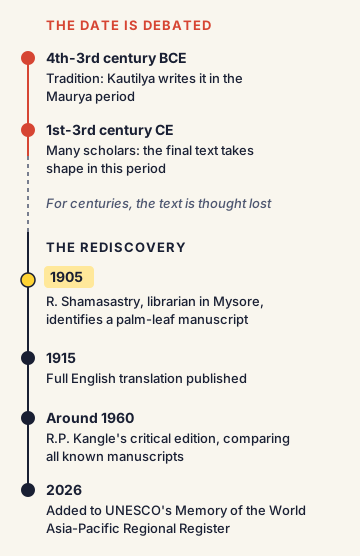
By tradition, Kautilya wrote it around the 3rd or 4th century BCE, in the Maurya period. Many modern scholars think the text we have was built up over a long time and given its final shape later, perhaps between the 1st and 3rd centuries CE. So there is a real debate about its date and whether one person wrote all of it.
How was it rediscovered?
For centuries the text was thought lost. In 1905, R. Shamasastry, a librarian at the Oriental Library in Mysore (now the Oriental Research Institute, Mysuru), identified a palm-leaf manuscript given by a scholar from Thanjavur. Its language was Sanskrit, but it was written in the Grantha script, an old script of South India. He published translations in parts from 1905, the Sanskrit text in 1909, and a full English translation in 1915. Later, R.P. Kangle prepared a careful critical edition around 1960, comparing all known manuscripts.
How is it organised?
The Arthashastra has 15 books, 150 chapters and 180 topics. It is written mostly in short prose statements (sutras), with some verses.
The key ideas UPSC asks about
- Saptanga theory (seven limbs of the state): A state has seven parts, like organs of a body: Swami (king), Amatya (ministers), Janapada (territory and people), Durga (fort), Kosha (treasury), Danda (army, or force) and Mitra (ally).
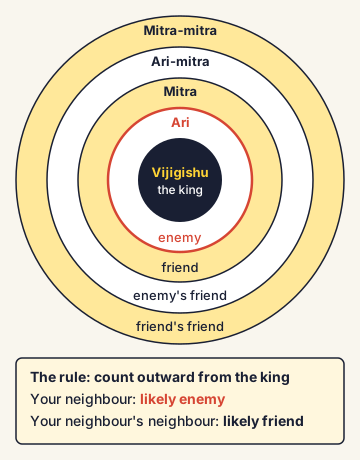
- Mandala theory (circle of states): Imagine your kingdom at the centre of rings. Your immediate neighbour is a likely enemy (because you compete for land). Your neighbour's neighbour is a likely friend. The "conqueror" king (vijigishu) plans his foreign policy using this map.
- Shadgunya (six policies of foreign relations): Sandhi (peace treaty), Vigraha (hostility or war), Asana (staying quiet, neutrality), Yana (marching or preparing to attack), Samshraya (seeking shelter with a stronger power) and Dvaidhibhava (double policy: peace with one, war with another).
- Four upayas (means to deal with others): Sama (persuasion), Dana (gifts), Bheda (dividing the opponent) and Danda (force). The text suggests trying the softer means before force.
- Administration and economy: Detailed rules on officers called adhyakshas (superintendents) for trade, mines, forests, weights and measures, liquor and more; on land revenue and taxes; on state control of key industries.
- Espionage: A large spy network to keep watch on officials, the public and enemy states.
- Law and justice: Rules on contracts, marriage, crime and punishment.
- Welfare of people: It says the king's happiness lies in the happiness of his subjects. A ruler must protect the weak and keep the people content.
India's position and use today
Indian strategic thinkers and officials often cite Kautilya. Ideas such as keeping many partners (close to the mandala and shadgunya logic), and balancing power with welfare, are used to explain India's foreign policy. The Arthashastra is also read in courses on public administration and economics.
The text also has international recognition. In November 2026, India's Ministry of Culture announced that "Kautilya's Arthashastra, Ancient Palm-leaf Manuscript on Governance and Statecraft" had joined UNESCO's Memory of the World Asia-Pacific Regional Register. UNESCO's regional committee for Asia and the Pacific, called MOWCAP, took this decision at its 11th session in Jakarta, Indonesia. The listed item is a 16th-century palm-leaf manuscript in Grantha script, kept at the Oriental Research Institute, Mysuru. As of November 2026, India has six entries on this regional register.
Commonly confused concepts
- Arthashastra vs Dharmashastra: Dharmashastras (such as Manusmriti) mainly deal with religious and social duties and moral law. The Arthashastra deals with practical statecraft, economy and power.
- Arthashastra vs Indica: Indica was written by Megasthenes, a Greek ambassador at Chandragupta Maurya's court. It is a foreigner's description of India (surviving only in quotes by later writers). The Arthashastra is an Indian manual on how to govern.
- Kautilya vs Machiavelli: Both are called political realists. Machiavelli's The Prince (1513) is about how a ruler gains and keeps power. Kautilya also stresses practical power, but ties it to the welfare of subjects and to rajadharma (the king's duty). The sociologist Max Weber wrote that, compared with the Arthashastra, Machiavelli's The Prince looks harmless, to show how hard-headed Kautilya's realism is.
- Chanakya the legend vs Kautilya the author: Tradition treats them as one person. Many modern scholars are not sure, because of the dating questions above.
Issues, criticism and the way forward
- Dating and authorship: Was it written by one person in the Maurya age, or compiled over centuries? This affects how far it can be used as evidence for Mauryan government.
- Ideal vs reality: It is a guidebook of how things should be done, not a record of what actually happened. Historians use it carefully.
- Ethics: Its approval of spying, deceit and harsh punishments is criticised. Supporters reply that these served the larger goal of a stable state and people's welfare.
- Relevance: Scholars argue for studying it alongside modern theories, rather than copying it directly, because modern states run on constitutions, rights and the rule of law.
Concepts to Know
- Statecraft: The art of running a state and managing its relations with other states.
- Political realism: The idea that states mainly act to protect their own power and interests, and that leaders should plan according to how the world actually is.
- Critical edition: A version of an old text prepared by comparing many manuscripts, to get as close as possible to the original wording.
- Sutra: A short, compact statement, often used in Sanskrit texts to pack rules or ideas into a few words.
- Vijigishu: "One who wishes to conquer": the king at the centre of the mandala, planning foreign policy.
- Memory of the World: A UNESCO programme, started in 1992, to protect old records such as manuscripts and help people reach them. It has an international register and regional registers. It lists records, so do not mix it up with World Heritage Sites, which are places.
- Author: Kautilya (traditionally Chanakya or Vishnugupta, adviser to Chandragupta Maurya)
- Language: Sanskrit; traditional date 4th-3rd century BCE; many scholars place the final text in the 1st-3rd century CE
- Structure: 15 books, 150 chapters, 180 topics
- Rediscovered by R. Shamasastry (Mysore) in 1905; Sanskrit text 1909; English translation 1915; R.P. Kangle's critical edition around 1960
- Saptanga: Swami, Amatya, Janapada, Durga, Kosha, Danda, Mitra
- Shadgunya: Sandhi, Vigraha, Asana, Yana, Samshraya, Dvaidhibhava
- Four upayas: Sama, Dana, Bheda, Danda
- Added to UNESCO Memory of the World Asia-Pacific Regional Register in 2026 (16th-century Grantha palm-leaf manuscript, Oriental Research Institute, Mysuru)
- 7 Nov 2026Added the 2026 UNESCO regional register listing of the Mysuru manuscript, its Grantha script, and the 1909 Sanskrit edition.
● Tracked since November 05, 2026 · last seen November 06, 2026 · updates as the daily brief publishes