Rajatarangini
Kalhana's History of Kashmir
Updated 7 Nov 2026: Added details of the November 2026 UNESCO regional register listing, including where the manuscript is kept, and noted Shrivara was Jonaraja's pupil.
The Rajatarangini, meaning "River of Kings", is a long Sanskrit poem written by Kalhana in the 12th century (around 1148-1149 CE). It tells the story of the kings of Kashmir from legendary early times up to Kalhana's own days. It is often called the first real work of history writing in India, because Kalhana tried to check his sources and tell events in time order, instead of only praising kings.
Why is it so important?
Most old Indian texts are religious works, epics or poems that praise a patron king. They rarely give dates or a clear order of events. So historians often have to depend on coins, inscriptions and foreign travellers. The Rajatarangini is different. It gives a long chain of rulers with their reigns, wars, palace plots, famines and floods. For the history of Kashmir, and for how Indians themselves wrote about the past, it is a key source.
Who was Kalhana?
Kalhana was a Kashmiri Brahmin and a learned Sanskrit poet. He is believed to be the son of Champaka, who was a minister at the court of King Harsha of Kashmir (of the Lohara dynasty). Kalhana wrote during the reign of King Jayasimha (ruled about 1128-1149). Because of his family, he knew a lot about court politics. Yet he does not seem to have written for royal reward, which made him more willing to criticise kings.
How is it organised?
The work has about 7,826 verses, divided into eight books. Each book is called a taranga, meaning "wave", which is why the whole is the "river" of kings.
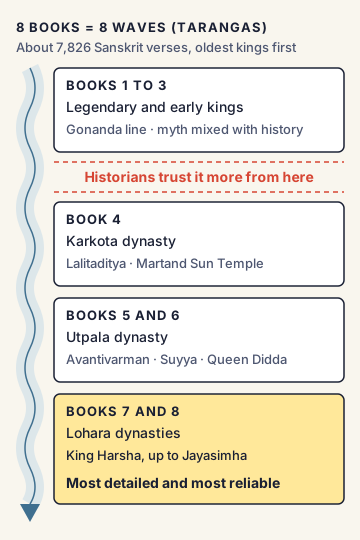
- Books 1 to 3: Legendary and early kings, such as the Gonanda line, which Kalhana links with the time of the Mahabharata. These parts mix myth with history.
- Book 4: The Karkota dynasty, including Lalitaditya Muktapida (8th century), famous for his military campaigns and for the Martand Sun Temple.
- Books 5 and 6: The Utpala dynasty, including Avantivarman, whose engineer Suyya is remembered for flood control and drainage works, and the strong queen Didda.
- Books 7 and 8: The Lohara dynasties, including King Harsha and later rulers up to Jayasimha. These are the most detailed and reliable parts, because they are close to Kalhana's own time.
Kalhana's method: what made it "history"?
Kalhana says he studied earlier king-lists and works, old inscriptions on temples, land-grant records and coins. He tried to compare these sources. He also says a historian should be like a judge, free from love or hatred, when describing the past. He openly criticises cruel or greedy kings, corrupt officials and the misuse of power. This care for evidence is why the Rajatarangini is valued as early historiography (the writing of history).
Its limits
The early books are full of legend and have impossible numbers. For example, one king, Ranaditya, is given a reign of 300 years, and some dates for well-known rulers like Mihirakula are off by centuries. Historians therefore trust the work more from Book 4 onwards, and even then they check its claims, such as the size of Lalitaditya's conquests, against other evidence.
The continuations
Later writers carried the story forward:
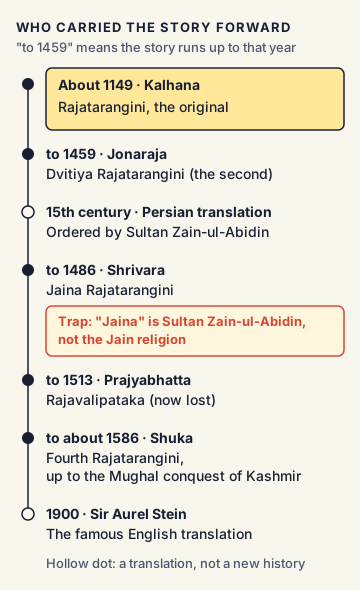
- Jonaraja: Dvitiya Rajatarangini (the second), up to the mid-15th century
- Shrivara (Jonaraja's pupil): Jaina Rajatarangini, covering the late 15th century (the name refers to Sultan Zain-ul-Abidin, not the Jain religion)
- Prajyabhatta: Rajavalipataka (now lost)
- Shuka: the fourth Rajatarangini, up to the Mughal conquest of Kashmir in the late 16th century
Sultan Zain-ul-Abidin (15th century) had the Rajatarangini translated into Persian. The famous English translation is by Sir Aurel Stein (1900), who studied the manuscripts closely.
Commonly confused concepts
- Rajatarangini vs Nilamata Purana: The Nilamata Purana is an older Kashmiri text about the valley's sacred places, Nagas and rituals. Kalhana used it as one source, but it is not a history of kings.
- Kalhana vs Kalidasa: Kalidasa was a classical poet and playwright (Abhijnanashakuntalam, Meghaduta), usually placed around the Gupta age. Kalhana was a 12th-century Kashmiri historian-poet.
- Rajatarangini vs Harshacharita: Banabhatta's Harshacharita (7th century) is a biography of King Harshavardhana of Kannauj, written in praise of its hero. The Rajatarangini covers many dynasties of Kashmir and is far more critical. Note that Kalhana's King Harsha (of Kashmir, 11th century) is a different person from Harshavardhana.
- Jaina Rajatarangini is not a Jain text. It is named after Sultan Zain-ul-Abidin.
Issues and debates (the Mains angle)
- How much can we trust it? Historians debate how to separate legend from fact in the early books.
- Did ancient India write history? Some colonial-era writers claimed Indians had no sense of history. The Rajatarangini is a strong counter-example, though historians note that other forms, such as genealogies, inscriptions and biographies, also served this purpose.
- Preservation: Its manuscripts were written in the Sharada script, which few people can read today. In November 2026, UNESCO added the manuscript kept at the Oriental Research Library, Srinagar, to its Memory of the World Asia-Pacific Regional Register. This register lists important old documents from Asia and the Pacific. It is a regional list, not UNESCO's international Memory of the World Register. Recognition by UNESCO adds weight to efforts to conserve and digitise them.
Concepts to Know
- Historiography: The study and method of history writing: how historians collect evidence, judge it and present the past.
- Chronicle: A record of events told in the order in which they happened.
- Dynasty: A line of rulers from the same family.
- Sharada script: An old script used in Kashmir to write Sanskrit and Kashmiri, roughly from the 8th century onwards.
- Verse: A line or set of lines in a poem. Sanskrit works like this were written in verse, not prose.
- Author: Kalhana; language: Sanskrit; written about 1148-1149 CE
- Meaning: "River of Kings"; 8 books (tarangas, "waves"); about 7,826 verses
- Written in the reign of Jayasimha of the Lohara dynasty
- Covers Gonanda (legendary), Karkota, Utpala and Lohara dynasties of Kashmir
- Continued by Jonaraja, Shrivara, Prajyabhatta and Shuka
- Persian translation under Zain-ul-Abidin; English translation by Aurel Stein (1900)
- Added to UNESCO Memory of the World Asia-Pacific Regional Register in November 2026 (manuscript kept at the Oriental Research Library, Srinagar)
- 7 Nov 2026Added details of the November 2026 UNESCO regional register listing, including where the manuscript is kept, and noted Shrivara was Jonaraja's pupil.
● Tracked since November 05, 2026 · last seen November 06, 2026 · updates as the daily brief publishes